
Q3 2025: Contradictions Emerge in WPA Pricing and A250/A1000 Deployment Timelines
 Aime Summary
Guidance:
- JV full-year 2025 spend expected at the higher end of the prior range: $17M–$18M.
- Expect the GE Vernova statement-of-work aggregate spend to be lower in 2026 versus 2025.
- AirJoule reported approximately $26M cash at quarter-end and contributed an additional $5M post-quarter; management says liquidity is sufficient to support corporate and JV operations through commercialization into 2026.
- Targeting productization and multi-unit commercial deployments in 2026; no revenue or EPS guidance provided.
Business Commentary:
* Water Scarcity and Energy Efficiency: - AirJoule Technologies is leveraging the growing demand for water and energy efficiency in various industries, specifically in data centers and manufacturing. - The company's platform technology addresses water scarcity by producing water from air and reduces energy consumption by up to 50% compared to traditional systems. - The demand for these solutions is driven by severe water stress in regions like the Western U.S. and the need for energy-efficient alternatives to meet sustainability goals.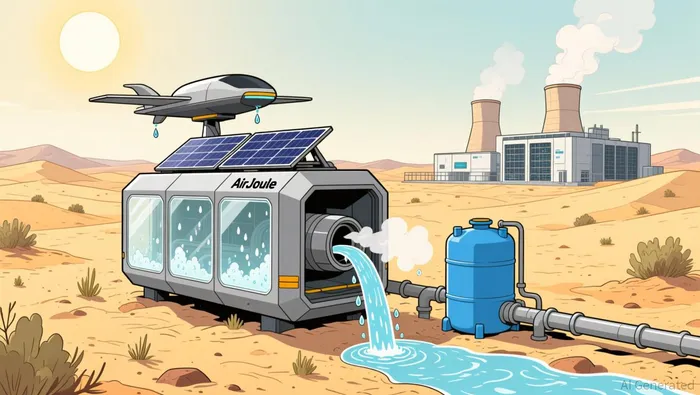
- Validation Through Deployments and Partnerships:
- AirJoule's real-world deployment in Texas and collaborations with prominent organizations such as Google, Microsoft, and the U.S. Army Engineer Research and Development Center validate its technology.
- These partnerships and deployments are critical for gaining customer confidence and advancing toward commercialization in 2026.
The recognition from industry leaders and defense organizations demonstrates the potential of AirJoule's platform to address critical national security challenges.
Productization and Commercialization:
- AirJoule is actively scaling its manufacturing readiness and productization to achieve commercialization objectives by
2026. - The company is focused on increasing water output, reducing system costs, and enhancing reliability to deliver economical and reliable systems.
The progress in product development and manufacturing capabilities supports the company's goals for commercial deployment and customer adoption.
Regulatory Tailwinds and Market Opportunities:
- AirJoule is capitalizing on regulatory tailwinds, such as the phaseout of high global warming potential refrigerants, which create demand for alternative technologies.
- The company is integrating its technology with industry leaders like Carrier, demonstrating its role in shaping the future of HVAC and air quality systems.
- These regulatory pressures and market demands are fostering significant interest and partnerships, positioning AirJoule as a solution to the transition away from traditional refrigerant-based systems.
Sentiment Analysis:
Overall Tone: Positive
- Management emphasized progress and market validation: "capitalizing on powerful converging macro trends" and "progress moves us meaningfully closer to our 2026 deployment goals." They highlighted new partnerships (GE Vernova, Carrier, Net Zero Hub), operating field data from Hubbard, and sufficient cash to support commercialization.
Q&A:
- Question from Amit Dayal (H.C. Wainwright): I just want to go over a line from the press release that says data from Hubbard is accelerating commercial adoption. How should we sort of read this statement? Are you implying the potential pipeline? Or are there some pilots that are taking place? Like any clarity on this sentence would be very helpful.
Response: Hubbard's live-field data is catalyzing customer interest and pipeline development—hyperscalers have visited and the system's real-world performance is driving engagement.
- Question from Amit Dayal (H.C. Wainwright): In the last earnings call, you talked about exploring product integration opportunities with GE Vernova. How is that going? Any progress on that front? Any color on how we should see maybe that contributing to any commercialization efforts in 2026?
Response: The GE Vernova collaboration is progressing through engineering/planning to integrate waste heat; next step is building a demonstration project in the field.
- Question from Amit Dayal (H.C. Wainwright): The R&D spend was pretty low in 3Q—only ~$8k. Any reason for such a low spend as you get closer to commercialization? Should we think most R&D is done and you're focusing on commercialization?
Response: Corporate R&D appears low due to a $475k reversal of accrued royalties; substantive R&D is being incurred at the JV level and is consistent with prior quarters.
- Question from Amit Dayal (H.C. Wainwright): What's the runway for the AirJoule JV after the $2.5M in 3Q? How long will that sustain and what are your needs going forward?
Response: Management expects full‑year JV spend of ~$17M–$18M for 2025, anticipates lower aggregate SOW spend in 2026, and says current cash is sufficient to fund corporate and JV activities into commercialization in 2026.
- Question from Jacob Sekelsky (Alliance Global Partners): On the water purchase agreement model, can you comment on the types of customers showing interest? Would these be AirJoule owned and operated systems under this model?
Response: Yes—AirJoule would own and operate systems under WPAs; interest comes from customers needing high‑purity water without cheap municipal or groundwater access, and WPAs sell water per gallon as an offtake.
- Question from Ryan Pfingst (B. Riley Securities): How important is the water purity advantage in commercial discussions with data centers and industrial customers, and how does AirJoule differentiate versus other atmospheric water generation approaches?
Response: Purity is critical for many use cases (e.g., distilled water for turbines); AirJoule differentiates by natively producing very clean distilled water and operating economically at lower humidities (down to ~30% RH), improving year‑round levelized cost per gallon.
- Question from Ryan Pfingst (B. Riley Securities): How much does the validation work with ASU and Dr. Westerhoff help commercial discussions and regulatory approvals?
Response: ASU provides independent validation of water output, energy use and water quality and serves as an influential technical endorsement for customers; regulatory/certification processes are pursued internally and are location‑specific.
- Question from Sean Milligan (Needham & Company): On the WPA model, can you frame how many discussions you're having—order of magnitude of pipeline and percentage exploring WPAs?
Response: We've had many dozens of discussions and broad positive reception to WPAs; management is approaching final conversations for 2026–27 deployments but did not give a precise percentage breakdown.
- Question from Sean Milligan (Needham & Company): What are you pricing against with the WPA model—how does pricing compare to other water suppliers?
Response: WPA pricing is positioned to be meaningfully cheaper than trucking water, which can cost ~$0.50–$0.75 per gallon, making AirJoule competitive where trucking is the alternative.
- Question from Sean Milligan (Needham & Company): For the Net Zero Innovation project, what's the scope, timing, unit count, and expected outcomes?
Response: AirJoule is a winner and will deploy into a Denmark testbed data center to showcase circular waste‑heat reuse to produce distilled water; the project offers high visibility with major data center partners and serves as a catalyst for global operational projects.
- Question from George Gianarikas (Canaccord Genuity): For 2026 sequencing, will A250 dehumidifier deploy before A1000 or will they launch simultaneously?
Response: A250 (2‑chamber) is expected to launch before A1000 (16‑chamber) due to simpler design and earlier progress; A1000 development is underway but likely follows by months.
- Question from George Gianarikas (Canaccord Genuity): You talked about 2026 as an inflection point—what does success look like by the end of next year?
Response: Success is defined as firmed demand signals and a secured pipeline for deployments (WPA or unit sales) plus product launches that demonstrate compelling dollars‑per‑gallon economics and reliable performance.
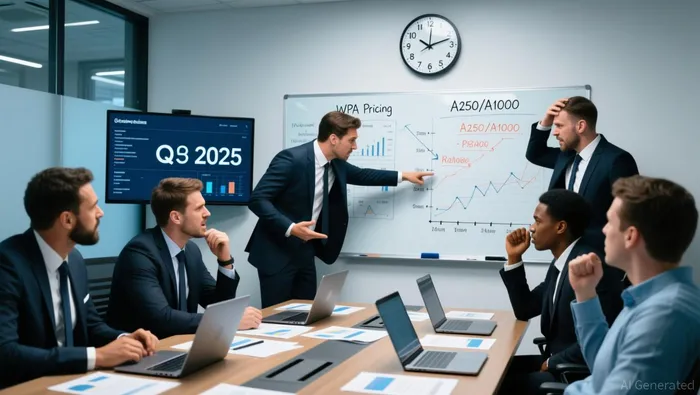
Contradiction Point 1
Water Purchase Agreement (WPA) Model Pricing
It involves pricing strategy for the Water Purchase Agreement model, which impacts customer acquisition and revenue projections.
Who are your competitors in the WPA model? How does your pricing compare to theirs? - Sean Milligan(Needham & Company)
20251114-2025 Q3: We are targeting customers who currently truck in water due to scarcity or high costs. Our pricing under WPAs is cheaper than trucking water, which can cost $0.50 to $0.75 per gallon. - Bryan Barton(CPO)
What level of cost savings can customers expect compared to alternatives? Can you quantify these savings and specify if they're based on free cash flow? - Jeffries (Jefferson G. feng)
2025Q2: We're not pricing materially higher than what the market is willing to pay today. So you can think, as we bring this to market, relative to pricing today for water, it may be an opportunity for companies to save 20% to 30% on their water. - Bryan Barton(CPO)
Contradiction Point 2
Timing of A250 and A1000 Deployments
It involves the timing and sequence of deploying the A250 and A1000 products, which can impact revenue projections and customer expectations.
Could you clarify the deployment sequence for A250 and A1000? - George Gianarikas(Canaccord Genuity)
20251114-2025 Q3: A250 will likely be deployed before A1000 due to simpler system design. Engineering activities for A1000 have started, but A250 has a head start. The sequence allows a simpler product to lead the market first. - Bryan Barton(CPO)
How does data gathering for the Hubbard project relate to work with ASU? - Jeffrey Campbell(Seaport Research Partners)
2025Q2: We're building A1000, A1000 is the core of our business right now. We're building A250, which is our miniaturized A1000. We continue to work on A250 as it moves forward. And obviously, that's planned for 2027. - Bryan Barton(CPO)

Discover what executives don't want to reveal in conference calls
Latest Articles
Stay ahead of the market.
Get curated U.S. market news, insights and key dates delivered to your inbox.
AInvest
PRO
AInvest
PRO



Comments
No comments yet