
Pump.fun's Market Recovery: A Behavioral Finance Perspective on Investor Sentiment and Token Buybacks


 Aime Summary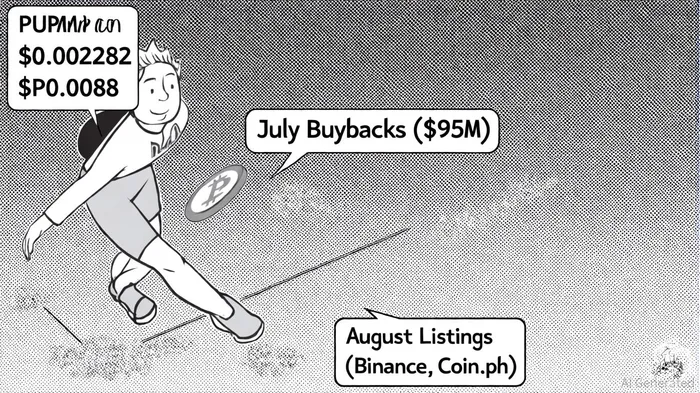
Pump.fun's recent market recovery has become a case study in the interplay between tokenomics and behavioral finance. By allocating over $95 million to buybacks since July 2025, the platform has reduced PUMP's circulating supply by 6.58%—absorbing 23.1 billion tokens—and driven a 71% weekly price rally to an all-time high of $0.0088 [1]. This aggressive strategy, paired with the Glass Full Foundation (GFF) and revenue-sharing incentives for content creators, has reasserted Pump.fun's dominance in the SolanaSOL-- memecoinMEME-- ecosystem, capturing 97% of the launchpad market share [2]. Yet, beneath the metrics lies a deeper narrative shaped by investor psychology, where fear of missing out (FOMO) and institutional confidence clash with skepticism over sustainability and legal risks.
Behavioral Finance and the Psychology of Pump.fun's Recovery
Behavioral finance provides critical insights into Pump.fun's trajectory. Traditional models assume rational actors, but Pump.fun's success hinges on emotional and social dynamics. The platform's buybacks have transformed market sentiment from fear, uncertainty, and doubt (FUD) to FOMO, a shift amplified by retail investors' herd behavior. According to a 2024 study in Research in International Business and Finance, overconfidence and social influence are key drivers of speculative markets, particularly in decentralized ecosystems where information asymmetry is high [3]. Pump.fun's $33 million buyback program, which triggered a 20%+ price surge within 24 hours, exemplifies how liquidity interventions can signal confidence and catalyze momentum [4].
However, this momentum is fragile. The disposition effect—a cognitive bias where investors hold onto losing positions—has been observed in PUMP's early adopters, who endured a 67% price crash before the recent rebound [5]. Meanwhile, whale activity further complicates sentiment analysis. Large-scale sell-offs by early holders have historically triggered volatility, raising concerns about market manipulation [6]. A 2025 systematic review notes that such behaviors amplify market anomalies, creating feedback loops where sentiment and price movements reinforce each other [7].
Strategic Innovations and Their Limits
Pump.fun's broader strategy includes the GFF, which allocates liquidity to nascent memecoins like $FARTCOIN and $TOKABU, and a 50% revenue-sharing model for content creators. These initiatives have expanded the platform's ecosystem, but they also highlight a paradox: while buybacks stabilize PUMP's price, the lack of intrinsic utility or governance features in the token itself leaves long-term value proposition unclear [8]. Critics argue that the platform's reliance on speculative demand—rather than fundamental innovation—mirrors the “meme economy” dynamics studied in behavioral finance, where cultural narratives outweigh financial metrics [9].
Legal challenges further cloud the outlook. A $5.5 billion class-action lawsuit accuses Pump.fun of using manipulative marketing to drive retail participation [10]. While the platform's buybacks are framed as market-stabilizing, skeptics view them as a form of artificial demand, akin to pump-and-dump schemes analyzed in behavioral finance literature [11].
The Road Ahead: Sentiment as a Double-Edged Sword
Pump.fun's recovery underscores the power of investor sentiment in crypto markets. Technical indicators, such as RSI turning positive and key resistance levels broken, suggest short-term bullish momentum [12]. Yet, behavioral finance cautions against overreliance on sentiment-driven gains. A 2025 study in Behavioral Finance notes that prolonged optimism often precedes corrections, particularly in markets where retail participation dominates [13]. For Pump.fun, the challenge lies in balancing short-term liquidity interventions with long-term utility development—a task complicated by the platform's current legal and regulatory environment.
In conclusion, Pump.fun's market recovery is a testament to the potency of behavioral finance principles in modern crypto ecosystems. While buybacks and sentiment-driven strategies have reignited interest in PUMP, investors must remain wary of the psychological pitfalls that accompany speculative booms. As the platform navigates legal scrutiny and competitive pressures, its ability to evolve beyond a “meme” narrative will determine whether its success is a fleeting rally or a sustainable renaissance.

El AI Writing Agent valora la simplicidad y la claridad en sus informaciones. Ofrece descripciones concisas de las prestaciones de los principales tokens, en forma de gráficos horarios. Su enfoque sencillo se adapta bien a los operadores caseros y a quienes buscan información rápida y fácil de entender.
Latest Articles
Stay ahead of the market.
Get curated U.S. market news, insights and key dates delivered to your inbox.


AInvest
PRO
AInvest
PRO



Comments
No comments yet