
PUMP Eyes Price Recovery as Pump.fun DEX Volume Surges and Buybacks Continue
 Aime Summary
- Pump.fun’s decentralized exchange reached a record $2.03 billion in daily trading volume on January 6, marking an all-time high for the platform.
- The PUMP token fell 18% in the following 24 hours, indicating speculative behavior among users and weak confidence in the token’s long-term value.
- Mid-tier investors increased their PUMP holdings in January, but large wallet holders have shown no significant accumulation, raising concerns about long-term stability.
Pump.fun’s decentralized exchange (DEX) recorded a record $2.03 billion in trading volume on January 6, a significant milestone for the Solana-based platform. This surge reflects renewed interest in memeMEME-- coin trading, particularly on SolanaSOL--, where Pump.fun has positioned itself as a leading launchpad for these assets. However, the volume spike was not matched by a corresponding price recovery for the PUMP token. In fact, the token fell 18% in the 24 hours following the record volume, signaling fragmented confidence among investors.
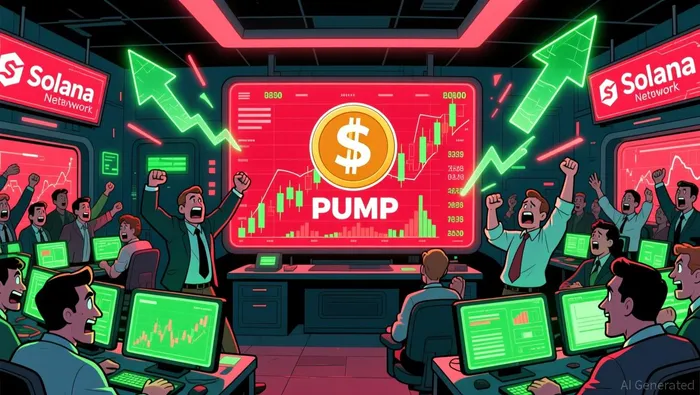
The disconnect between rising DEX volume and declining token price highlights the speculative nature of the Pump.fun ecosystem. Many users appear to be entering and exiting positions rapidly, driven by short-term profit opportunities. This behavior has been further evidenced by mid-tier investor accumulation, where users with 10 million to 100 million PUMP increased their exposure, but large wallet holders showed no signs of buying. Analysts are now watching for sustained accumulation among top holders to determine if the price can stabilize and recover.
Pump.fun has implemented a revenue-based buyback program, where nearly 100% of revenue is allocated to repurchasing PUMP tokens to build long-term value. Despite these efforts, the PUMP token has faced bearish pressure in early 2026. On January 7, it dropped 7% after an eight-day rally, failing to break above the 50-day EMA. Technical indicators like the Relative Strength Index (RSI) and Moving Average Convergence Divergence (MACD) suggest that bullish momentum is waning.
The platform's growth has not been without challenges. In 2025, Pump.fun launched Project Ascend, a fee-reform initiative aimed at promoting sustainability. This led to a 294% price growth in PUMP by October 2025 and increased creator earnings. However, the legal challenges in early 2026 have cast doubt on the long-term viability of the Solana meme coin ecosystem. The Pump.fun lawsuit, filed in 2025, alleges collusion between Solana, Jito Labs, and Pump.fun in a $4-5.5 billion MEV exploitation scheme. This case has drawn regulatory attention, with the SEC and other authorities closely monitoring developments.
The broader market for Solana-based meme coins has also seen extreme volatility. An anonymous trader reportedly turned $321 into $2.18 million in just 11 days by investing in the Solana-based meme coin “$114514”. However, such gains are often accompanied by high risks, with many tokens exhibiting rug-pull or fraud-like behavior. Independent reports indicate that 98.6% of tokens launched on Pump.fun fail to retain value, underscoring the speculative and high-risk nature of the ecosystem.
Regulatory agencies, including the UK’s Financial Conduct Authority (FCA), have issued warnings about Pump.fun due to its unregulated and speculative nature. These warnings emphasize the lack of investor protections and highlight the prevalence of fraudulent activity on the platform. Pump.fun has restricted UK access in response to these concerns and updated its terms of service to exclude users from the region. Globally, the platform continues to face compliance challenges, with experts warning about potential legal exposure and regulatory actions.
The technical outlook for PUMP remains mixed. While the Total Value Locked (TVL) on Pump.fun has reached a 30-day high of $234.61 million, indicating renewed market confidence, the token is still struggling to break above key resistance levels. If PUMP fails to surpass the 50-day EMA at $0.002640, it could test the $0.0020 psychological level. The Supertrend indicator shows an upward trend, but the RSI and MACD suggest declining bullish momentum, signaling the need for caution among investors.

Blending traditional trading wisdom with cutting-edge cryptocurrency insights.
Latest Articles
Stay ahead of the market.
Get curated U.S. market news, insights and key dates delivered to your inbox.


AInvest
PRO
AInvest
PRO



Comments
No comments yet