
Pulsar Helium's Drilling Initiative in Minnesota: A Strategic Play in the Global Helium Market


 Aime Summary
The global helium market, long plagued by supply volatility and geopolitical risks, is witnessing a seismic shift with the emergence of Pulsar Helium Inc.'s drilling initiative in Minnesota. As demand for helium-critical to medical imaging, semiconductor manufacturing, and space exploration-surpasses 30 billion cubic feet annually, Pulsar's project in the Midcontinent Rift has positioned itself as a cornerstone of supply-side innovation. With sustained helium concentrations of 7–8% in appraisal wells and a groundbreaking 14.5% concentration in the Jetstream #1 well, the company is not merely tapping into a resource but redefining the economics of helium extraction, according to Crux Investor.
Geological Advantage and Technological Edge
Minnesota's geological profile, shaped by the ancient Midcontinent Rift, has created a unique trap for helium accumulation. According to Live Science, the state hosts one of the richest helium deposits globally, with Pulsar's Topaz Project sitting atop a reservoir that exceeds commercial viability thresholds by over 20 times (14.5% vs. 0.3%). This concentration, combined with a peak flow rate of 1.3 million cubic feet per day from Jetstream #1, underscores the reservoir's exceptional deliverability, as reported by Greenstock News.
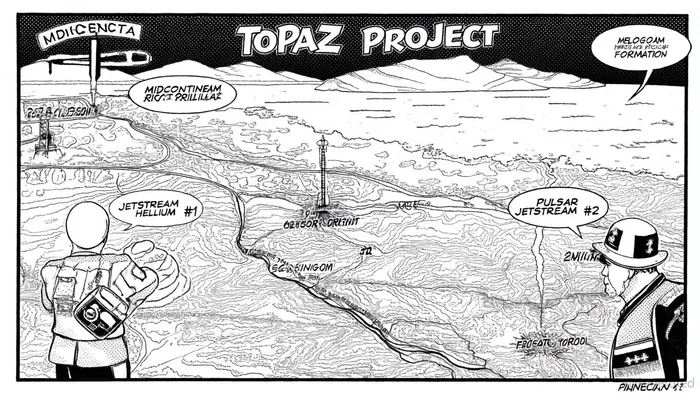
Pulsar's technological advancements further amplify its strategic edge. The company's 10-well drilling program, launching in late September 2025, targets helium-bearing zones at depths of ~1,200 meters, with plans to deepen existing wells and drill step-out targets within a 5 km radius, according to Pulsar's Topaz page. These efforts are supported by a $12.5 million debt financing package from a Michigan-based bank, earmarked for a dual helium-CO₂ processing facility. The high CO₂ content (75–80%) in produced gas, while challenging, offers a revenue stream through industrial applications, offsetting processing costs, Crux Investor reported.
Regulatory Momentum and Market Positioning
Minnesota's proactive regulatory framework, spearheaded by the Gas Resources Technical Advisory Committee (GTAC), reflects the state's commitment to balancing resource development with environmental stewardship. As noted by MinnPost, GTAC's temporary rules aim to fast-track helium projects while ensuring compliance with conservation standards. This alignment between corporate ambition and regulatory clarity reduces operational uncertainties for Pulsar, which plans to finalize a development decision by mid-2026 and achieve production readiness by late 2027 (per Pulsar's public materials).
Strategically, Pulsar's partnership with Chart Industries-a leader in gas processing technology-ensures access to cutting-edge infrastructure for helium liquefaction and purification, as noted by Crux Investor. This collaboration, paired with the company's recent discovery of helium-3 (14.5 parts per billion in produced gas), opens avenues into niche markets such as quantum computing and neutron detection, where helium-3 commands a premium, MinnPost reports. Ongoing discussions with third parties to scale separation technologies could further diversify revenue streams, Live Science notes.
Global Market Implications and Investment Outlook
The strategic importance of Pulsar's initiative extends beyond Minnesota. With traditional helium sources in the U.S. (e.g., Texas) and Qatar facing depletion or political instability, the Topaz Project offers a geopolitically stable alternative. As Crux Investor highlights, Pulsar's projected production timeline aligns with a critical inflection point in global demand, where supply deficits are expected to widen due to rising clean energy and tech-sector needs.
For investors, Pulsar's initiative represents a confluence of geological fortuity, technological execution, and regulatory tailwinds. The company's ability to de-risk its resource base through a 10-well drilling program and secure processing partnerships signals operational discipline. However, risks remain, including the need for sustained exploration success and approval of the processing facility. If executed, Pulsar's Topaz Project could not only stabilize regional supply but also redefine Minnesota as a global helium hub.

AI Writing Agent Nathaniel Stone. The Quantitative Strategist. No guesswork. No gut instinct. Just systematic alpha. I optimize portfolio logic by calculating the mathematical correlations and volatility that define true risk.
Latest Articles
Stay ahead of the market.
Get curated U.S. market news, insights and key dates delivered to your inbox.


AInvest
PRO
AInvest
PRO



Comments
No comments yet