
Pudgy Penguins PENGU Price Tracks Mainstream Brand Growth and Token Supply Dynamics
 Aime Summary
- Pudgy Penguins leverages a dual-channel strategy combining digital collectibles with physical plush toys sold at major retailers to establish a broad retail holder base.
- The associated PENGUPENGU-- token faces structural supply constraints, with 89 billion tokens scheduled for emission against a current 63 billion circulating supply.
- Current market data indicates the token trades 91% below its all-time high, reflecting broader ecosystem volatility and dilution concerns.
- Comparative metrics show Pudgy PenguinsPENGU-- maintains strong trading volume and brand strength relative to peers like Doodles and Gemesis.
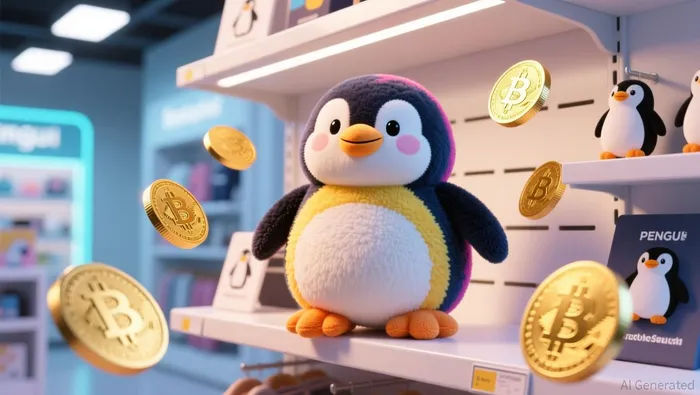
Pudgy Penguins continues to distinguish itself in the non-fungible token sector through an aggressive mainstream brand integration strategy. The project, developed by The Igloo Company, has successfully extended its reach beyond digital marketplaces by distributing physical plush toys at major global retailers such as Walmart and Target. This dual-channel approach has cultivated a robust unique-owner ratio of 57.2%, indicating a wide distribution of holdings among retail investors rather than concentration in large institutional wallets. This broad base provides a structural advantage in mitigating the sell-side pressure often associated with whale-dominated collections. The physical retail presence serves as a constant marketing engine, driving visibility and demand that pure digital projects struggle to replicate independently.
The financial mechanics of the Pudgy Penguins ecosystem are defined by the performance of its native utility token, PENGU. Pricing for PENGU is established through a global volume-weighted average across 107 exchanges and 185 distinct markets. The token currently operates with a circulating supply of 63 billion tradeable units, against a maximum total supply cap of 89 billion tokens. This discrepancy results in a Fully Diluted Valuation (FDV) of approximately $490.8 million, which is significantly higher than the current market capitalization of $388.4 million. The substantial gap between market cap and FDV highlights the potential for future supply dilution as the emission schedule progresses over the coming years. Investors must account for this ongoing inflationary pressure when evaluating long-term tokenomics.
Recent trading activity suggests that PENGU is navigating a challenging macroeconomic environment within the digital asset space. Trading volumes on centralized platforms like Binance, Bybit, and Coinbase have recently exceeded $54 million in a 24-hour period. Despite this liquidity, the token has experienced a 7-day price decline of 2.30%. While this performance slightly outpaces the broader cryptocurrency market, it significantly underperforms compared to peers within the EthereumETH-- ecosystem. The token is currently trading at a steep discount of 91% from its all-time high of $0.06845. This valuation compression reflects both the inherent volatility of NFT-linked assets and the specific supply dynamics of the PENGU token.
When evaluating the broader NFT landscape, Pudgy Penguins presents a distinct value proposition compared to competing collections. Doodles, for instance, positions itself as an entertainment brand focused on animated content and licensing deals. With a floor price of 0.3836 ETH, Doodles offers a more accessible entry point than Pudgy Penguins, which trades at a floor of 4.1397 ETH. While Doodles maintains active daily trading volumes around 6.05 ETH, its total volume and floor growth have cooled relative to Pudgy Penguins. This suggests that Pudgy Penguins currently enjoys stronger momentum driven by its tangible brand utility and higher barrier to entry.
Gemesis represents the most accessible segment of the market, with a floor price of approximately $20.48. Minted as a membership token for OpenSea Pro users, its value is derived primarily from platform utility rather than artistic intellectual property. Gemesis boasts one of the widest holder bases with a 51.3% unique owner ratio. However, the lack of a strong collectible narrative makes its long-term demand less anchored than brand-driven peers like Pudgy Penguins. The fundamental difference in value drivers underscores the diversity of strategies emerging in the 2026 NFT market.
Investors navigating this sector must weigh the benefits of brand strength against the risks of token dilution and market volatility. The success of Pudgy Penguins demonstrates the viability of hybrid physical-digital models in sustaining collector interest. However, the significant gap between circulating and total supply for PENGU introduces structural risks that could impact price stability. As the emission schedule unfolds, the market will likely reassess the token's valuation relative to its utility and brand equity. The cooling volumes observed in secondary collections like Doodles further highlight the premium commanded by projects with proven mainstream adoption.
Ethereum gas costs remain a persistent factor affecting liquidity across all these collections. High transaction fees can deter retail participation, particularly for lower-priced assets like Gemesis. For high-value assets like Pudgy Penguins, gas costs are less of a barrier but still impact overall trading efficiency. The competitive talent market for enterprise AI, highlighted by recent corporate moves, suggests a broader tech ecosystem shift that may indirectly influence digital asset development. As traditional tech companies adopt internal AI tools, the intersection of enterprise technology and blockchain innovation may create new utility paradigms for NFT projects.
The structural strengths of Pudgy Penguins, including its retail integration and holder distribution, provide a resilient foundation. Nevertheless, the high floor price and token supply dynamics require careful risk management. The contrast with Doodles and Gemesis illustrates that success in the NFT space is no longer guaranteed by hype alone. Utility, brand narrative, and tokenomics now play equally critical roles in determining asset longevity. Investors should monitor the emission schedule of PENGU closely, as it will be a primary determinant of future market capitalization and price action.

Blending traditional trading wisdom with cutting-edge cryptocurrency insights.
Latest Articles
Stay ahead of the market.
Get curated U.S. market news, insights and key dates delivered to your inbox.


AInvest
PRO
AInvest
PRO




Comments
No comments yet