
Pudgy Penguins Faces Supply Inflation Amid Robinhood Web3 Expansion
 Aime Summary
- Pudgy Penguins faces recurring supply inflation from scheduled token unlocks, creating consistent sell-side pressure that suppresses price rallies.
- Robinhood reported record net income of $573 million while pivoting its business model toward a comprehensive Web3 financial ecosystem.
- The structural divergence between Pudgy Penguins' physical retail expansion and bearish tokenomics highlights a disconnect between brand value and token utility.
- Investors are weighing the potential of utility-driven NFTs against the reality of token dilution in an increasingly competitive digital asset landscape.
Pudgy Penguins is executing a major physical retail strategy, placing PenguPENGU-- Plushies in over 1,800 Target stores across the U.S., following successful rollouts at Walmart and Amazon. This strategy aims to acquire crypto-unfamiliar users via QR-coded toys, funneling them into the Web3 ecosystem . However, the token does not directly capture revenue from toy sales, meaning price impact depends on successful onboarding and conversion into ecosystem participants .
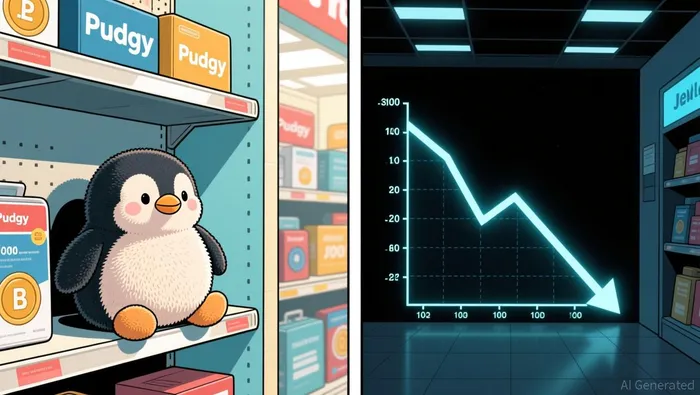
Concurrently, PENGU faces recurring supply inflation from scheduled token unlocks . A notable 703 million PENGU unlock occurred, distributed across 19 wallets, with approximately 29.28% of total supply allocated to the team and company through 2028 . This creates consistent sell-side pressure that can suppress price rallies, even amid positive brand news .
The token’s disclaimer that it holds "no commercial value" further disconnects it from the brand’s financial success, making it vulnerable to dilution . Ecosystem utility growth offers a mixed outlook, with the project expanding through Pudgy World, a browser-based game, and staking at approximately 12% APY . Successful utility growth could create sustainable buy-side demand, offsetting unlock pressure, but current utility is still developing .
How Does Token Unlock Pressure Affect PENGU Valuation?
The monthly supply increase of approximately 710 million tokens creates a significant hurdle for price appreciation . Near-term price action is likely capped by unlock schedules, while medium-term prospects hinge on whether gaming and staking utility can generate enough demand to absorb new supply . The token's value is pressured by inflation that must be offset by ecosystem utility adoption .
This structural divergence between successful physical retail expansion and bearish tokenomics is a key concern for investors . While mainstream brand growth builds long-term user acquisition, the token's value is pressured by inflation that must be offset by ecosystem utility adoption . Price appreciation requires demand growth to outpace the monthly supply increase .
What Is Robinhood’s Strategy for Web3 and Digital Assets?
Robinhood Markets reported its strongest quarterly performance, posting net income of $573 million on $1.31 billion in revenue. The results highlight the strength of its expanding financial ecosystem, particularly the RobinhoodHOOD-- Gold subscription service, which has grown to 4.8 million users . This recurring revenue model provides stability by reducing reliance on volatile transaction volumes .
Despite the strong earnings, the company's stock (NASDAQ: HOOD) fell below the $90 mark . Investors appear to be weighing the company's lofty growth expectations against the need for sustained profitability and successful execution of new initiatives . The market reaction underscores that strong earnings alone are no longer sufficient when valuations already price in years of expansion .
Beyond traditional trading, Robinhood is transforming into a comprehensive digital financial platform . Key growth drivers include its investment in blockchain infrastructure through Robinhood Chain, which aims to tokenize financial assets and enable decentralized services within a retail environment . Additionally, the company is expanding into prediction markets, allowing users to trade on real-world event outcomes, signaling a move toward becoming a broader marketplace for financial participation .
Speculation is also high regarding the upcoming launch of Stonk Broker NFTs . Unlike traditional collectibles, these NFTs are expected to offer utility and integration with Robinhood’s on-chain ecosystem, potentially leveraging the company's large existing user base for distribution . If successful, this could represent a significant evolution in utility-driven digital assets .
The company is actively transforming from a commission-free trading platform into a broader digital financial ecosystem. Key strategic pillars include Robinhood Chain, a blockchain infrastructure designed to tokenize financial assets and enable decentralized services, and prediction markets, which allow trading on real-world event outcomes . These initiatives aim to integrate investing, crypto trading, and programmable financial products .
A significant focus is the upcoming Stonk Broker NFTs . Unlike traditional collectibles, these NFTs are expected to offer utility within the Robinhood ecosystem, such as exclusive features or governance rights . Leveraging its large retail user base, Robinhood aims to drive adoption through direct distribution, potentially challenging established brands like Pudgy PenguinsPENGU-- .
Investors are closely watching whether these blockchain and digital asset initiatives can convert into durable long-term revenue . The market reaction suggests that strong earnings alone are insufficient; sustained profitability alongside successful innovation in Web3 and tokenized assets will be critical for future valuation support .
The juxtaposition of Robinhood’s Web3 ambitions and Pudgy Penguins’ retail expansion highlights the evolving landscape of digital assets . While Robinhood focuses on infrastructure and utility, Pudgy Penguins relies on physical brand integration . The market is likely to continue scrutinizing how these different models translate into sustainable value for token holders .

Blending traditional trading wisdom with cutting-edge cryptocurrency insights.
Latest Articles
Stay ahead of the market.
Get curated U.S. market news, insights and key dates delivered to your inbox.


AInvest
PRO
AInvest
PRO




Comments
No comments yet