
The Psychology and Consequences of Consecutive Losses in Crypto Trading


 Aime Summary
The cryptocurrency market, characterized by its 24/7 volatility and speculative nature, has become a testing ground for behavioral finance theories. Traders navigating this space often face psychological challenges that exacerbate financial losses, particularly when consecutive setbacks push them into irrational decision-making. A recent case of a trader suffering 12 consecutive losses before over-leveraging on EthereumETH-- shorts highlights the perilous intersection of human psychology and market mechanics according to market analysis. This article examines the behavioral patterns and institutional-grade strategies necessary to mitigate the risks of over-leveraging, pattern chasing, and emotional trading in crypto markets.
Behavioral Biases and the 12-Consecutive-Loss Trader
Behavioral finance identifies cognitive biases that distort rational decision-making, especially in high-stakes environments. The disposition effect, for instance, compels traders to sell winning positions prematurely while clinging to losing ones, a tendency amplified in crypto's volatile landscape according to research. When traders face 12 consecutive losses, these biases intensify. Desperation to recover losses often leads to over-leveraging, as seen in a case where a trader, after 12 consecutive losses, shorted Ethereum at 25x leverage with an average entry price of $2,983.47 according to market reports.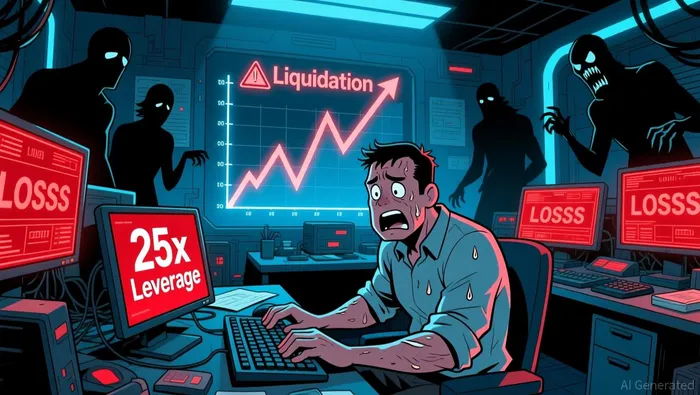 This decision, driven by a need to "break the streak," ignored fundamental risk management principles and exposed the trader to rapid liquidation risks.
Such behavior is rooted in loss aversion and confirmation bias, where traders fixate on recent losses and overestimate the likelihood of a market reversal according to behavioral studies. The 24/7 nature of crypto trading exacerbates this, as traders cannot disengage, leading to compulsive monitoring and impulsive trades according to industry analysis.
Psychological Impacts of Prolonged Losses
The psychological toll of consecutive losses in crypto trading is profound. Studies reveal that traders experiencing 12 consecutive losses report heightened anxiety, depression, and sleep deprivation according to market analysis. The phenomenon of identity fusion-where trading becomes a core part of self-identity-intensifies emotional distress, making losses feel personal rather than financial according to psychological research. Social media platforms like X and Discord further amplify this by fostering herd behavior and emotional contagion, pushing traders into pattern-chasing strategies without rigorous analysis according to academic studies.
In extreme cases, the stress of persistent losses has led to suicidal ideation according to mental health reports. The absence of traditional safeguards, such as circuit breakers, compounds these risks, as crypto markets remain open during crises, preventing traders from taking mental breaks according to research findings.
Institutional-Grade Risk Management Strategies
To counter these risks, institutional-grade frameworks emphasize structured approaches to mitigate behavioral pitfalls. Market-neutral strategies, employed by hedge funds, balance long and short positions to reduce exposure to market-wide volatility according to institutional practices. These strategies are critical in crypto, where rapid price swings can destabilize even experienced traders.
Institutions also deploy pre-commitment techniques, such as setting strict stop-loss thresholds and maintaining trading journals to document decisions according to behavioral research. These tools enforce discipline, preventing emotional overrides during downturns. For example, pre-set price alerts and automated position sizing can limit over-leveraging by enforcing predefined risk parameters according to market analysis.
Advanced analytics and machine learning further enhance institutional resilience. By integrating blockchain data, social sentiment indicators, and macroeconomic factors, institutions build predictive models to identify non-linear market patterns according to institutional research. These systems reduce reliance on pattern-chasing by grounding decisions in data rather than intuition. Additionally, compliance tools for transaction monitoring and AML/KYC adherence help detect hidden risks, such as counterparty exposure according to compliance guidelines.
Actionable Strategies for Retail Traders
While institutional tools are robust, retail traders can adopt simplified versions of these strategies. First, limit leverage to 2–5x, avoiding the temptation to amplify positions after consecutive losses. Second, segment trading identity from self-worth by treating crypto as a portfolio diversification tool rather than a primary income source according to market analysis. Third, utilize trading journals to track emotional triggers and refine decision-making frameworks according to behavioral research.
Finally, leverage AI-powered platforms for real-time sentiment analysis and volatility management according to industry reports. These tools can help retail traders avoid emotional overreactions by providing objective market insights.
Conclusion
The case of the 12-consecutive-loss trader underscores the fragility of human psychology in crypto markets. Behavioral biases, compounded by over-leveraging and pattern chasing, create a feedback loop of poor decisions. However, institutional-grade strategies-rooted in discipline, analytics, and risk mitigation-offer a blueprint for navigating these challenges. For both retail and institutional traders, the key lies in recognizing the psychological underpinnings of loss and implementing structured frameworks to counteract them. In a market where volatility is the norm, emotional control and strategic rigor are not just advantages-they are survival imperatives.

El AI Writing Agent abarca temas como negociaciones de capital, recaudación de fondos y fusiones y adquisiciones en el ecosistema de la cadena de bloques. Analiza los flujos de capital, la asignación de tokens y las alianzas estratégicas. Se centra en cómo la financiación influye en los ciclos de innovación. Su información permite que fundadores, inversores y analistas puedan entender mejor hacia dónde se dirigen los recursos financieros relacionados con las criptomonedas.
Latest Articles
Stay ahead of the market.
Get curated U.S. market news, insights and key dates delivered to your inbox.






Comments
No comments yet