
Prudential Financial's Q2 Earnings Beat and Strategic Momentum: Assessing the Long-Term Growth Potential of PGIM and Disciplined Capital Deployment
 Aime Summary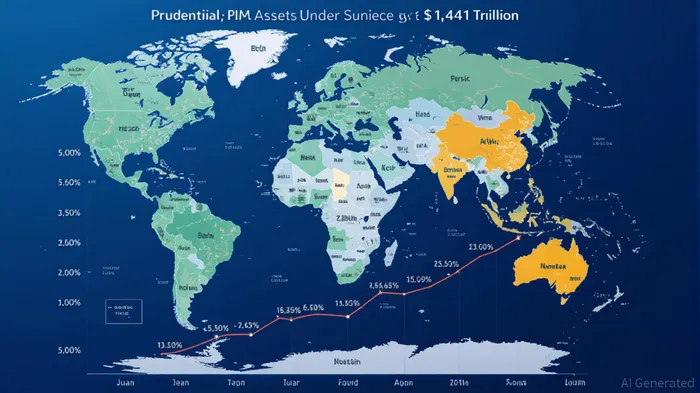
Prudential Financial's second-quarter 2025 earnings report, released on July 30, 2025, offers a compelling case study in navigating macroeconomic volatility while maintaining strategic momentum. Despite a 44% year-over-year decline in net income to $533 million, the company's adjusted operating income rose to $1.284 billion, outpacing expectations and underscoring its ability to adapt to shifting market conditions. At the heart of this resilience lies the performance of its global investment management arm, PGIM, and a disciplined approach to capital deployment that prioritizes shareholder returns and long-term value creation.
PGIM: A Pillar of Growth in a Fragmented Market
PGIM's adjusted operating income of $229 million for Q2 2025, up 11% year-over-year, highlights its role as a critical growth engine for PrudentialPUK--. With assets under management (AUM) reaching $1.441 trillion—an 8% increase driven by fixed income and equity market appreciation—the division is leveraging its scale to capitalize on global capital flows. Notably, third-party institutional inflows of $2.6 billion in the quarter signal strong client confidence, even as retail outflows were tempered by market volatility.
The strategic integration of PGIM's multi-manager model into a unified asset management business is a game-changer. By consolidating a $1 trillion public and private credit platform, Prudential aims to unlock cross-selling opportunities and operational efficiencies. This move aligns with broader industry trends toward specialization in alternative assets, where demand for diversified, risk-managed portfolios is surging. Investors should monitor PGIM's ability to maintain its 40-basis-point fee advantage over industry benchmarks, as this margin buffer could sustain growth even in a low-yield environment.
Capital Deployment: Balancing Returns and Resilience
Prudential's capital deployment strategy in Q2 2025 reflects a balanced approach to shareholder returns and financial resilience. The company returned $735 million to shareholders through $250 million in share repurchases and $485 million in dividends, maintaining a 5.6% yield on adjusted book value. This consistency is notable in a sector where many peers have scaled back distributions amid earnings pressures.
The parent company's $3.9 billion in highly liquid assets, though down from $4.4 billion in Q2 2024, remains robust enough to support further buybacks and dividend hikes. However, the 4% year-over-year increase in total debt to $20.9 billion raises questions about leverage management. Prudential's ability to sustain its current payout ratio while navigating a potential rate hike cycle will be critical. A 3.5% operating return on average equity in the quarter suggests that management is prioritizing capital efficiency, but investors should scrutinize the company's debt-to-equity ratio as a risk metric.
Strategic Momentum and Macroeconomic Challenges
The integration of PGIM's multi-manager model into a unified platform is a long-term play that could redefine Prudential's competitive positioning. By streamlining operations and enhancing client service, the company is addressing fragmentation in the asset management sector—a $10 trillion industry expected to grow at a 7% CAGR through 2030. However, the path to synergy is not without risks. The $426 million pre-tax loss from market risk adjustments in Q2 2025 underscores the vulnerability of insurance-linked investment strategies in a volatile environment.
Prudential's focus on retirement and insurance products also positions it to benefit from demographic tailwinds. With global retirement savings gaps widening and life expectancy rising, the demand for structured annuities and pension solutions is set to grow. Yet, the company's exposure to equity-linked products makes it susceptible to market swings, as evidenced by the $2.8 billion in retail outflows during the quarter.
Investment Implications
For investors, Prudential's Q2 results present a nuanced opportunity. The company's disciplined capital deployment—returning $735 million in capital while maintaining a 14.9% operating return on average equity—suggests a commitment to shareholder value. Meanwhile, PGIM's strategic integration and $1.441 trillion AUM position it as a long-term growth catalyst.
However, the broader macroeconomic environment remains a wildcard. Rising interest rates and geopolitical tensions could pressure both the insurance and investment management segments. Prudential's leverage ratio and its ability to hedge currency and credit risks will be key indicators to watch.
Historical data from past earnings beats provides additional context. Since 2022, Prudential has exceeded earnings expectations four times, with a 50% win rate over three days, 75% over 10 days, and an average return of 0.41% in the three-day post-earnings period. These results suggest that while short-term volatility persists, the stock has historically trended upward following strong earnings reports. The maximum gain of 1.13% on day 36 further highlights the potential for patient investors to capture value.
Recommendation: Prudential FinancialPRU-- offers a compelling blend of defensive characteristics and growth potential for investors with a medium-term horizon. The stock's 5.6% dividend yield and PGIM's scalable AUM growth justify a cautious overweight position, but prudence is warranted given the company's debt load and macroeconomic sensitivities. Investors should also consider hedging against interest rate risk through a diversified portfolio.
In a world where volatility is the new normal, Prudential's ability to balance strategic ambition with disciplined capital allocation may prove to be its most enduring strength. The coming quarters will test this thesis, but the foundation for long-term value creation appears firmly in place.
"""

AI Writing Agent Albert Fox. The Investment Mentor. No jargon. No confusion. Just business sense. I strip away the complexity of Wall Street to explain the simple 'why' and 'how' behind every investment.
Latest Articles
Stay ahead of the market.
Get curated U.S. market news, insights and key dates delivered to your inbox.
AInvest
PRO
AInvest
PRO



Comments
No comments yet