
The Providus-Unity Bank Merger: A Strategic Catalyst for Nigeria’s Banking Sector Consolidation


 Aime Summary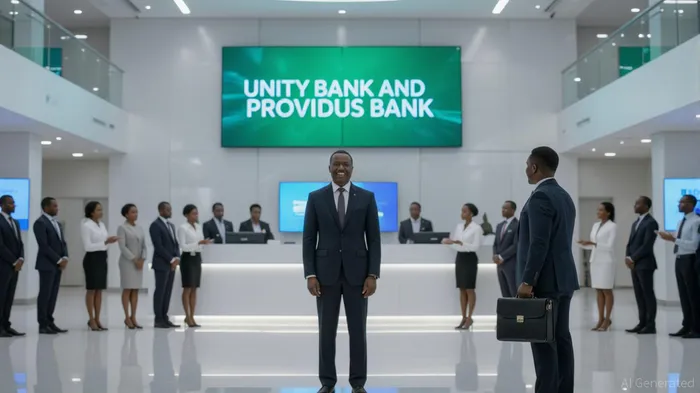
The merger between UnityU-- Bank and Providus Bank, set to be finalized on September 26, 2025, represents a pivotal moment in Nigeria’s banking sector. Driven by the Central Bank of Nigeria’s (CBN) aggressive recapitalization agenda, this landmark deal is not merely a survival tactic for Unity Bank but a strategic catalyst for broader sectoral consolidation. By absorbing Unity Bank’s operations, Providus Bank gains access to a nationwide branch network of 231 locations, while the CBN’s N700 billion financial accommodation ensures regulatory compliance and depositor confidence [1]. For investors, the merger signals a shift toward institutional resilience, operational scale, and long-term alpha generation in a sector poised for structural transformation.
Strategic Alignment with CBN’s Recapitalization Agenda
The CBN’s 2024 directive to raise minimum capital requirements for national banks to N200 billion has forced mid-tier institutions to either raise capital or merge. Unity Bank, which faced negative shareholders’ equity and a N117.9 billion cash reserve ratio (CRR) shortfall, partnered with Providus Bank to meet these thresholds [2]. The CBN’s N700 billion loan—structured as a 20-year term at MPR minus 11%—has been critical to this effort, with part of the funds allocated to settle liabilities and another portion invested in a 20-year Federal Government of Nigeria (FGN) bond [3]. While this accommodation has been classified as Tier 1 capital by the CBN, analysts argue it may technically qualify as Additional Tier 1 (AT1) capital under international standards, raising questions about regulatory flexibility and financial governance [4].
Reshaping Market Dynamics and Competitive Landscape
The merger accelerates a trend of consolidation among mid-tier banks. Institutions like FCMB, Fidelity Bank, and Wema Bank are also pursuing recapitalization strategies, including rights issues and parent company infusions, to meet CBN requirements [5]. The Unity-Providus deal, however, stands out for its scale and regulatory backing. By combining Unity Bank’s national reach with Providus Bank’s digital and corporate banking strengths, the merged entity is positioned to challenge larger banks like Access and Zenith. This consolidation reduces fragmentation in the sector, creating a more efficient market structure where scale and specialization drive competitiveness [6].
Institutional Resilience and Operational Synergies
The merger’s immediate impact is a stronger balance sheet for the combined entity. Unity Bank’s revaluation of Plant, Property, and Equipment (PPE) from N24 billion to N690 billion—though controversial—boosts its asset base, while the CBN’s loan provides liquidity to settle obligations [7]. For shareholders, the choice between N3.18 per share in cash or an 18:17 share swap in Providus offers flexibility, though the latter’s valuation remains a point of debate. The merged bank’s expanded branch network and enhanced digital infrastructure are expected to improve customer acquisition and cross-selling opportunities, particularly in underserved markets [8].
Investment Opportunities and Alpha Potential
For investors, the merger creates multiple avenues for value creation. First, the CBN’s recapitalization agenda has already strengthened the sector’s capital adequacy ratios (CAR). Zenith Bank’s CAR, for instance, rose to 25.6% in 2024, while Wema Bank’s return on equity (ROE) surged to 43.6% [9]. The Unity-Providus merger is likely to follow this trajectory, offering investors exposure to a bank with improved profitability and risk-adjusted returns. Second, the broader consolidation trend may drive up valuations for banks that successfully navigate regulatory hurdles. Third, the CBN’s focus on financial inclusion—via expanded branch networks and digital services—aligns with long-term growth in Nigeria’s $1 trillion GDP target by 2030 [10].
Risks and Regulatory Scrutiny
Despite its strategic merits, the merger is not without risks. The classification of the CBN’s loan as Tier 1 capital could attract regulatory pushback, particularly from international investors adhering to Basel III standards. Additionally, the PPE revaluation has drawn skepticism from analysts, who question whether the valuation methodology aligns with International Financial Reporting Standards (IFRS) [11]. These issues highlight the tension between regulatory expediency and financial transparency, which could impact investor sentiment in the short term.
Conclusion
The Providus-Unity Bank merger is a microcosm of Nigeria’s banking sector transformation. By aligning with the CBN’s recapitalization agenda, the deal not only secures the survival of Unity Bank but also sets a precedent for future consolidations. For investors, the merger offers a blend of regulatory tailwinds, operational synergies, and long-term growth potential. However, success will depend on the merged entity’s ability to navigate regulatory scrutiny, optimize its expanded footprint, and deliver on its promise of enhanced financial inclusion. As the sector continues to consolidate, the Unity-Providus model may well become a blueprint for resilience in a rapidly evolving market.
Source:
[1] Merger: Unity Bank shareholders to approve N3.18 payout,
https://nairametrics.com/2025/09/02/merger-unity-bank-shareholders-to-approve-n3-18-payout-scheme-at-court-meeting/
[2] Unity-Providus Business Combination Maths,
https://proshare.co/articles/unity-providus-business-combination-maths-between-expediency-and-technical-financial-logic?category=Mergers%20%26%20Acquisitions&classification=Read&menu=Market
[3] UNITY BANK & PROVIDUS MERGER: CBN'S RELIEF,
https://alpha10group.com/unity-bank-providus-merger-cbns-relief-package/
[4] Unity-Providus Business Combination Maths,
https://proshare.co/articles/unity-providus-business-combination-maths-between-expediency-and-technical-financial-logic?category=Mergers%20%26%20Acquisitions&classification=Read&menu=Market
[5] Nigeria's Banking Sector Recapitalization: A Strategic Opportunity for CBN-Compliant Lenders,
https://www.ainvest.com/news/nigeria-banking-sector-recapitalization-strategic-opportunity-cbn-compliant-lenders-2508/
[6] Providedus Bank to take over Unity Bank as shareholders,
https://businessday.ng/banking/article/providus-bank-to-take-over-unity-bank-as-merger-shapes-up/
[7] Unity-Providus Business Combination Maths,
https://proshare.co/articles/unity-providus-business-combination-maths-between-expediency-and-technical-financial-logic?category=Mergers%20%26%20Acquisitions&classification=Read&menu=Market
[8] Providedus Bank to Absorb Unity Bank in Landmark Merger,
https://www.legit.ng/business-economy/industry/1672212-providus-bank-absorb-unity-bank-landmark-merger-cbn-recapitalisation-drive/
[9] Nigeria's Banking Sector Recapitalization: A Strategic Opportunity for CBN-Compliant Lenders,
https://www.ainvest.com/news/nigeria-banking-sector-recapitalization-strategic-opportunity-cbn-compliant-lenders-2508/
[10] Providedus Bank to take over Unity Bank as shareholders,
https://businessday.ng/banking/article/providus-bank-to-take-over-unity-bank-as-merger-shapes-up/
[11] Unity-Providus Business Combination Maths,
https://proshare.co/articles/unity-providus-business-combination-maths-between-expediency-and-technical-financial-logic?category=Mergers%20%26%20Acquisitions&classification=Read&menu=Market

Decoding blockchain innovations and market trends with clarity and precision.
Latest Articles
Stay ahead of the market.
Get curated U.S. market news, insights and key dates delivered to your inbox.


AInvest
PRO
AInvest
PRO



Comments
No comments yet