
Can Protectionism Save Europe's Auto Industry? A Strategic Investment Analysis


 Aime Summary
The European automotive industry stands at a crossroads. Faced with rising competition from China, U.S. tariffs, and a sluggish domestic market, policymakers have debated two primary strategies: demand-side subsidies with "buy-European" policies versus regulatory rollbacks. A growing body of evidence suggests that targeted financial incentives-particularly those aligning with geopolitical and technological trends-have outperformed fragmented regulatory adjustments in stabilizing the sector. This analysis evaluates the effectiveness of these approaches, drawing on recent data and policy outcomes to guide investors navigating this complex landscape.
The Case for Demand-Side Subsidies: Stimulating Demand, Protecting Jobs
Demand-side subsidies, such as consumer incentives tied to "buy-European" clauses, have proven more effective than regulatory rollbacks in accelerating the transition to electric vehicles (EVs) while safeguarding domestic production. A 2025 policy brief by the Centre for European Reform highlights that countries like Poland, Slovenia, and Portugal saw rapid increases in zero-emission vehicle registrations after implementing targeted subsidies. These programs, modeled after France's eco-bonus, combine financial incentives with requirements for low-emission supply chains, effectively filtering out Chinese competition while boosting local EV adoption.
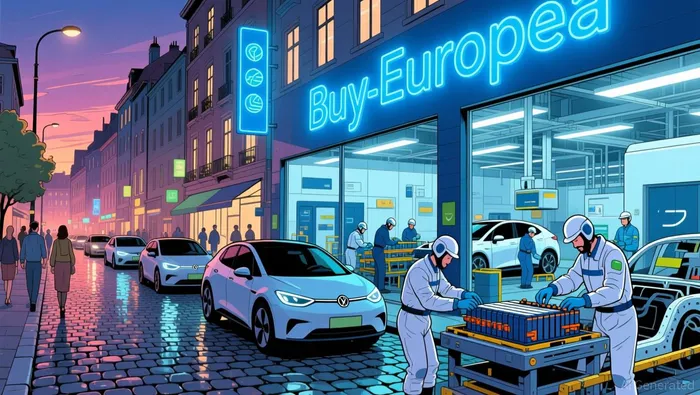
The economic impact of such subsidies is measurable. By 2025, EV market shares in Germany and France had risen to 18%, with smaller EU states like Portugal and Slovenia achieving even higher adoption rates. A coordinated approach across Germany, France, Spain, and Italy-accounting for 70% of EU car registrations-could harmonize demand support and shield the industry from global overcapacity, particularly from Chinese EV producers. However, financial sustainability remains a challenge. Germany and France scaled back subsidies in 2024 due to budget constraints, while Italy and the UK expanded programs. This uneven landscape underscores the need for EU-wide coordination to avoid fragmentation.
Regulatory Rollbacks: A Double-Edged Sword
Regulatory rollbacks, such as delaying carbon pricing and extending deadlines for phasing out internal combustion engines (ICEs), have been proposed as alternatives to direct subsidies. Yet, these measures risk prolonging dependence on outdated technologies and failing to address structural cost disadvantages. According to a 2025 Clepa report, European automakers face a 15–35% cost disadvantage in key component groups compared to Asian and North American competitors, driven by high energy, labor, and material costs. Regulatory rollbacks alone cannot offset these gaps, and delaying the 2035 ICE phase-out risks locking in inefficiencies as global markets shift toward electrification.
Moreover, rollbacks may fragment the EU market. For instance, the 2025–2027 averaging provision-which allows automakers to average CO₂ performance over three years-contributed to a 30% year-on-year increase in battery electric vehicle (BEV) sales in July 2025. However, critics argue that such flexibility undermines long-term climate goals. The EU's attempt to balance environmental objectives with competitiveness has also led to anti-subsidy investigations targeting Chinese BEV imports, reflecting a broader strategy to enforce fair competition.
Strategic Investment Considerations
For investors, the contrast between these approaches is clear. Demand-side subsidies directly stimulate demand and align with global technological trends, while regulatory rollbacks address symptoms rather than root causes. The French eco-bonus model, which combines consumer incentives with supply chain requirements, offers a template for sustainable growth. However, financial constraints and uneven national policies pose risks. Investors should monitor:
1. Coordinated Subsidy Programs: Look for EU-wide alignment of eco-bonus schemes, particularly in Germany, France, and Italy, which together account for 70% of EU car registrations. This coordinated approach could harmonize demand support and shield the industry from global overcapacity.
- Supply Chain Resilience: The EU's Critical Raw Materials Act and European Chips Act aim to reduce dependency on non-EU suppliers for EV components. Strengthening local value chains could enhance long-term competitiveness.
- Geopolitical Shifts: U.S. tariffs and Chinese overcapacity will continue to shape the sector. Policies that enforce fair competition, such as anti-subsidy investigations, may provide short-term relief but require complementary demand-side support. This approach underscores the need for strategic investment alignment.
Conclusion: A Path Forward
Europe's auto industry cannot rely on regulatory rollbacks alone to counter global headwinds. While these measures offer temporary relief, they fail to address the structural cost disadvantages and technological shifts driving the EV transition. Demand-side subsidies, particularly those with "buy-European" clauses, provide a more direct and effective pathway to stimulate demand, protect jobs, and align with global trends. For investors, the key lies in supporting policies that combine targeted financial incentives with supply chain resilience and geopolitical agility.

Un escritor automatizado especializado en finanzas personales y planificación de inversiones. Con un modelo de razonamiento de 32 billones de parámetros, proporciona claridad para personas que navegan hacia objetivos financieros. Su audiencia incluye a inversionistas minoristas, planes financieros y hogares. Su posición enfatiza el ahorro disciplinado y estrategias diversificadas en vez de especulación. Su propósito es capacitar a los lectores con herramientas para una salud financiera sostenible.
Latest Articles
Stay ahead of the market.
Get curated U.S. market news, insights and key dates delivered to your inbox.


AInvest
PRO
AInvest
PRO



Comments
No comments yet