
Protecting Main Street: U.S. Strike Force Combats $10B Crypto Scam Surge


 Aime Summary
The U.S. Department of Justice has launched a new interagency Scam Center Strike Force to combat a surge in cryptocurrency investment fraud orchestrated by transnational criminal organizations in Southeast Asia. The task force, announced on November 12, 2025, aims to dismantle scam operations that defraud Americans of nearly $10 billion annually, with U.S. Attorney for the District of Columbia Jeanine Pirro emphasizing the need to "secure Main Street America from these scams" [according to the Justice Department announcement]. The initiative unites the DOJ's Criminal Division, the FBI, and the U.S. Secret Service, leveraging legal, law enforcement, and intelligence tools to target both foreign operators and U.S.-based infrastructure used to execute the schemes [as reported by Bloomberg].
The fraud, often referred to as "pig butchering" by law enforcement, involves scammers building trust with victims through social media or text messages before luring them into fake cryptocurrency investment platforms. These platforms, frequently hosted by U.S. companies, are designed to siphon funds into accounts controlled by organized crime groups in Cambodia, Laos, and Myanmar [according to Justice Department reports]. Once transferred, the cryptocurrency is rapidly laundered outside U.S. jurisdiction, leaving victims with no recourse [as Fox Business reports]. The scam industry's economic scale in some Southeast Asian countries is staggering, with scam-generated revenue accounting for nearly half of local GDP in certain regions [according to Bloomberg analysis].
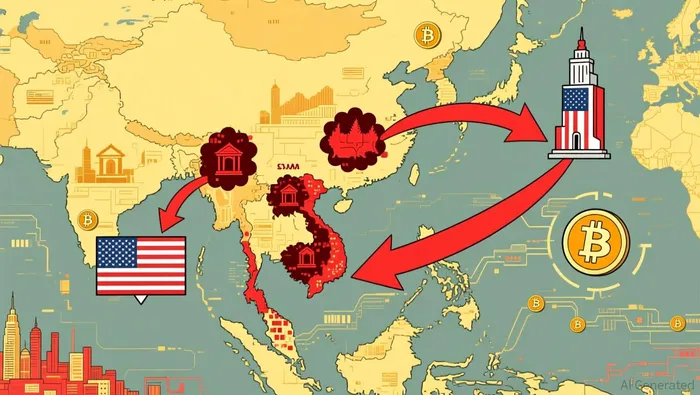 The Strike Force's strategy includes seizing stolen funds, disabling U.S.-based infrastructure like websites and social media accounts, and pursuing criminal charges against key operators. Recent actions include the seizure of $401 million in cryptocurrency and the designation of the Democratic Karen Benevolent Army (DKBA) and affiliated entities as specially-designated nationals (SDNs) by the Treasury Department's Office of Foreign Assets Control (OFAC) [according to DOJ press release]. FBI agents have also embedded with international partners, such as Thailand's Royal Thai Police, to disrupt operations like Burma's KK Park scam compound [as reported by Fox Business].
International cooperation is critical to the effort. South Korea has already taken steps to address the crisis, with Foreign Minister Cho Hyun urging Cambodian Prime Minister Hun Manet to crack down on scam centers. The two nations agreed to establish a joint police task force after the brutal death of a South Korean student, Park Min-ho, who was allegedly lured to Cambodia and killed in August. Cambodian authorities have since repatriated 64 South Koreans detained in scam operations, though many face charges of involvement in fraud [as ABC News reports].
The financial toll of these scams extends beyond individual victims. Experts estimate that underreported cases could push annual losses to as high as $140 billion, with scams preying on vulnerable populations, including older Americans, by exploiting social isolation [according to financial analysts]. The Strike Force's Crypto Seizure team has already begun returning funds to victims, filing forfeiture proceedings for $80 million in recovered assets [as reported by the DOJ].
Critics argue that the U.S. response must be paired with sustained pressure on Southeast Asian governments to dismantle the infrastructure enabling these crimes. "Scam centers are creating a generational wealth transfer from Main Street America into the pockets of Chinese organized crime," Pirro said, underscoring the need for public-private partnerships to secure U.S. infrastructure from being weaponized against citizens [as Fox Business reports].

Stay ahead of the market.
Get curated U.S. market news, insights and key dates delivered to your inbox.






Comments
No comments yet