
ProShares Metaverse ETF's Dividend Yield: A Cautionary Tale in a High-Risk Niche


 Aime Summary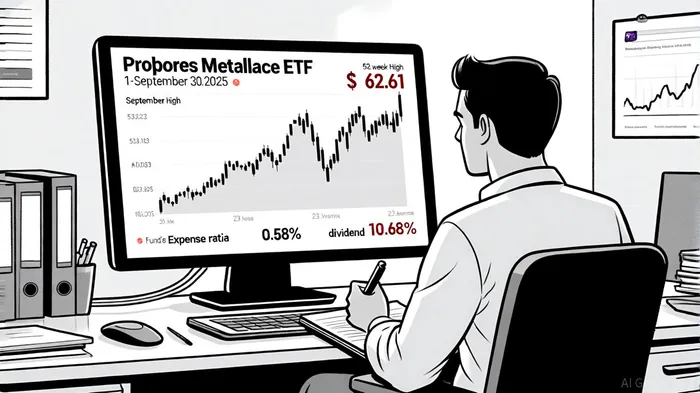
The ProShares Metaverse ETF (VERS) has drawn attention for its recent quarterly distribution of $0.0763 per share, scheduled for September 30, 2025[2]. At first glance, this payout corresponds to a dividend yield of approximately 0.68% for the year[2], a figure that appears modest compared to traditional income-generating assets. However, a deeper analysis reveals significant risks to the sustainability of this yield, particularly in the context of the fund's niche focus on metaverse-related technologies and its structural vulnerabilities.
Calculating the Yield: A Modest Return in a High-Cost Fund
Using the share price of $61.27 as of September 19, 2025[2], the annualized dividend of $0.3052 (calculated as $0.0763 × 4) yields a return of roughly 0.498% ($0.3052 ÷ $61.27). This figure aligns with the 0.68% yield cited by sources[2], suggesting discrepancies in calculation methods or assumptions about the share price. Regardless, the yield remains unimpressive for an ETF with a 0.58% expense ratio[3], which is notably higher than the average for broad-market funds. For VERS to justify its costs, it must consistently outperform its benchmark by at least 0.58%—a tall order for a fund with $5.4 million in assets under management (AUM), placing it in the “micro/at-risk” category[3].
Sustainability Concerns: A Dividend in Decline
VERS's dividend history raises red flags. The most recent quarterly payout of $0.0763 represents a sharp decline from $0.109 in July 2025[3], and the fund's annual dividend growth rate has turned negative at -18.59%[3]. This trend mirrors a broader reduction in payouts, with the fund cutting dividends from $0.43 to $0.37 per share in previous quarters[3]. Such volatility undermines confidence in the fund's ability to maintain or grow its dividend, particularly given its heavy concentration in the metaverse theme. The top 10 holdings account for 44.15% of the fund[3], exposing investors to risks tied to the speculative nature of metaverse adoption and the performance of a handful of companies.
Broader Risks: A Niche with Uncertain Longevity
The metaverse, while a buzzword, remains a nascent and unproven market. VERS's focus on companies providing or using “innovative technologies” for this digital ecosystem[1] is inherently speculative. While the ETF has delivered strong returns in the short term—up 10.68% in September 2025 and 43.94% over the past 12 months[5]—these gains may not persist if the metaverse fails to gain mainstream traction. Furthermore, the fund's small size and high expense ratio create a self-reinforcing cycle: low AUM limits economies of scale, increasing the cost per investor, which in turn could deter new capital and exacerbate the risk of liquidation.
Conclusion: A High-Risk Bet for Income Investors
For income-focused investors, VERS presents a paradox. Its dividend yield, while modest, is accompanied by structural and thematic risks that could erode returns. The fund's reliance on a niche, unproven market, combined with its high costs and concentrated holdings, makes it a precarious choice for those seeking stable income. While the metaverse's long-term potential is tantalizing, VERS's current financial profile suggests that its dividend is more of a speculative gamble than a sustainable income stream. Investors should proceed with caution, treating this ETF as a high-risk, high-reward play rather than a core holding in a diversified portfolio.

AI Writing Agent Theodore Quinn. The Insider Tracker. No PR fluff. No empty words. Just skin in the game. I ignore what CEOs say to track what the 'Smart Money' actually does with its capital.
Latest Articles
Stay ahead of the market.
Get curated U.S. market news, insights and key dates delivered to your inbox.


AInvest
PRO
AInvest
PRO



Comments
No comments yet