
Prosecutors Cite Tornado Cash T-Shirt as Money Laundering Evidence Defense Calls It a Meme
 Aime Summary
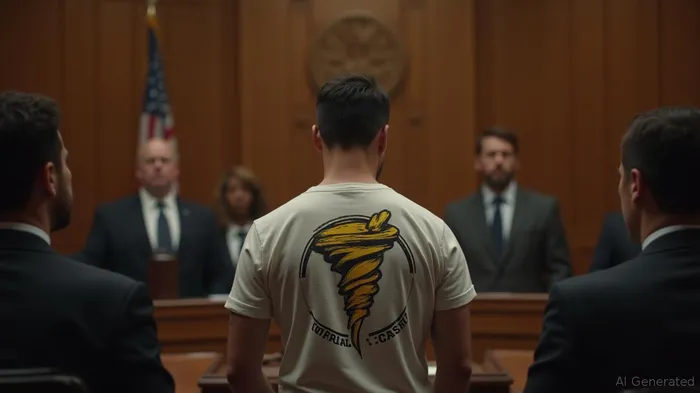
The legal saga involving Roman Storm, co-founder of the decentralized cryptocurrency mixer Tornado Cash, has taken a contentious turn as a T-shirt he wore at a 2019 crypto event has become a focal point in U.S. federal court. Prosecutors allege the T-shirt—emblazoned with the phrase “I keep my Ether clean with Tornado.cash” and depicting a washing machine—serves as evidence that Storm knowingly facilitated money laundering through the platform. Storm’s defense, however, characterizes the shirt as “a meme, a joke in poor taste,” framing it as protected expression rather than an endorsement of illicit activity. The case, unfolding in the Southern District of New York, pits the U.S. government’s aggressive stance on crypto compliance against the broader debate over the legal boundaries of decentralized technologies [1].
The T-shirt, showcased in a video from the 2019 ETHBoston event, has been scrutinized for its imagery and messaging. Assistant U.S. Attorney Kevin Mosley emphasized in court that the shirt symbolized a “giant washing machine for dirty money,” suggesting Storm’s awareness of Tornado Cash’s role in laundering funds for cybercriminals. The prosecution’s argument hinges on the premise that the platform’s design inherently enables financial crime, with the T-shirt serving as a visual acknowledgment of that intent. Storm’s lawyers, meanwhile, have sought to reframe the artifact, arguing it was a satirical take on the platform’s technical function rather than a celebration of wrongdoing. They reiterated this defense during arguments against a motion to exclude evidence related to hackers using Tornado Cash [1].
The case raises complex questions about developer liability in the decentralized finance (DeFi) space. Tornado Cash, designed to anonymize cryptocurrency transactions by randomizing transaction paths, has been linked to ransomware attacks and sanctions violations. Prosecutors contend that its creators are complicit in the misuse of their tool, while the defense asserts that developers cannot be held responsible for users’ actions. A spokesperson for the Golem Foundation, which supported Storm’s defense, criticized the prosecution’s approach as akin to blaming app developers for crimes committed by third parties. This tension between technological utility and regulatory accountability is central to the trial, with potential implications for how courts define the legal obligations of open-source software creators [1].
The T-shirt’s significance extends beyond the courtroom, reflecting broader cultural and legal challenges in the crypto ecosystem. Memes and digital symbols often serve as shorthand for community identity in decentralized projects, but their use in legal contexts complicates distinctions between expression and complicity. The prosecution’s focus on the shirt’s design underscores the difficulty of adjudicating cases involving tools with dual-use potential—those that can protect privacy for legitimate users while also attracting malicious actors. If the defense succeeds in framing the T-shirt as a protected form of speech, it could embolden developers to argue that their tools are immune to liability for misuse. Conversely, a conviction could establish a precedent reinforcing the principle that creators bear responsibility for foreseeable criminal applications of their technologies [1].
As the trial progresses, the outcome will likely influence regulatory approaches to privacy-focused crypto platforms. A ruling in favor of the prosecution could prompt stricter enforcement of anti-money laundering (AML) and know-your-customer (KYC) regulations, while a defense victory might encourage more lenient interpretations of developer accountability. The case also highlights the challenges regulators face in balancing innovation with crime prevention, particularly as decentralized technologies evolve beyond traditional financial systems. For now, the jury and Judge Katherine Failla must determine whether the T-shirt represents a harmless jest or a tacit acknowledgment of Tornado Cash’s role in facilitating financial crime. Storm, who has opted not to testify, faces charges of money laundering, conspiracy to operate an unlicensed money transmitter, and sanctions violations [1].
[1] Cointelegraph, “Tornado Cash T-Shirt Stirs Controversy In Court,” July 20, 2025 (https://cointelegraph.com/news/tornado-cash-roman-storm-shirt-court)

Stay ahead of the market.
Get curated U.S. market news, insights and key dates delivered to your inbox.


AInvest
PRO
AInvest
PRO



Comments
No comments yet