
ProFrac's Q3 2025: Contradictions Emerge on Pricing Strategy, Customer Engagement, and Fleet Dedication
 Aime Summary
Date of Call: November 10, 2025
Financials Results
- Revenue: $403M, down from $502M in Q2 2025
Guidance:
- 2025 cash CapEx expected $160M to $190M (midpoint reduced ~$25M from prior guidance).
- $100M of annualized cash savings targeted by end of Q2 2026 (allocated: $35M–$45M labor, $30M–$40M nonlabor, $20M–$30M CapEx).
- Liquidity actions: completed ~ $79M equity net proceeds and $40M Flotek seller note sale; expect remaining $40M of 2029 senior notes in December and pursuing up to $40M additional debt (up to ~$200M incremental capital possible).
- Expect market stabilization and potential demand improvement in 2026 driven by natural gas fundamentals.
Business Commentary:
* Market Volatility and Strategic Adjustments: - ProFrac experiencedmarket volatility in Q3, with customers implementing project delays and deferrals, resulting in white space issues that impacted operational efficiency. - The company responded by prioritizing dedicated fleets and focusing on more robust, less volatile programs, aiming to optimize their cost structure. - This strategic shift is expected to improve efficiency and enhance control over operations, contributing to a sustainable business model.- Cost Management and Savings Initiatives:
- ProFrac identified initial COGS, SG&A, and capital expenditure savings of
$100 millionat the midpoint on an annualized basis by the end of Q2 2026. - Savings were comprised of
$35 million to $45 millionfrom both COGS and SG&A labor reductions and an additional$30 million to $40 millionacross nonlabor items. The company believes these measures will position it for long-term value creation and reduce the need for additional capital raises.
Revenue and Profitability Trends:
- ProFrac reported
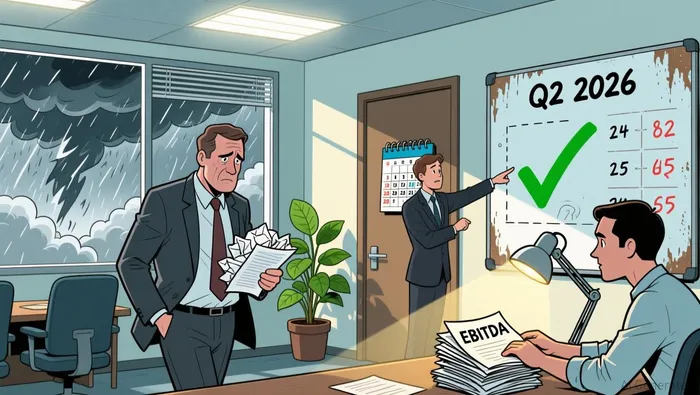
revenuesof$403 millionand an adjusted EBITDA of$41 millionin Q3, compared to$502 millionand$79 millionrespectively in Q2. - Revenue and profitability were impacted by a reduction in fleet count and increased white space, leading to operational inefficiencies.
- The company focused on maintaining a mid-20s fleet count and improving utilization to enhance profitability, despite lower pricing.
- Proppant Production and Strategic Focus:
- The Proppant Production segment generated
$76 millionin revenues in Q3, effectively flat from Q2, with approximately44%of volumes sold to third-party customers. - The company aims to capitalize on opportunities in regions like the Haynesville and South Texas, where throughput improvements and natural gas demand are expected to drive improved performance.

Sentiment Analysis:
Overall Tone: Neutral
- Management emphasized operational adjustments and liquidity actions: "we are adjusting our strategy to build a sustainable, resilient business model" and identified "$100 million of structural cash savings." They also noted Q3 weakness (revenues $403M vs $502M Q2) while outlining cost, capital and technology levers to position for 2026.
Q&A:
- Question from Stephen Gengaro (Stifel, Nicolaus & Company): How do you approach pricing amidst aggressive spot competition and what are you seeing in the market?
Response: Focus on reliable, dedicated programs over chasing spot; expect spot pricing to normalize and likely recover in 2026, but won't pursue spot unless pricing and reliability are materially improved.
- Question from Stephen Gengaro (Stifel, Nicolaus & Company): How do you reconcile flat/softer pricing and lower fleet counts with expectations for improved profitability?
Response: Profitability gains will come from tighter cost controls, consistent fleet counts, higher utilization and operating leverage rather than higher horsepower rates.
- Question from John Daniel (Daniel Energy Partners, LLC): What portion of your mid-20s active fleets are dedicated today?
Response: Approximately 80% dedicated today, targeting the high-90s percentage as we progress into 2026.
- Question from John Daniel (Daniel Energy Partners, LLC): Were the September 'head fakes' mainly spot work and did that prompt your reassessment?
Response: Mostly spot-driven delays plus some well issues; many programs delayed in September restarted in October, prompting a shift toward more dependable, dedicated work.
- Question from John Daniel (Daniel Energy Partners, LLC): What level of spot pricing/reliability would make you revisit adding spot mix?
Response: Would require materially higher and more reliable spot pricing and utilization; only if economics justify added fleets/employees and reliability improves—likely reconsidered in 2026.
- Question from John Daniel (Daniel Energy Partners, LLC): Are the cost cuts permanent/sustainable if activity steadies?
Response: Yes—management characterized the cuts as sustainable, based on historical benchmarking and rightsizing headcount, maintenance cycles and processes.
- Question from John Daniel (Daniel Energy Partners, LLC): Customer interest in continuous pumping—what are you seeing and what does it entail?
Response: Interest exists; continuous pumping can deliver benefits but requires more horsepower, planned maintenance windows and tailored operator solutions—benefits can outweigh costs for some operators.
- Question from Daniel Kutz (Morgan Stanley): On Proppant Production, are higher volumes internal or external and do you expect flat Q4 revenues?
Response: Q3 mix shifted toward West Texas (lower ASP); Q4 and 2026 improvement expected from increased volumes in South Texas and Haynesville which should boost ASP and revenues.
- Question from Daniel Kutz (Morgan Stanley): How much of Q4 profit improvement is driven by cost-outs and segment breakdown?
Response: Most cost-out impact is in Stimulation Services; Proppant segment improvements will be driven primarily by operating leverage and rising utilization rather than major incremental cost cuts.
- Question from Daniel Kutz (Morgan Stanley): Where is frac nameplate capacity and tech mix trending (e‑frac, dual fuel, attrition)?
Response: Premium e-fleets and dual-fuel units show highest demand and utilization; new e-frac builds paused, doing Tier 4 upgrades, and full uptake of premium platforms anticipated into 2026.
- Question from Donald Crist (Johnson Rice): What are customer conversations around Haynesville heading into 2026?
Response: Strong, growing interest and increased operator activity; management expects a good start to 2026 with programs becoming stickier as LNG-driven gas demand supports activity.
- Question from Donald Crist (Johnson Rice): Have you considered selling Flotek shares to improve liquidity and share price?
Response: They evaluate assets regularly, view Flotek as high potential, but are cautious about disposition timing and execution to avoid negative market perception of continued selling.
Contradiction Point 1
Market Behavior and Pricing Strategy
It reflects a change in the company's approach to market conditions and pricing strategy, which could impact investor expectations and competitive positioning.
How does ProFrac price its services and assess market trends? - Stephen Gengaro (Stifel, Nicolaus & Co., Inc.)
2025Q3: ProFrac maintains consistent pricing between spot and committed programs. As market conditions improve, spot pricing should return to higher levels. The focus is on reliable, consistent programs rather than aggressive spot pricing. - Matthew Wilks(Executive Chairman & President)
Will pricing become more attractive to operators given the tight labor and frac crew demand, and potential shortages of skilled workers by 2026? - John Daniel (Daniel Energy)
2025Q2: We maintain a consistent pricing -- between committed programs and spot work. And then as we move into 2026, if the market conditions do improve, which we're optimistic about, we'll certainly look to take advantage of that higher spot pricing. - Matthew Wilks(Executive Chairman)
Contradiction Point 2
Customer Engagement and Activity Levels
It involves differing descriptions of customer engagement and activity levels, which could impact future sales projections and operational planning.
What prompted the reassessment of your strategy? - John Daniel (Daniel Energy Partners)
2025Q3: We're seeing a lot more engagement around the 2026 programs for operators. - Matthew Wilks(Executive Chairman & President)
Is engagement higher than current activity levels? Or can you elaborate further on their requests? - John Daniel (Daniel Energy)
2025Q2: We're seeing a lot more engagement around the 2026 programs for operators. We saw a pretty sharp drop off after Liberation Day. And since then, a lot of the operators that have slowed activity have started coming back, looking at what they need to do to bring some of them back. - Matthew Wilks(Executive Chairman)
Contradiction Point 3
Proppant Production and Cost Out Initiatives
It reflects differing expectations for cost savings and operational efficiencies, which could impact financial projections and operational strategies.
How much do cost-out initiatives drive 4Q profit improvements in Proppant Production? - Daniel Kutz (Morgan Stanley)
2025Q3: Most cost-out improvements are in Stimulation Services, with Proppant Production benefiting from increased utilization and operating leverage. - Matthew Wilks(Executive Chairman & President)
Will you maintain 2023's strong Proppant Production growth into 2025? Do you expect improvement? How does this impact Stimulation Services? - Donald Crist (Johnson Rice)
2025Q2: We expect full year 2025 results to include higher margins for both segments, with lower costs and higher utilization expected at Proppant Production. - Matthew Wilks(Executive Chairman)
Contradiction Point 4
Spot Market Pricing Strategy
It highlights a shift in ProFrac's pricing strategy, potentially impacting profitability and market positioning.
How does ProFrac approach pricing, and what market trends are you observing? - Stephen Gengaro (Stifel, Nicolaus & Co., Inc.)
2025Q3: ProFrac maintains consistent pricing between spot and committed programs. As market conditions improve, spot pricing should return to higher levels. The focus is on reliable, consistent programs rather than aggressive spot pricing. - Matthew Wilks(CEO)
Can you discuss pricing dynamics in Haynesville compared to West Texas and expected balancing effects? - Alec Scheibelhoffer (Stifel)
2025Q1: ProFrac has always been a spot buyer and a committed buyer but our pricing is consistent between the two. I think the key for us is, we're focused on spot business and that's going to be our focus going forward. - Matt Wilks(CEO)
Contradiction Point 5
Fleet Strategy and Dedication
It involves changes in fleet strategy and dedication levels, which directly impact operational efficiency and revenue projections.
What portion of your fleet is currently dedicated? - John Daniel (Daniel Energy Partners)
2025Q3: About 80% of the fleet count is dedicated, with expectations to shift to the high 90s by 2026. - Matthew Wilks(CEO)
How is the pressure pumping business performing, and what's the outlook? - Ladd Wilks (ProFrac Holding Corp.)
2024Q4: We expect that the majority of our e-fleets and next-gen gas burning fleets will now be dedicated beginning in January.....We have two e-fleets that are currently dedicated today and four fleets of next-gen gas burning fleets dedicated. - Ladd Wilks(CEO)

Discover what executives don't want to reveal in conference calls
Latest Articles
Stay ahead of the market.
Get curated U.S. market news, insights and key dates delivered to your inbox.
AInvest
PRO
AInvest
PRO



Comments
No comments yet