
The Productivity Tech Boom: Riding Demand, Navigating Regulation
The global workplace productivity software market is in the midst of an extraordinary expansion, fueled by the remote work revolution and rapid advances in AI. By 2025, the sector is projected to hit $75.5 billion, growing at a 16.3% CAGR, with AI-driven tools now enabling everything from real-time project management to automated fraud detection. Yet behind this boom lies a critical challenge: regulatory and ethical risks stemming from invasive employee monitoring practices. For investors, the path to profit lies not in chasing every surveillance tool, but in backing firms that balance innovation with privacy-first frameworks and diversified revenue streams.
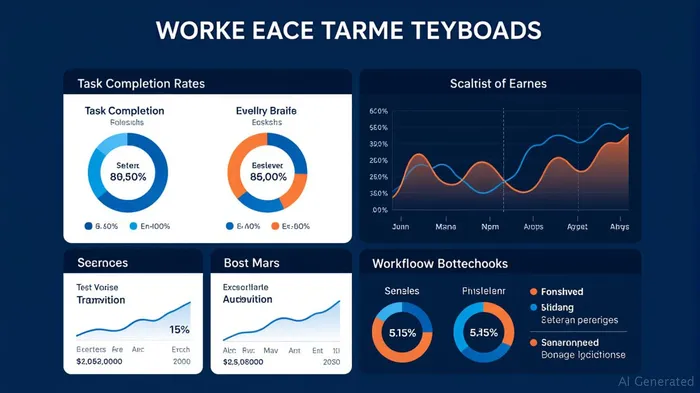
The Surge in Adoption: Remote Work and AI Innovation
The shift to hybrid work has been a catalyst for productivity tracking adoption. With 16% of British workers fully remote and 28% in hybrid roles, companies are deploying tools like MicrosoftMSFT-- Teams and Salesforce's Agentforce to manage distributed teams. AI's role is transformative: 13% of employees already use generative AI for over 30% of their daily tasks, while 47% expect to reach that threshold within a year.
The technology itself is advancing rapidly. Multimodal AI tools—like Google's Gemini Live (processing audio, text, and video) and OpenAI's Sora (generating video content)—are expanding beyond simple task tracking to support creative and analytical workflows. Meanwhile, specialized chips (GPUs/TPUs) are enabling real-time applications, such as AI chatbots that autonomously handle customer service tasks.
Microsoft's stock performance exemplifies this sector's growth. Its productivity suite—Microsoft 365—now integrates AI-driven collaboration tools, task management, and security features, reflecting the demand for holistic solutions.
The Regulatory Crossroads: Privacy and Ethical Concerns
Yet this boom is not without growing pains. Half of employees express worries about AI inaccuracies and cybersecurity risks, while regulators are tightening the screws. The EU is considering new labor laws to limit invasive monitoring, requiring explicit consent for tracking tools. GDPR compliance alone costs companies an average of $1.2 million annually, and fines for non-compliance can reach 4% of global revenue.
Firms relying on surveillance-heavy models—such as keystroke logging or screen-capture software—are particularly vulnerable. A 2024 survey found that 48% of employees would refuse jobs at companies using such tools, signaling a potential talent retention crisis.
Navigating the Landscape: Where to Invest
Investors should prioritize companies that:
1. Prioritize privacy-first design: Look for firms with GDPR/CCPA certifications and tools that anonymize data or allow opt-outs.
2. Diversify beyond surveillance: Seek companies with revenue streams in collaborative platforms (e.g., Asana's project management), AI training (e.g., IBM's SkillsBuild), or security solutions (e.g., Microsoft's Azure Sentinel).
3. Focus on ethical AI: Companies like SalesforceCRM--, which embeds bias audits into its Einstein Analytics tools, are better positioned to avoid regulatory backlash.
Leading contenders include:
- Microsoft: Its cloud-based, AI-integrated productivity stack offers a broad portfolio with strong compliance infrastructure.
- Notion Labs: Its flexible workspace platform avoids invasive tracking, relying instead on user-driven organization and collaboration tools.
- eProductivity Software: Post-acquisition of EPMS, it now offers print management solutions alongside productivity tracking, reducing reliance on a single revenue stream.
The Bottom Line
The productivity tech sector is a growth engine, but its trajectory hinges on navigating regulatory headwinds. Investors who focus on firms with robust data governance and diversified business models will be best positioned to capitalize on the $136.9 billion market expected by 2029. The winners will be those that treat employee privacy not as a compliance checkbox, but as a strategic advantage in an era where trust is the ultimate productivity metric.
Final Note: Monitor the EU's proposed workplace monitoring regulations (expected Q4 2025) as a key inflection pointIPCX-- for sector valuations.

Delivering real-time insights and analysis on emerging financial trends and market movements.
Latest Articles
Stay ahead of the market.
Get curated U.S. market news, insights and key dates delivered to your inbox.




Comments
No comments yet