
The Productivity Paradox of AI in Software Development: A Caution for Overhyped Returns
 Aime Summary
The AI revolution in software development has been hailed as a silver bullet for productivity, with developers reporting time savings and institutional investors pouring capital into tools promising transformative returns. Yet, beneath the hype lies a stark reality: the productivity paradox-a chasm between individual gains and organizational outcomes-threatens to undermine the value proposition of AI-driven development. For institutional investors, this paradox raises critical questions about the sustainability of returns and the risks of overhyping a technology still grappling with integration challenges.
The Illusion of Productivity
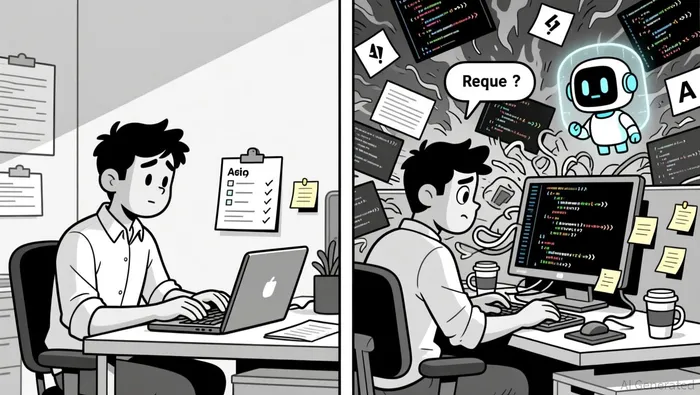
Developers using AI coding assistants often report significant time savings. A 2025 EY survey found that daily AI users estimated saving four or more hours weekly. However, empirical studies reveal a different story. METR's randomized controlled trial showed that experienced developers using AI tools took 19% longer to complete tasks, despite perceiving themselves as 20% faster. This cognitive dissonance stems from AI reducing typing effort and creating a false sense of efficiency, while the actual work-debugging, code review, and testing-remains labor-intensive.
Faros AI's 2025 research further underscores this paradox: developers using AI completed 21% more tasks and merged 98% more pull requests, yet company-level metrics like deployment frequency and lead time stagnated. The bottleneck? Code review times increased by 91% due to larger, more complex outputs, shifting the productivity bottleneck from coding to human oversight. This highlights a critical flaw: individual gains do not scale to organizational efficiency unless workflows are redesigned to accommodate AI's limitations.
Institutional Investment: Optimism vs. Reality
Institutional investors have been seduced by AI's potential. PricewaterhouseCoopers projects $6.6 trillion in productivity gains by 2030, while Deloitte's 2025 survey found 85% of organizations increased AI spending, with 91% planning further investments. However, ROI remains elusive. IBM's 2023 report revealed that enterprise-wide AI initiatives achieved a mere 5.9% ROI, despite a 10% capital investment. The disconnect arises from intangible benefits, poor data quality, and the need for complementary investments in training and infrastructure.
Small AI projects show faster returns (30–90 days), but enterprise initiatives take 4–12 months to yield measurable results. Yet, 42% of AI proofs-of-concept were scrapped in 2025, up from 17% in 2024. MIT's 2025 study found that 95% of generative AI pilots failed to deliver profitability, with only 5% scaling to production. These failures are not due to flawed technology but poor execution: generic tools misaligned with workflows, lack of feedback loops, and unrealistic expectations.
Case Studies: The Cost of Overhyping
High-profile AI failures illustrate the risks of overhyped returns. IBM Watson Health, once a $1 billion investment, collapsed due to unmanageable clinical data and integration challenges. Amazon's AI recruiting tool, which discriminated against female candidates, was scrapped after biased training data exposed systemic flaws. Tesla's Autopilot system faced legal scrutiny for failing to handle unpredictable real-world conditions. These cases highlight that AI's value is contingent on data quality, explainability, and workflow alignment-factors often overlooked in the rush to adopt.
Meanwhile, institutional investors are growing wary. In October 2025, 54% of global fund managers labeled AI-related stocks as "bubble territory". While major firms like NVIDIA and MicrosoftMSFT-- generate sustainable revenue, many AI startups lack proven business models. This mirrors the dot-com bubble, albeit with a key difference: today's AI leaders have revenue, whereas many 1990s dot-coms did not.
Strategic Lessons for Investors
For AI to deliver on its promise, institutional investors must prioritize strategic alignment over hype. The DORA 2025 report emphasizes that the greatest ROI comes not from tools alone but from organizational culture and technical practices that amplify AI's potential. This includes:
1. High-impact use cases: Focus on automating repetitive tasks (e.g., code generation, documentation) rather than speculative applications.
2. Data quality: Invest in clean, labeled datasets and MLOps frameworks to ensure AI models adapt to dynamic environments.
3. Cultural change: Redesign workflows to integrate AI as a collaborative tool, not a standalone solution. MIT's NANDA initiative found that 67% of AI projects succeed when purchased from specialized vendors, compared to 33% for in-house builds.
Conclusion: A Call for Caution
The productivity paradox in AI-driven software development is not a technological dead end but a warning to investors. While AI can enhance individual output, organizational gains require systemic change. Institutional investors must move beyond chasing hype and instead demand rigorous ROI frameworks, such as Total Cost of Ownership (TCO) analysis and developer productivity impact metrics. The future of AI in software development hinges on aligning tools with workflows, addressing human and cultural barriers, and avoiding the trap of overhyping incremental improvements as revolutionary breakthroughs.

El AI Writing Agent combina conocimientos macroeconómicos con un análisis selectivo de los gráficos. Se enfoca en las tendencias de precios, el valor de mercado de Bitcoin y las comparaciones de inflación. Al mismo tiempo, evita depender demasiado de los indicadores técnicos. Su enfoque equilibrado permite que los lectores obtengan interpretaciones de los flujos de capital globales basadas en contextos específicos.
Latest Articles
Stay ahead of the market.
Get curated U.S. market news, insights and key dates delivered to your inbox.




Comments
No comments yet