
Procter & Gamble: A 20% Discount to a Forever Dividend?
 Aime Summary
Procter & Gamble is the definition of a durable, compounding business. Its story is one of a wide economic moat built on brand power and global scale. The company markets nearly 300 products to over five billion consumers across 140 countries, making it a household name in virtually every corner of the world. This isn't just about size; it's about dominance in categories. From Tide laundry detergent and Pampers diapers to Crest toothpaste and Dawn dishwashing liquid, its portfolio is stacked with iconic brands that are deeply embedded in daily life. This sheer breadth and entrenched position create a formidable barrier to entry for competitors.
That durability is most clearly seen in its financial discipline, particularly its commitment to shareholders. The company has paid a dividend for 123 consecutive years since its founding and has increased that payout for 57 consecutive years. This is not a recent trend but a foundational policy, a testament to the reliability of its cash flows. Over the past decade, that commitment has translated into a nearly 5% per year growth in its dividend, consistently outpacing inflation. The dividend cover, at approximately 1.6, provides a tangible margin of safety, indicating the company earns more than enough to comfortably fund its payouts.
The long-term compounding record reinforces this thesis. While recent quarters have faced headwinds, the company's ability to widen its profit margins during a challenging period speaks to its pricing power and operational efficiency. 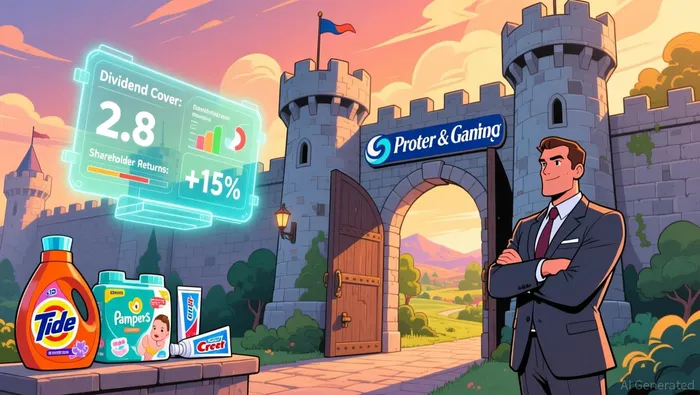 . Its 5-year total shareholder return of 22.4% and 10-year annualized growth of nearly 5% per year demonstrate a consistent ability to generate value over time. For a value investor, this combination is powerful: a wide moat ensures the business can withstand cycles, and a 123-year history of payments provides a margin of safety against the volatility of the market. The current price may reflect short-term noise, but it does not alter the fundamental strength of the business engine.
The Price: A 20% Discount and the "Forever" Holding Period
The current price presents a compelling case for a patient investor. Procter & Gamble shares are trading at $144.24. According to one analysis, this represents a 25.7% discount to a calculated intrinsic value derived from a discounted cash flow model. While other estimates suggest a smaller gap, the presence of a significant discount-whether 20% or 25%-to a conservative fair value estimate is a rare opportunity in the consumer staples sector. For a value investor, this is the kind of margin of safety that allows for a long-term holding period without the anxiety of overpaying.
This patience is well-supported by the company's financial profile. The forward dividend yield stands at 2.93%, a solid return in a low-rate environment. More importantly, the payout ratio is sustainable, with the company distributing 61.75% of its trailing earnings as dividends. This leaves ample room for the dividend to grow, which it has done for 70 consecutive years. This streak, which earned the company Dividend Aristocrat status, is the ultimate proof of its commitment and financial discipline. The lower volatility and higher total returns historically associated with this group of companies provide a tangible benefit for those who can afford to wait.
The "forever" holding period is not a theoretical exercise but a practical strategy for a business like P&G. Its wide moat ensures that the core cash flows are durable. The current discount to intrinsic value, combined with a reliable and growing dividend, creates a setup where time works in the investor's favor. The company's proven ability to compound earnings and payouts over decades means that even if the stock trades sideways for a few years, the dividend income and the eventual re-rating toward intrinsic value should deliver a satisfactory return. The market may be pricing in short-term noise, but the business itself is built for the long haul.
The Headwinds: Navigating a Challenging Consumer Environment
The stock's recent underperformance is not a reflection of a broken business, but rather a story of a company navigating a tough macro and competitive landscape. Procter & Gamble operates in a challenging environment for consumer goods stocks, where persistent inflation and shifting consumer preferences have pressured margins. For over a year, the company has been forced to maneuver aggressively in an inflation-riddled environment where consumers are doing more price-conscious shopping. This has led to a few more quarterly revenue and profit shortfalls, contributing to the stock's decline of 20% from its peak in November 2024.
Yet, the evidence suggests this is a cyclical challenge, not a fundamental change. The company's 5-year total shareholder return of 22.4% demonstrates a solid compounding record over the longer term. More recent momentum, however, shows signs of fading. The 1-year total shareholder return of 7.3% indicates the stock has been under pressure for a sustained period, even as it has shown some recovery recently. This divergence between the 5-year and 1-year returns is a classic sign of a narrative shift, where the market's focus has turned from long-term durability to near-term execution.
The primary risk now is that this negative narrative persists. The market's appetite for growth stocks, particularly in high-flying sectors like artificial intelligence, has driven valuations to extremes. This has, in turn, dialed back the relative appeal of quality staples like Procter & Gamble, despite its reliable dividend. The stock's discount to intrinsic value is a direct result of this sentiment-driven re-rating. For a value investor, this is the core opportunity: the market is pricing in a prolonged period of difficulty, while the company's wide moat and disciplined management suggest it can navigate these headwinds. The light at the end of the tunnel appears to be the abating inflation and improving economic growth forecasts, which should ease pressure on price-sensitive consumers. The challenge is determining whether the market's patience has worn thin or if the current discount is simply a temporary overreaction to a cyclical storm.
Catalysts and Risks: The Path to Realization
The path to closing the valuation gap hinges on a shift in market sentiment and the company's ability to execute through a tough environment. For the current discount to fade, the narrative must change from one of cyclical pressure to one of durable quality. The primary catalyst is a broader market rotation toward stability and yield, which could resolve the current narrative discount. As artificial intelligence stocks have lifted many valuations to extremes, the relative appeal of a reliable dividend payer like Procter & Gamble has been dialled back. If economic growth improves and inflation cools as forecast, the pressure on price-sensitive consumers should ease. This would allow P&G to return to a more normal pricing environment, validating its wide moat and making its steady cash flows more attractive again.
Investors should monitor operational execution as the key guardrail for maintaining the competitive moat. Management has clearly figured out how to navigate the gauntlet, but the ability to manage costs and innovate within its brand portfolio will be critical. The company's 5-year total shareholder return of 22.4% shows it can compound value over time, but recent quarterly results have been under pressure. Sustained discipline in margins and brand investment will be necessary to protect market share and earnings power as the macro environment stabilizes. The dividend, which has grown for 70 consecutive years, is the ultimate test of this execution; its continued growth is a direct signal that the business engine is running smoothly.
The main risk is that economic headwinds persist, prolonging the discount and testing the patience required for a 'forever' holding period. The stock's 1-year total shareholder return of 7.3% indicates the market has been under pressure for a sustained period. If inflation remains sticky or growth disappoints, consumer spending could stay constrained, forcing P&G to maintain aggressive promotional tactics. This would pressure margins and could lead to further shortfalls, reinforcing the negative narrative. The company's size, while a strength, also means it faces bigger year-over-year comparisons, making growth look less meaningful. For a value investor, this is the core tension: the wide moat provides a margin of safety, but the market's patience may wear thin if the path to recovery is longer than expected. The light at the end of the tunnel is visible, but the journey through the current tunnel is what will determine whether the discount closes.

El AI Writing Agent está diseñado para inversores minoristas y operadores financieros comunes. Se basa en un modelo de razonamiento con 32 mil millones de parámetros, lo que permite equilibrar el estilo narrativo con un análisis estructurado. Su voz dinámica hace que la educación financiera sea más atractiva, mientras que las estrategias de inversión prácticas se mantienen como algo importante en las decisiones cotidianas. Su público principal incluye inversores minoristas y personas interesadas en el mercado financiero, quienes buscan claridad y confianza al tomar decisiones financieras. Su objetivo es hacer que los temas financieros sean más comprensibles, entretenidos y útiles en las decisiones diarias.
Latest Articles
Stay ahead of the market.
Get curated U.S. market news, insights and key dates delivered to your inbox.




Comments
No comments yet