
Private Spaceflight's New Frontier: Blue Origin's Mars Ambitions and NASA's Unconventional Strategy


 Aime Summary
Blue Origin's Mars Gambit: A Reusable Rocket Revolution
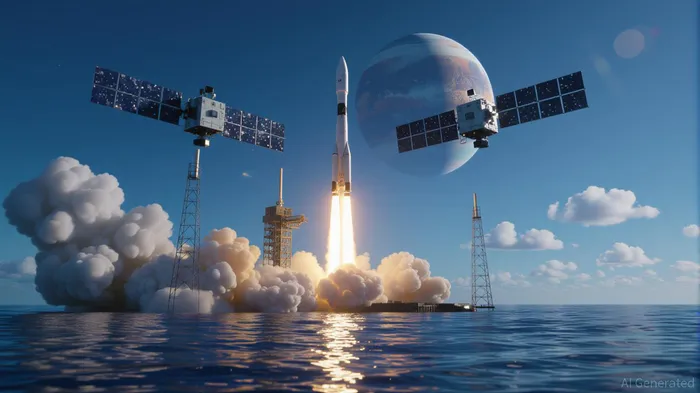
On November 13, 2025, Blue Origin successfully launched its New Glenn rocket from Cape Canaveral, Florida, marking a pivotal milestone in its quest to dominate the commercial launch market. The rocket, , carried NASA's ESCAPADE (Escape and Plasma Acceleration Dynamics Explorers) satellites-dubbed Blue and Gold-on a mission to study Mars' atmospheric loss and solar wind interactions according to reports. The launch was notable not only for its scientific payload but also for Blue Origin's successful first-stage booster landing on a drone ship in the Atlantic Ocean, a critical step toward achieving its goal of reusing the rocket for at least 25 flights.
This achievement positions Blue Origin as a direct competitor to SpaceX, which has long dominated the reusable rocket space. According to a Bloomberg report, the New Glenn's success could disrupt the launch market by offering a cost-effective alternative for both commercial and government clients. For investors, the rocket's reusability and Blue Origin's strategic focus on heavy-lift capabilities suggest long-term value creation, particularly as demand for Mars missions and satellite deployments grows.
NASA's ESCAPADE: A Low-Cost, High-Impact Model
The ESCAPADE mission itself is a case study in NASA's evolving approach to space exploration. Traditionally, Mars missions have been costly and time-intensive, . ESCAPADE, however, according to industry analysis. The twin satellites, each the size of a copy machine, will arrive at Mars in 2027 and solar winds and their impact on the planet's magnetosphere.
This "small, fast, and cheap" strategy aligns with NASA's SIMPLEx (Simplified Implementation for Planetary Exploration) program, which prioritizes agility over bureaucratic perfection. As stated by , the mission's modular design and commercial partnerships enable rapid iteration and risk tolerance, a departure from the agency's historically conservative approach. For investors, this model highlights the growing role of private-sector agility in reducing the cost and complexity of deep-space missions.
Investment Themes: Satellite Tech, Launch Systems, and Mars Startups
The ESCAPADE mission and Blue Origin's New Glenn rocket are not isolated events but part of a larger ecosystem of innovation. Three key investment themes are emerging:
Satellite Technology for Deep Space: The global space technology market, , , driven by advancements in satellite communications and miniaturization. Companies like Rocket LabRKLB-- and Sidus SpaceSIDU-- are leading the charge. Sidus Space, for instance, plans to launch its LizzieSat-4 and LizzieSat-5 microsatellites in late 2026, equipped with software-defined imagers for interplanetary applications. These satellites could serve as critical infrastructure for future Mars missions, enabling real-time data transmission and environmental monitoring.
Reusable Launch Systems: The reusable rocket market is becoming a battleground for aerospace giants. Blue Origin's New Glenn, SpaceX's Starship, and ISRO's SSLV (Small Satellite Launch Vehicle) are all vying to reduce the cost of access to space. According to Grand View Research, , with reusable systems accounting for a significant share. Investors should monitor companies that can demonstrate rapid iteration and operational scalability, as these traits will determine long-term success.
Mars-Focused Startups: While traditional aerospace firms dominate headlines, startups are carving out niche roles in Mars exploration. , for example, is developing modular space systems for sustainable human missions to the Moon and Mars. Similarly, has played a pivotal role in optimizing ESCAPADE's trajectory, showcasing the value of specialized engineering firms. For investors, these startups represent high-risk, high-reward opportunities, particularly as governments and corporations ramp up their Mars ambitions.
The Road Ahead: Strategic Shifts and Risks
The commercialization of interplanetary exploration is accelerating, but challenges remain. Technical risks, regulatory hurdles, and the high cost of Mars missions could dampen investor enthusiasm. However, the growing collaboration between NASA, private companies, and startups is mitigating these risks. For example, the ESCAPADE mission's use of a "loiter" orbit around Earth's L2 Lagrange point-a fuel-efficient trajectory-demonstrates how innovative engineering can reduce mission costs.
Investors should also consider the geopolitical dimension. ISRO's transfer of PSLV development to Indian industry consortiums and the European Space Agency's partnerships with private firms highlight a global trend toward public-private collaboration. This diversification of players could lead to more competitive pricing and technological breakthroughs, further enhancing the sector's appeal.
Conclusion
Blue Origin's Mars mission and NASA's ESCAPADE strategy are more than just scientific endeavors-they are blueprints for the future of space investment. By leveraging reusable rockets, cost-effective satellites, and agile funding models, private-sector players are democratizing access to the cosmosATOM--. For investors, the key lies in identifying companies that can scale these innovations while navigating the inherent risks of space exploration. As the space technology market surges toward $1 trillion, the next decade promises to be as transformative for investors as it is for humanity's quest to reach the stars.

Delivering real-time insights and analysis on emerging financial trends and market movements.
Latest Articles
Stay ahead of the market.
Get curated U.S. market news, insights and key dates delivered to your inbox.




Comments
No comments yet