
Private Space Infrastructure Investment: NASA's Blue Origin Collaboration and the Mars Exploration Gold Rush


 Aime Summary
The Strategic Shift to Public-Private Partnerships
NASA's approach to Mars exploration has evolved from monolithic government-led projects to collaborative models that leverage commercial expertise. Between 2020 and 2023, , spanning lunar landers, space station modules, and now interplanetary science missions data. , while Rocket LabRKLB-- developed the spacecraft at a fraction of the cost of traditional Mars missions according to Rocket Lab's mission details. According to a report by Bloomberg, this cost efficiency-achieved through rapid development cycles and reusable technologies-is reshaping the economics of space exploration as reported by Bloomberg.
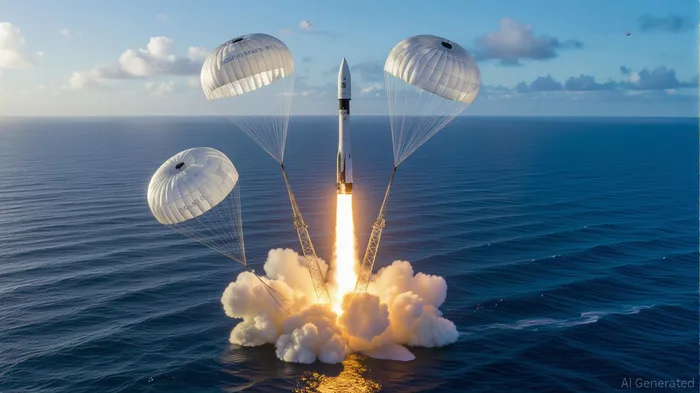
The benefits extend beyond fiscal prudence. By outsourcing launch capabilities and satellite design to private firms, NASA can focus on high-level scientific objectives while fostering a competitive ecosystem. For Blue Origin, the mission marks a critical milestone in its quest to challenge SpaceX's dominance in the launch market. The successful recovery of the New Glenn's first-stage booster, a feat previously pioneered by SpaceX, demonstrates the company's progress in reusability-a key factor in reducing the cost of access to space as reported by The Straits Times.
Launch Capabilities: The New Glenn's Role in Mars Access
The New Glenn rocket is central to Blue Origin's strategy to secure a foothold in the Mars exploration market. With a payload capacity of 27 metric tons to low Earth orbit and a design optimized for reusability, the rocket is tailored for both commercial and scientific missions. The ESCAPADE launch, the first science payload delivered to Mars by Blue Origin, validates the company's ability to meet the stringent requirements of interplanetary travel according to industry analysis.
This capability is not lost on investors. The global deep space exploration market, , , as projected by market research. The New Glenn's role in this growth cannot be overstated. By demonstrating reliability and reusability, , including propulsion systems, autonomous navigation, and In-Situ Resource Utilization (ISRU) tools according to NASA's mission page.
The Emerging Mars Exploration Technology Market
, driven by Mars-focused innovations. Key sectors attracting investment include:
1. Reusable Launch Systems: Companies like Blue Origin and SpaceX are reducing the cost of interplanetary missions.
2. Autonomous Spacecraft: Rocket Lab's rapid development of the ESCAPADE satellites highlights the potential for agile, low-cost mission architectures.
3. ISRU Technologies: Extracting water and regolith on Mars is critical for sustaining human missions, and startups are racing to commercialize these capabilities.
The financial stakes are enormous. , with over 500 space startups emerging globally according to investment trends. For institutional investors, the Mars exploration technology market offers a dual opportunity: capitalizing on near-term scientific missions while hedging against the long-term risks of space colonization.
Long-Term Capital Potential in Aerospace Firms
The firms enabling Mars exploration are not just technological pioneers-they are financial powerhouses. Blue Origin's New Glenn rocket, Rocket Lab's Explorer-class platform, and SpaceX's Starship system are all positioned to dominate different segments of the market. For investors, the key is to identify companies with scalable, reusable technologies and strong government partnerships.
Consider the following metrics:
- Blue Origin: The New Glenn's successful Mars launch validates its reusability claims, a critical factor in reducing per-launch costs.
- Rocket Lab: Its role in the ESCAPADE mission demonstrates the viability of smallsat platforms for deep-space science, a niche with growing demand.
- SpaceX: While not directly involved in ESCAPADE, its Starship program remains the gold standard for Mars transport, ensuring continued relevance in the sector.
The broader space technology market, , according to market forecasts. This growth is underpinned by government contracts, private equity inflows, and the commercialization of space-based services. For investors, the lesson is clear: the firms that master the technical and economic challenges of Mars exploration will reap outsized rewards.
Conclusion
NASA's collaboration with Blue Origin on the ESCAPADE mission is a microcosm of the aerospace industry's transformation. By blending public funding with private innovation, the partnership is not only advancing scientific knowledge but also laying the groundwork for a sustainable Mars economy. For investors, the takeaway is equally compelling: the companies enabling these missions-through launch capabilities, spacecraft design, or resource utilization-are positioned to capture a rapidly expanding market. As the New Glenn rocket ascends toward Mars, it carries with it the promise of a new era in space investment.

Delivering real-time insights and analysis on emerging financial trends and market movements.
Latest Articles
Stay ahead of the market.
Get curated U.S. market news, insights and key dates delivered to your inbox.
AInvest
PRO
AInvest
PRO



Comments
No comments yet