
Private Payroll Growth in January Well Below Estimates, ADP Reports, Posing Challenges to Overall Job Market Health
 Aime Summary
The U.S. labor market showed little momentum at the start of 2026, as private payroll growth in January fell well short of expectations, according to the latest ADPADP-- National Employment Report released Wednesday.
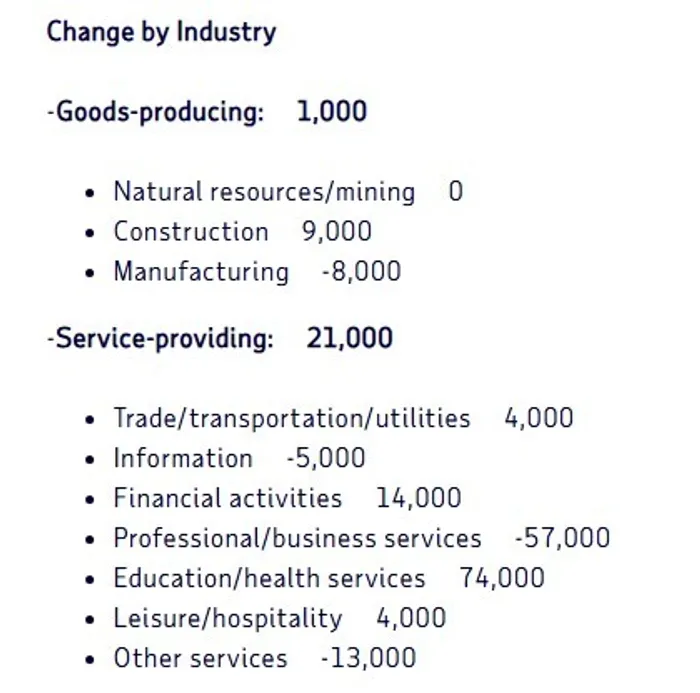
Private employers added just 22,000 jobs during the month, missing the Dow Jones consensus forecast of 45,000 and coming in below December's downwardly revised gain of 37,000. Without a sharp increase in hiring in education and health services, which added 74,000 positions, overall job growth would have been negative, underscoring the fragility of the current hiring environment.
The January figures reinforce a trend that defined much of 2025: a low-hire, low-fire labor market marked by slowing job creation but stable wage growth. ADP Chief Economist Nela Richardson noted that private employers added 398,000 jobs in 2025, a steep decline from 771,000 in 2024, extending a multiyear deceleration in employment gains even as pay growth has remained resilient.
Sector performance in January was uneven. Outside of education and health services, financial activities contributed 14,000 jobs, construction added 9,000, and both trade, transportation and utilities as well as leisure and hospitality posted gains of 4,000 each. However, several key sectors continued to shed jobs. Professional and business services saw a sharp decline of 57,000 positions, manufacturing lost 8,000 jobs, information services fell by 5,000, and the other services category dropped by 13,000. Manufacturing has now recorded job losses every month since March 2024, highlighting persistent weakness in the goods-producing side of the economy.
From a company size perspective, job creation was concentrated entirely among medium-sized firms. Businesses employing between 50 and 499 workers added a net 41,000 jobs, while small establishments were flat overall and large employers cut 18,000 positions. Firms with 1 to 19 employees added 30,000 jobs, but those with 20 to 49 workers lost an equal number, offsetting gains at the smaller end.
Regionally, employment gains were led by the Midwest, which added 25,000 jobs, and the Northeast, which saw an increase of 17,000. In contrast, the South recorded a net loss of 10,000 jobs, driven largely by a steep decline in the South Atlantic region, while the West lost 11,000 positions as hiring weakened in the Pacific states.
Despite the soft hiring backdrop, wage growth remained stable. Pay for job-stayers rose 4.5 percent year over year in January, unchanged from December. Job-changers saw annualized pay growth slow slightly to 6.4 percent from 6.6 percent. Wage gains were strongest at large firms, where job-stayers experienced 5.0 percent growth, while workers at the smallest firms saw more modest increases.
The ADP report, based on anonymized payroll data from more than 26 million private-sector employees, typically serves as a precursor to the more closely watched nonfarm payrolls report from the Bureau of Labor Statistics. However, the January BLS employment report, originally scheduled for release on February 6, has been delayed due to a partial government shutdown.

Crypto market researcher and content strategist with 3 years of experience in digital asset analysis and market commentary. Skilled at transforming complex blockchain data and trading signals into clear, actionable insights for investors. Experienced in covering Bitcoin, Ethereum, and emerging ecosystems including DeFi, Layer2, and AI-related projects. Passionate about bridging professional market research with accessible storytelling to empower readers and investors in the fast-evolving crypto landscape.
Latest Articles
Stay ahead of the market.
Get curated U.S. market news, insights and key dates delivered to your inbox.


AInvest
PRO
AInvest
PRO



Comments
No comments yet