
U.S. Private Nonfarm Payrolls Signal Sectoral Divergence: Navigating Rotation Opportunities in a Fragmented Labor Market
 Aime Summary
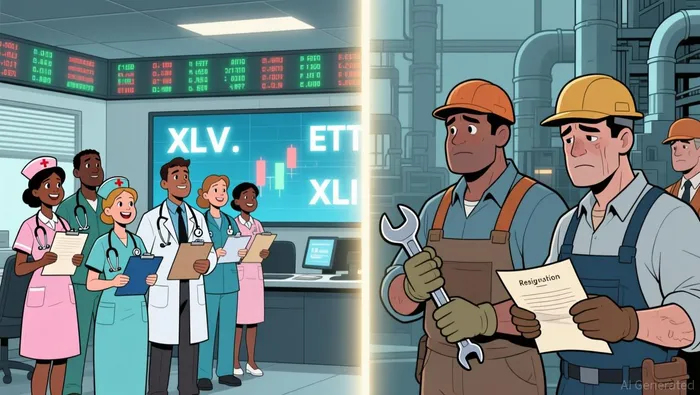
The U.S. labor market in August 2025 painted a picture of stark contrasts. While total nonfarm payrolls rose by a modest 22,000 jobs—well below the 75,000 forecast—the report underscored a growing divergence between sectors. Healthcare emerged as a beacon of resilience, adding 31,000 jobs, while manufacturing and federal government employment crumbled. This fragmentation has created fertile ground for investors to exploit sector rotation strategies, capitalizing on the uneven recovery and policy-driven shifts in demand.
The Healthcare Surge: A Structural Tailwind
Healthcare's performance in August was not merely cyclical but structural. The sector added 31,000 jobs, driven by ambulatory services, nursing facilities, and hospitals. While this fell short of the 12-month average of 42,000, it highlighted the sector's durability amid broader economic headwinds. The aging population, rising demand for social assistance, and a post-pandemic healthcare infrastructure boom have cemented healthcare as a long-term growth engine.
For investors, this translates to a clear signal: rotate into healthcare ETFs like XLV (Health Care Select Sector SPDR). The sector's ability to absorb labor market volatility—unlike manufacturing or government—makes it a defensive play in a slowing economy. XLV's exposure to pharmaceuticals (30%) and healthcare services (22%) aligns with the sector's job gains and long-term demographic tailwinds.
The Government and Manufacturing Dilemma: Policy-Driven Weakness
The federal government's 15,000-job loss in August marked a continuation of a 97,000-job decline since January 2025, driven by White House-led spending cuts. Meanwhile, manufacturing shed 12,000 jobs, with strike activity and tariff uncertainty exacerbating the downturn. These sectors are not merely cyclical casualties but victims of structural policy shifts.
The Industrial Select Sector SPDR (XLI), which tracks manufacturing and industrial firms, has seen underperformance since August. Investors should avoid overexposure to XLI, as trade policy risks and labor shortages persist. The sector's 12-month job loss of 78,000 underscores its fragility.
The Fed's Dilemma and Market Implications
The August data reinforced expectations of a Federal Reserve rate cut, with the CME FedWatch tool pricing in a 99% probability of a 25-basis-point reduction by September. A dovish Fed environment typically favors sectors with high sensitivity to lower borrowing costs, such as healthcare and consumer discretionary, while penalizing cash-heavy sectors like utilities and industrials.
The unemployment rate rising to 4.3% and average hourly earnings up 0.3% further signal a labor market in transition. While wage growth remains contained, the risk of inflationary pressures from tariffs looms. Investors should monitor the 10-year Treasury yield as a proxy for Fed policy and market sentiment.
Strategic Rotation: From Vulnerable to Resilient
The August payroll report is a call to action for investors to rebalance portfolios toward sectors with structural growth and away from those facing policy-driven headwinds. Here's how to position:
- Overweight Healthcare (XLV): The sector's job gains and demographic tailwinds justify a higher allocation. Look for ETFs with exposure to innovation-driven firms (e.g., biotech) and services (e.g., hospitals).
- Underweight Government and Industrial Sectors (XLI): These sectors face prolonged weakness. Consider hedging with short-term Treasury bonds or defensive utilities.
- Monitor Trade-Exposed Sectors: While transportation and warehousing added 4,000 jobs, broader trade-exposed industries like wholesale trade (-12,000) remain vulnerable. Use sector-specific ETFs like IYT (Industrials Select Sector SPDR) to selectively rotate in/out.
Conclusion: A Market of Contrasts
The August 2025 payroll report is a microcosm of a broader economic story: a labor market where healthcare thrives while government and manufacturing falter. For investors, this divergence is an opportunity. By rotating into sectors with structural resilience and avoiding those mired in policy-driven decline, portfolios can navigate the fragmented landscape with precision. The key is to act swiftly—before the Fed's rate cuts and sectoral shifts become fully priced into the market.

Stay ahead of the market.
Get curated U.S. market news, insights and key dates delivered to your inbox.
AInvest
PRO
AInvest
PRO



Comments
No comments yet