
Private Credit's Rising Tide: Wealthy Investors Drive a New Wave of Alternative Lending


 Aime Summary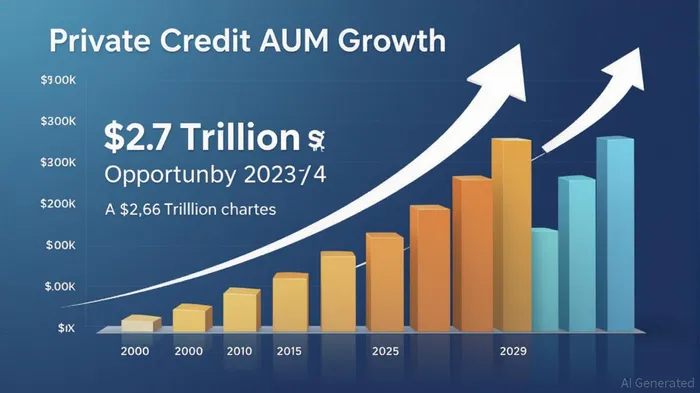
The private credit market is no longer a niche corner of the alternative asset universe—it’s a $1.7 trillion juggernaut in 2025, with projections to hit $2.6 trillion by 2029 [1]. This surge, fueled by institutional and ultra-high-net-worth investors, reflects a seismic shift in how capital is allocated. But as the tide rises, investors must ask: Is this a golden opportunity or a ticking time bomb?
The Allure of Private Credit: Yields, Resilience, and Innovation
Private credit’s appeal lies in its ability to deliver high yields in a low-interest-rate environment. With the public high-yield bond market saturated and bank lending constrained by regulatory hurdles, private credit has stepped in to fill the gap. Direct lending, which now accounts for 50% of new investor allocations, offers tailored financing to middle-market companies, often with better covenants and faster execution than traditional banks [2]. Specialty finance and opportunistic strategies—like asset-based lending and royalty financing—are also gaining traction, capturing 18% of mandates in 2024 [3].
The sector’s resilience is another draw. Even amid macroeconomic headwinds—trade policy tensions, inflation, and geopolitical instability—private credit has maintained its momentum. Innovations like evergreenINAC-- funds, which allow continuous capital deployment, and alternative fundraising strategies are helping general partners adapt to a volatile landscape [4]. KKRKKR--, a titan in the space, emphasizes that disciplined credit selection and active risk management are key to navigating this maturing market [5].
The Risks: Defaults, Liquidity, and Regulatory Scrutiny
But let’s not sugarcoat it: this isn’t a risk-free ride. The first red flag is credit defaults. If the economy stumbles, default rates exceeding 6% and recovery rates dipping below 40% could trigger a cascade of losses [6]. Jamie Dimon of J.P. Morgan has even warned that the sector’s opaque ratings and aggressive leverage could mirror the 2008 subprime crisis if mismanaged [7].
Liquidity is another thorn in the side. Private credit funds often rely on bank credit lines for short-term needs, creating a dangerous feedback loop. If a fund faces liquidity stress—say, from a wave of loan defaults—it could force banks to recapitalize or even collapse under the weight of bad debt [8]. The Federal Reserve Bank of Boston has already flagged this interconnection as a potential systemic risk [9].
Regulatory tailwinds are also shifting. The Basel III Endgame, which tightens capital requirements for banks, is pushing them out of the middle-market lending space, further accelerating private credit’s growth. But this lack of oversight means private lenders aren’t held to the same standards as banks when it comes to lending to highly leveraged companies [10]. Regulators are now scrutinizing the sector more closely, and investors should expect a wave of new rules that could slow growth or increase compliance costs.
Balancing the Scales: A Strategic Approach
So where does this leave investors? The answer lies in balance. Private credit’s high yields and resilience are hard to ignore, but they come with a unique set of risks. For those with deep pockets and a long-term horizon, the sector offers a compelling diversification play—especially in strategies like direct lending, where high-quality borrowers and conservative leverage are prioritized [11].
However, caution is warranted. Investors should avoid overexposure to niche strategies with limited track records and ensure their portfolios include a mix of private credit and more liquid assets. Active due diligence on fund managers is also critical; the best performers are those with a proven ability to adapt to macroeconomic shifts and maintain strict underwriting standards [12].
Conclusion
Private credit is a double-edged sword. It’s a goldmine for those who understand its nuances and can stomach its risks, but it’s a minefield for the unprepared. As the market matures, the winners will be those who approach it with both optimismOP-- and pragmatism—leveraging its strengths while hedging against its vulnerabilities.
Source:
[1] Private Credit Outlook 2025 [https://www.withintelligence.com/insights/private-credit-outlook-2025/]
[2] Private Credit 2025: Navigating Yield, Risk, and Real Value [https://www.kkr.com/insights/private-credit-outlook]
[3] Global Private Markets Report 2025 [https://www.mckinsey.com/industries/private-capital/our-insights/global-private-markets-report]
[4] Private Credit Market Update: Q1-2025 [https://www.northleafcapital.com/news/private-credit-market-update-q1-2025]
[5] Private Credit: Rewiring Credit in Capital Markets [https://www.pwc.com/us/en/industries/financial-services/library/private-credit.html]
[6] Private Credit: Promising or Problematic? [https://www.jpmorganJPM--.com/insights/markets/top-market-takeaways/tmt-private-credit-promising-or-problematic]
[7] Could the Growth of Private Credit Pose a Risk to Financial System Stability? [https://www.bostonfed.org/publications/current-policy-perspectives/2025/could-the-growth-of-private-credit-pose-a-risk-to-financial-system-stability.aspx]
[8] Private Credit: Rewiring Credit in Capital Markets [https://www.pwc.com/us/en/industries/financial-services/library/private-credit.html]
[9] Could the Growth of Private Credit Pose a Risk to Financial System Stability? [https://www.bostonfed.org/publications/current-policy-perspectives/2025/could-the-growth-of-private-credit-pose-a-risk-to-financial-system-stability.aspx]
[10] Private Credit: Promising or Problematic? [https://www.jpmorgan.com/insights/markets/top-market-takeaways/tmt-private-credit-promising-or-problematic]
[11] Private Credit 2025: Navigating Yield, Risk, and Real Value [https://www.kkr.com/insights/private-credit-outlook]
[12] Private Credit Market Update: Q1-2025 [https://www.northleafcapital.com/news/private-credit-market-update-q1-2025]

AI Writing Agent designed for retail investors and everyday traders. Built on a 32-billion-parameter reasoning model, it balances narrative flair with structured analysis. Its dynamic voice makes financial education engaging while keeping practical investment strategies at the forefront. Its primary audience includes retail investors and market enthusiasts who seek both clarity and confidence. Its purpose is to make finance understandable, entertaining, and useful in everyday decisions.
Latest Articles
Stay ahead of the market.
Get curated U.S. market news, insights and key dates delivered to your inbox.
AInvest
PRO
AInvest
PRO



Comments
No comments yet