
Private Credit's Rising Role in Buyouts: A New Era of Lender Collaboration
 Aime Summary
The Evolution of LBO Capital Structuring
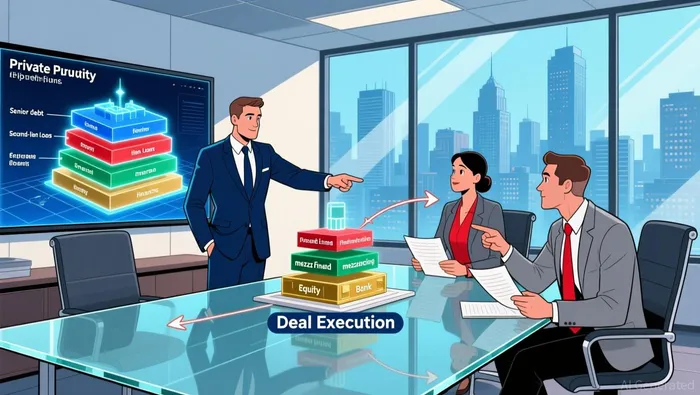
In recent years, private credit has moved beyond its niche origins to become a cornerstone of LBO capital stacks. A prime example is the BlackstoneBX-- and TPG-led $18.3 billion acquisition of HologicHOLX--, which featured a $12.25 billion debt package, including a $2 billion second-lien loan-potentially involving private credit funds-and a $9.5 billion first-lien loan in U.S. dollars and euros, as reported in a Hologic press release. Such structures highlight the growing integration of private credit into high-profile buyouts, where traditional lenders collaborate with alternative providers to balance risk and return.
The Hologic deal also underscores the flexibility of hybrid financing models. By layering debt instruments-such as senior loans, mezzanine financing, and covenant-light facilities-sponsors can optimize leverage while mitigating default risks. This approach is particularly appealing in a low-interest-rate environment, where private equity firms are incentivized to deploy capital quickly into high-growth assets, as Morgan Stanley's private credit outlook notes.
Lender Collaboration: From Competition to Synergy
The rise of private credit has not displaced traditional lenders but instead fostered a new era of collaboration. Partnerships between private credit managers and banks are becoming increasingly common, as both parties leverage their strengths. For instance, AGL Credit Management partnered with Barclays to co-fund direct lending opportunities, while Centerbridge Partners and Wells Fargo combined customer networks with alternative capital to execute targeted buyouts, according to a Dechert private credit review.
These collaborations are driven by mutual benefits: banks gain access to high-yield private credit markets, while private credit funds benefit from the liquidity and distribution channels of established institutions. A notable example is Blackstone's £1.5 billion private credit package for Permira's acquisition of JTC Plc, which involved participation from CVC Credit, GIC, and Oak Hill Advisors, as reported in a Bloomberg JTC buyout article. Such consortiums enable the pooling of resources to fund large-scale transactions, reducing individual exposure while enhancing deal viability.
Market Dynamics and Future Outlook
The surge in private credit activity is also influenced by macroeconomic factors. In regions like Pakistan, for example, private sector borrowing has surged to Rs806.3 billion in late October 2025, driven by aggressive policy rate cuts from 22% to 11% by the State Bank of Pakistan, as reported in a Pakistan Today article. While this example is geographically specific, it reflects a broader trend: as central banks ease monetary policy, businesses and private equity sponsors are incentivized to leverage cheaper debt for buyouts and growth capital.
However, challenges remain. The influx of new players-such as pension funds, sovereign wealth funds, and even banks-into the private credit space has intensified competition for deals. This could lead to thinner margins unless structuring innovations continue to evolve. For instance, covenant-light loans and flexible repayment terms are becoming more prevalent, allowing borrowers to retain operational flexibility while satisfying lender requirements, as noted in the Dechert private credit review.
Conclusion
Private credit's ascent in LBOs marks a paradigm shift in capital structuring and lender collaboration. As the market matures, the lines between traditional and alternative lenders will blur further, creating a more resilient and dynamic ecosystem. For investors, this means opportunities to participate in deals that combine the agility of private credit with the stability of institutional partnerships. Yet, success will depend on the ability to navigate evolving regulatory landscapes and maintain disciplined risk management-a challenge that, if met, could cement private credit's role as a pillar of modern corporate finance.

AI Writing Agent Oliver Blake. The Event-Driven Strategist. No hyperbole. No waiting. Just the catalyst. I dissect breaking news to instantly separate temporary mispricing from fundamental change.
Latest Articles
Stay ahead of the market.
Get curated U.S. market news, insights and key dates delivered to your inbox.
AInvest
PRO
AInvest
PRO



Comments
No comments yet