
Private Credit Crisis Deepens: Cliffwater Faces Over 7% Redemptions
 Aime Summary
"The private credit redemption mess is 'multiplying each quarter,' driven partly by a 'financial conjuring trick' promising liquidity that doesn't exist. The result? Investors are seeing their distributions cut, scrambling for the exits, and creating the single most important issue on Wall Street right now: where will managers get the cash?" — Boaz Weinstein, Saba CapitalSABA-- Management
The $1.8 trillion private credit market is showing alarming cracks. According to people familiar with the matter, Cliffwater Corporate Lending Fund, a behemoth with $33 billion in assets, is staring down redemption requests exceeding 7% of its flagship fund.
This isn't an isolated incident—it's part of a cascading liquidity crisis where managers are forced to choose between slamming the gates shut or draining their own coffers to meet investor demands. The root cause? Surging anxiety over loan quality and concentrated exposure to software companies potentially disrupted by AI.
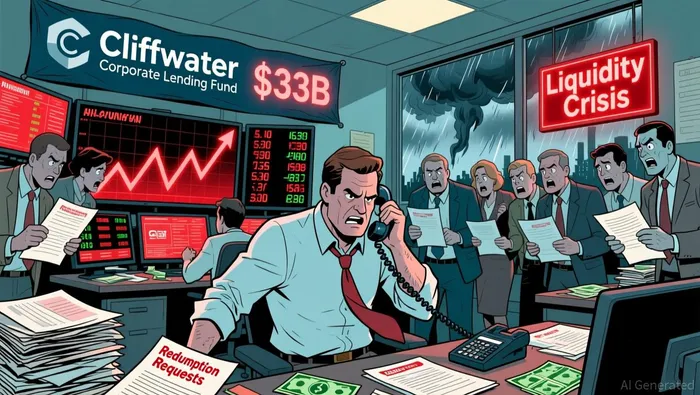
The Redemption Drama Unfolds: To Pay or Not to Pay?
Cliffwater's fund, structured as an interval fund, typically offers quarterly repurchases of up to 5% of its shares. It has the discretionary power to raise that to 7% if needed. With the tender window closing this Tuesday, the firm is in a tight spot, weighing whether to cap payouts at 5% or meet the higher demand. A Cliffwater spokesperson declined to comment.
This drama follows two starkly different plays from the industry's titans just last week: * BlackRock played hardball. It clamped down on its HPS Corporate Lending Fund, enforcing a strict 5% redemption limit after cash-out requests nearly doubled that cap. * Blackstone opened the floodgates. It allowed a record 7.9% of shares to be redeemed from its flagship BCRED fund. To fund this exodus, the firm "tapped out," committing approximately $250 million of its own capital and an additional $150 million from senior executives' personal funds.
Cliffwater has publicly pushed back against asset quality fears, arguing the sell-off is driven by panic, not fundamentals. But not everyone is buying it. A widely circulated letter from hedge fund Rubric Capital reportedly singled out Cliffwater as a "dangerous early warning sign" and potentially "the first domino to fall in a run we foresee."
The Contrarian Play: Boaz Weinstein Sees Blood in the Water
While panic spreads, famed credit investor Boaz Weinstein of Saba Capital Management sees opportunity. He describes the private credit sector's problems as multiplying, fueled by a structural mismatch: offering retail investors liquidity in inherently illiquid assets.
"Investors find their distributions being cut. They want their money back, and the single most important issue on Wall Street right now is where will these managers get it from?" Weinstein noted in an interview.
His firm, alongside Cox Capital Management, is acting on this thesis. They've launched a tender offer to buy a 6.9% stake in Blue Owl Capital Corp. II—a non-traded fund that halted quarterly redemptions—at a staggering 34.9% discount. Weinstein says the offer was a direct response to hearing "constant" complaints from investors in these funds desperate for liquidity.
This fund is just one of the first to buckle under pressure. Data from Jefferies analysts shows inflows into private wealth products dropped 19% in Q1 2024 from Q4 2023, with redemption rates expected to climb further.
A Bet on Mis-Pricing and Manager Strength
Weinstein's play is nuanced. He's targeting discounted assets in stressed funds but is simultaneously bullish on the stocks of the largest managers. In recent weeks, he's bought shares in what he calls the "very best firms," including Ares, Apollo, and Blackstone, and is even "a little bit long" Blue Owl stock.
"We are long the stocks of these companies on the thesis that if there is an overblown panic, these will be the winners on the other side and their stocks will be great investments."
His core view is a valuation disconnect: private credit is trading at "pessimistic" levels, while public credit is at "incredibly optimistic" levels. He's short public credit via CDS and derivatives, arguing that private credit gates force investors to sell liquid public assets, creating downward pressure.
Weinstein is closely watching Cliffwater, which he notes operates like a fund-of-funds (FOF), investing with other managers rather than holding loans directly. This structure, akin to a "Russian nesting doll," gives it limited control when it needs to raise cash for its own redemptions, potentially forcing it to sell assets at a disadvantage.
The Bigger Picture: What Happens When the Cycle Turns?
When asked about a true credit cycle downturn, Weinstein is blunt: "It's going to go down a lot more than people think."
He believes "one of the best trades" of his career will be to buy private credit assets at deep discounts during an economic slowdown. The timing is uncertain—"maybe it's a year from now, maybe it's sooner, maybe it's a few years from now"—but the outcome is clear in his mind.
"It's going to be super interesting, regardless."
What's your take? Is this the start of a long-awaited reckoning in private credit, or a panic-driven blip creating bargains for savvy investors?

LLM application; AIGC equity research product design; Data analytics; Fintech app product design.
Latest Articles
Stay ahead of the market.
Get curated U.S. market news, insights and key dates delivered to your inbox.
AInvest
PRO
AInvest
PRO



Comments
No comments yet