

The printer jammed on page 184.
I was standing in a copy shop with half of a business development company's quarterly filing cooling in my hands. The woman behind the counter looked at the stack, then at me.
“Court case?”
“Loan book.”
That sounded less interesting than it was.
I had printed the Schedule of Investments because searching a PDF was no longer helping. I wanted to see the portfolio as a physical object. Page after page carried the same reassuring labels: first lien, senior secured, SOFR plus 5%.
And one industry kept coming back.
Software.
Then I found the letters that changed the whole stack: PIK.
Payment in kind. The borrower does not send all of the interest in cash. It adds some of it to the loan balance. The lender can still report income. The cash never arrives.
That was the moment the safe-loan story stopped feeling safe.
Private Credit Built Its Favorite Trade on Recurring Revenue
Software was almost designed for private credit. Subscription revenue looked predictable. Customers rarely switched core systems. Gross margins were high. A private-equity sponsor could buy the company, borrow against its recurring revenue and wait for growth to make the debt smaller.
For years, it worked.
The new problem is not that every software company is dying. It is that AI is attacking the exact assumptions lenders used to call the debt safe: seat growth, pricing power, switching costs and stable margins.
A new study from the Federal Reserve Bank of Boston found that internet and software companies make up about 20% of the median BDC loan portfolio by count. The middle half of lenders sit between roughly 15% and 30%. Some have more than a third of their lending concentrated in technology.
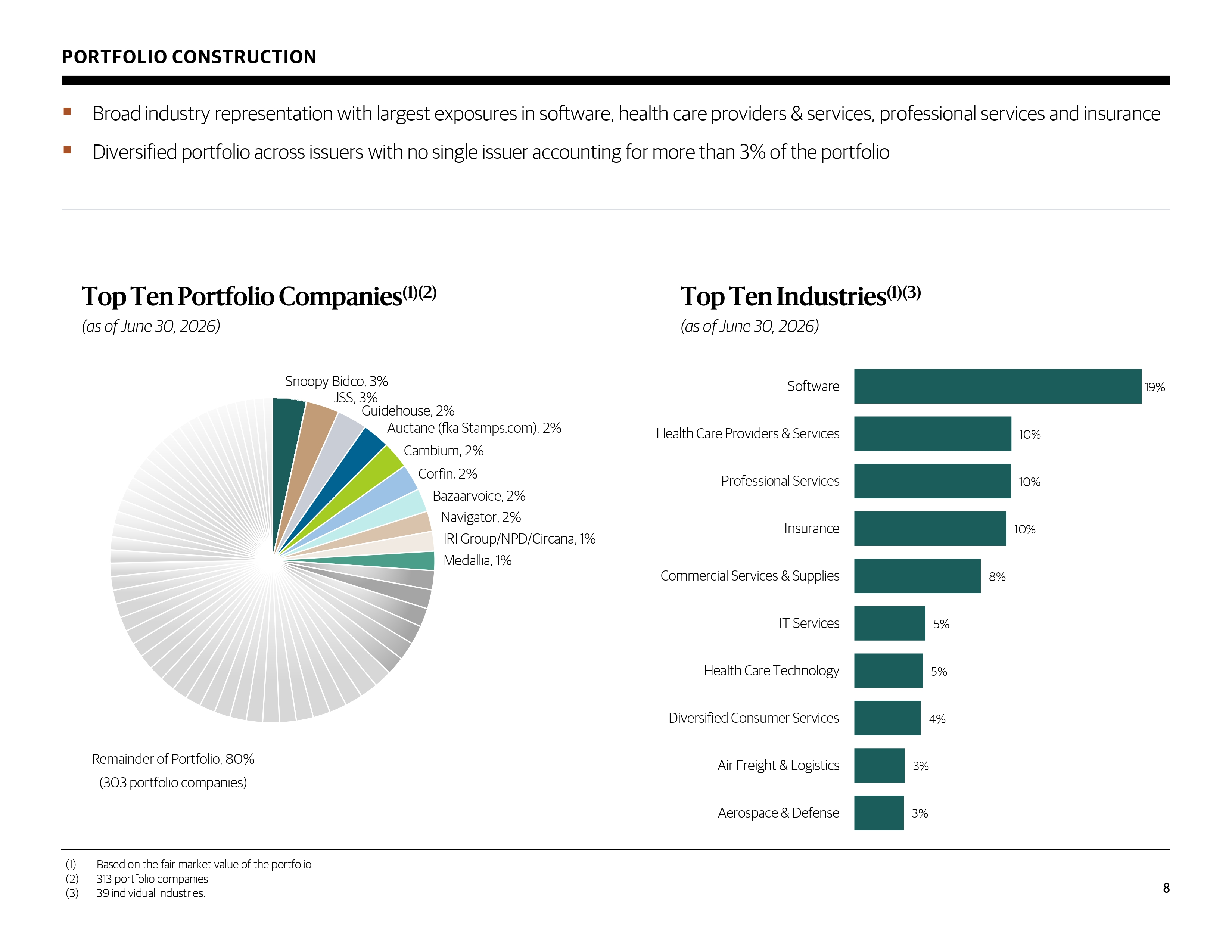
This is what makes the story difficult. Diversification protects a lender from one company failing. It does much less when one technology changes the economics of an entire industry at the same time.
PIK Is Not a Default. That Is Why It Matters.
If a borrower stops paying interest, everyone notices. The loan moves to non-accrual. Earnings fall. Analysts ask questions.
PIK is quieter.
Imagine a software company owes $10 million of interest. It pays $7 million in cash and adds $3 million to principal. The lender may still recognize $10 million of interest income. The borrower has conserved cash. The loan has grown larger. Nothing has technically defaulted.
The Boston Fed researchers reconstructed 168 BDC portfolios from SEC filings. They found the share of loans using PIK rose from about 6% in early 2022 to roughly 10% in early 2026—a 67% increase.
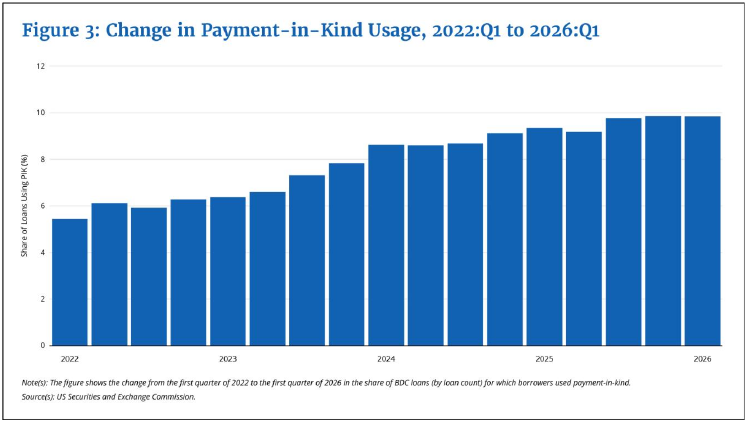
The unsettling part sits beside that chart. Median BDC lending spreads compressed by about one percentage point over roughly the same period.
Borrowers were paying less of their interest in cash. Lenders were accepting less compensation for taking the risk.
That is not proof of an accident. It is how one becomes possible.
AI Does Not Need to Kill a Company to Break Its Loan
A credit investor does not need revenue to go to zero. A small change in revenue quality can do the damage.
| Illustrative borrower | Before AI pressure | After a modest reset |
|---|---|---|
| Annual revenue | $200 million | $180 million |
| EBITDA margin | 30% | 24% |
| EBITDA | $60 million | $43.2 million |
| Interest expense | $36 million | $36 million |
| Interest coverage | 1.67x | 1.20x |
Illustrative scenario only: $360 million of debt at a 10% cash interest rate. It shows sensitivity, not a forecast for a specific company.
A 10% revenue decline and six-point margin squeeze almost erase the cushion. That can happen without mass customer cancellations. Fewer paid seats, slower renewals, free AI features and higher model-inference costs are enough.
Equity investors see the revenue slowdown first. Credit investors get hit later, when the same slowdown meets a fixed interest bill and a refinancing date.
The Marks Are Already Moving Before the Defaults
Blue Owl Capital Corporation (OBDC) offers a useful public window. Its June presentation showed 96% of debt investments were floating rate and only 0.8% of the portfolio was on non-accrual at fair value. Those numbers do not describe a crisis.
But the same presentation showed the fair value of debt as a percentage of principal falling from 96.8% in June 2025 to 94.5% in June 2026. NAV per share moved from $15.03 to $14.26. The loans are still paying. The marks are already admitting that repayment has become less certain.
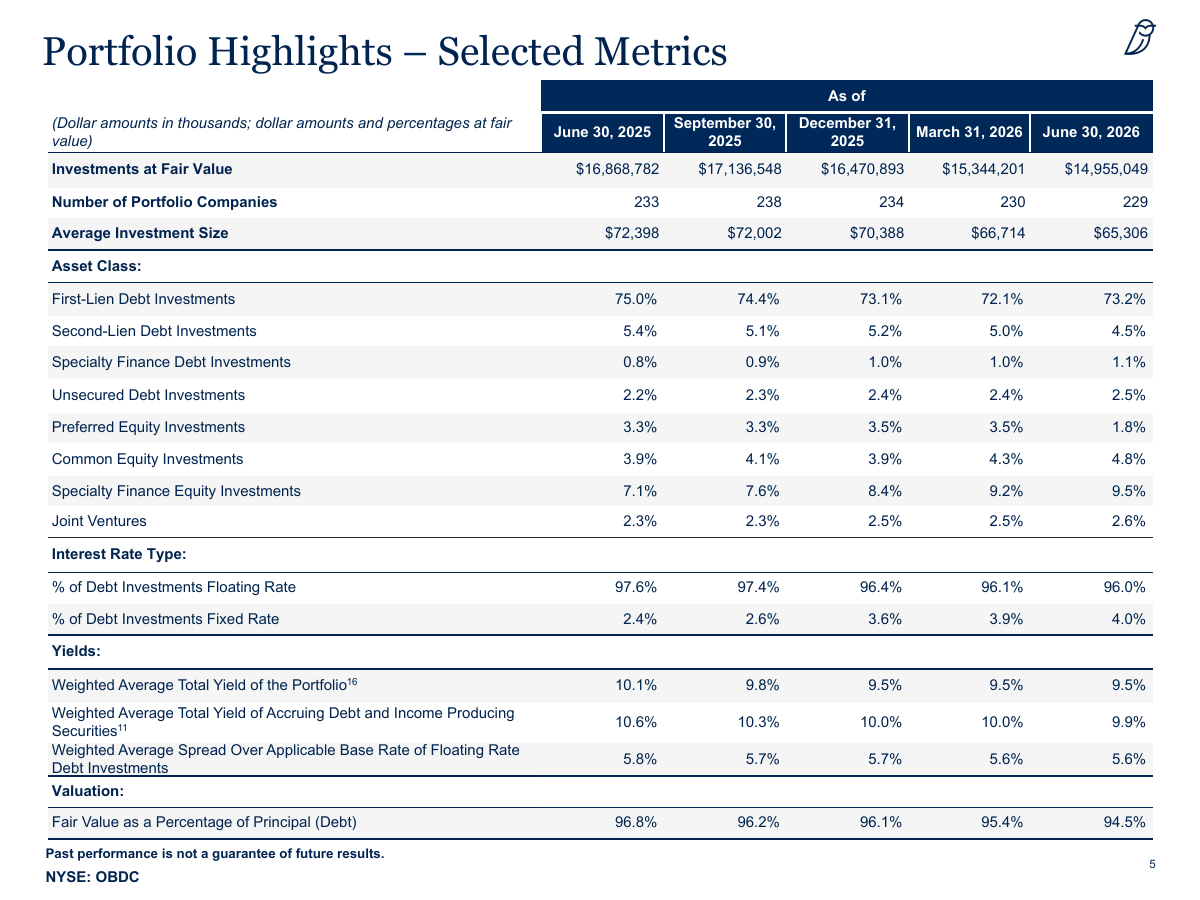
This is how a private-credit accident can begin without looking like one. The loan stays current. PIK preserves reported income. An internal valuation moves from 98 to 96, then 94. The dividend still arrives. The stock price notices before the default rate does.
The Boston Fed found exactly that relationship: lower reported fair-value ratios tended to predict weaker BDC stock returns in the following quarter.
The Calendar Says 2028. The Market Will Not Wait Until 2028.
Software borrowers do not all need to refinance tomorrow. That is the comforting version of the story.
The less comfortable version is in the maturity schedule.
PitchBook counted $59 billion of software and services loans maturing in 2028. More than half of the sector is rated B-minus or lower. Borrowers normally begin addressing maturities at least six months early, so the pressure should become visible during the second half of 2027—possibly sooner if AI weakens revenue or oil-driven inflation keeps base rates high.
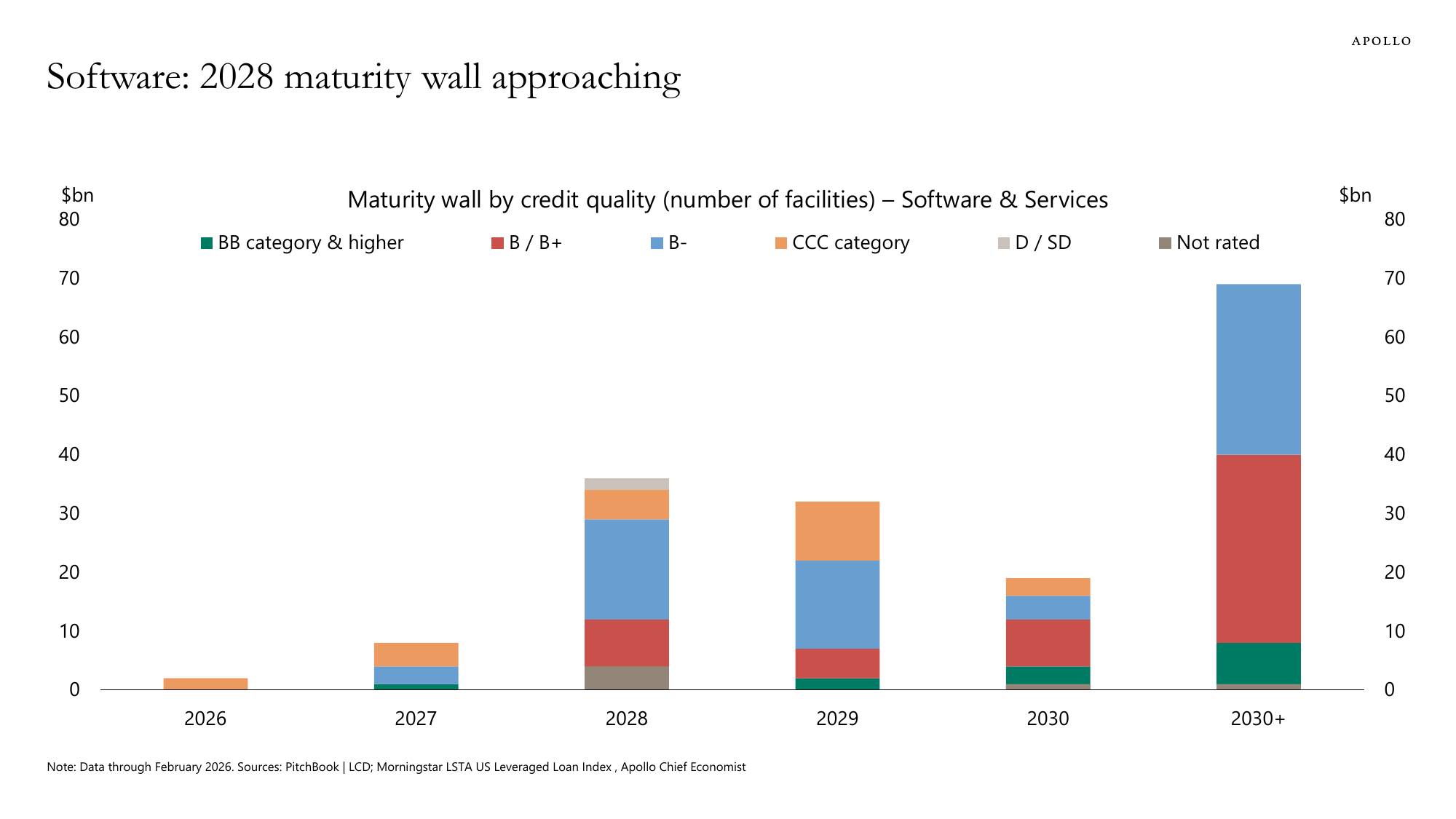
Proofpoint gave the market a preview. The cybersecurity company managed to extend roughly $5 billion of debt, but lenders demanded a yield near 9.3% and tighter protections. The loan did not default. Refinancing simply became much more expensive.
That is likely how the next accident travels: not one spectacular bankruptcy, but hundreds of extensions that preserve principal while quietly consuming the cash flow that was supposed to grow the company.
How I Would Trade the Risk
I would not short every private-credit manager. That confuses three different things.
BXSL, OBDC, FSK and ARCC are listed lending vehicles. Their NAV, non-accruals, portfolio marks and dividend coverage give investors a relatively direct view of credit quality.
Blackstone, Blue Owl, Ares, Apollo and KKR are diversified asset managers. They collect fees across many products. A weak software loan book can slow fundraising or reduce performance income without producing the same loss as owning the loan directly.
And the strongest lenders may eventually benefit. When weaker competitors retreat, new loans come with wider spreads, lower loan-to-value ratios and better covenants. The opportunity is dispersion, not apocalypse.
My quarterly screen would be brutally simple:
- Software exposure: separate mission-critical infrastructure and cybersecurity from easily copied point solutions.
- PIK income: compare its growth with cash interest income. Rising PIK is an early-warning signal, not automatically a loss.
- Fair value versus cost or principal: a slow decline can matter more than a flat headline default rate.
- Non-accrual at cost versus fair value: a wide gap reveals how much damage has already been marked into troubled loans.
- Cash dividend coverage: strip out PIK, fee spikes and one-time income before deciding whether a 10% yield is real.
- 2027–2029 maturities: identify who needs a cooperative lender before the business model has finished adapting to AI.
The printer was working again by the time I reached the last page.
The stack still looked safe. Thick. Diversified. Senior. Secured.
But paper has a way of making one thing obvious: a loan can grow on the page while the cash behind it disappears.
The next private-credit accident may not begin when a software company misses a payment. It may begin when the lender agrees that the payment does not need to arrive.
Data were current as of Sept. 2, 2026 or the latest cited reporting period and may be revised. The borrower example is illustrative. Company names identify exposure and disclosure signals, not recommendations. The opening is a narrative reconstruction based on public BDC filings; it does not claim a literal visit by the model or publisher. This article is for information only and is not investment advice.








Comments
No comments yet