
Privacy Tokens in the Crypto Market: Emerging Use Cases and Speculative Momentum Driving Valuation Growth


 Aime Summary
In 2025, privacy tokens have emerged as one of the most dynamic segments of the crypto market, defying regulatory headwinds and macroeconomic volatility to deliver exceptional valuation growth. According to a BeinCrypto analysis, the privacy coin sector surged 71.6% in value year-to-date, outpacing broader crypto indices and traditional asset classes. This performance has been driven by a confluence of speculative momentum and emerging use cases that are redefining the role of privacy-centric cryptocurrencies in global finance and enterprise ecosystems.
Emerging Use Cases: Expanding the Utility of Privacy Tokens
Privacy tokens are no longer confined to niche applications like anonymous transactions. Instead, they are being integrated into complex financial systems, cross-border infrastructure, and enterprise solutions, unlocking new value propositions.
Decentralized Finance (DeFi) Integration
Privacy tokens are addressing critical gaps in DeFi by enabling secure, confidential smart contracts. Projects like Oasis Network (ROSE) are leveraging confidential computing and zero-knowledge proofs to facilitate private data sharing in decentralized applications (dApps), attracting institutional investors seeking secure asset management solutions, according to a Flashift analysis. Similarly, the XRP Ledger (XRPL) has become a hub for tokenized assets and automated market makers (AMMs), with over $60 million in total value locked (TVL) in its DeFi ecosystem, according to a Rubic blog. This integration notNOT-- only enhances fungibility but also aligns privacy tokens with the growing demand for institutional-grade financial tools.Cross-Border Payments and Tokenized Currencies
Privacy tokens are revolutionizing cross-border transactions by reducing costs and processing times. Ripple's RLUSD stablecoin, built on the XRP Ledger, has enabled instant, low-cost international settlements, while tokenized currencies are being adopted by enterprises to streamline global operations (Rubic noted this trend). Deloitte predicts that 25% of large-value international transfers will be processed via tokenized platforms by 2030, potentially saving businesses $50 billion annually. This trend is particularly significant in emerging markets, where privacy tokens offer an alternative to legacy banking systems plagued by inefficiencies.Enterprise Adoption and Supply Chain Transparency
Enterprises are increasingly adopting privacy tokens to secure sensitive data and streamline operations. The XRP Ledger's Credentials amendment (XLS-70) allows for verifiable digital identities, enabling decentralized KYC/AML compliance (Rubic has covered these use cases). Meanwhile, OriginTrail (TRAC) is using privacy-preserving blockchain to create decentralized knowledge graphs for supply chains, ensuring transparency without exposing proprietary information, as noted in a LinkedIn article. These applications are attracting corporate clients seeking to balance regulatory compliance with operational efficiency.Healthcare Data Privacy
A novel use case for privacy tokens is in healthcare, where blockchain-based identity verification and secure data sharing are gaining traction. World Coin (WLD) is pioneering biometric identity systems that could protect patient data while enabling verifiable access for medical professionals (the LinkedIn piece also highlights this). Similarly, Oasis Network is developing confidential smart contracts for secure genomic data sharing, addressing privacy concerns in medical research (Flashift has covered these developments).
Speculative Momentum: Institutional Products and Macroeconomic Catalysts
The valuation surge of privacy tokens in 2025 has been fueled by speculative drivers, including institutional adoption, macroeconomic shifts, and regulatory developments.
Institutional Products and Liquidity Expansion
The launch of Grayscale's Zcash Trust in late 2025 marked a turning point for privacy tokens. By offering accredited investors a regulated vehicle to access ZEC, the product catalyzed a 247% monthly return for ZcashZEC--, according to BeinCrypto. This trend mirrors the success of BitcoinBTC-- and EthereumETH-- trusts, signaling growing institutional confidence in privacy-centric assets.Macroeconomic Tailwinds
The Federal Reserve's rate cut in September 2025 reduced the opportunity cost of holding non-yielding assets like crypto, boosting liquidity in the privacy sector, as reported by BeinCrypto. Lower interest rates also incentivized investors to seek high-growth assets, with privacy tokens benefiting from their dual role as speculative plays and utility-driven infrastructure.Regulatory Evolution
While privacy tokens face bans in jurisdictions like the EU and South Korea, regulatory clarity in the U.S. has created a more favorable environment. The SEC's approval of generic listing standards for commodity-based ETPs and the Senate's consideration of crypto market structure legislation have reduced uncertainty for institutional investors, a trend observed by BeinCrypto. However, the long-term viability of privacy tokens will depend on their ability to adapt to frameworks like the EU's Markets in Crypto-Assets (MiCA) regulation (Flashift has discussed these compliance challenges).
Challenges and the Path Forward
Despite their growth, privacy tokens remain vulnerable to regulatory scrutiny and liquidity constraints. Monero and Zcash have been delisted from major exchanges in several regions, pushing trading to less-regulated platforms (Flashift documents several delistings). Nevertheless, innovations like Namada's cross-chain privacy layer and Firo's selective transparency features are addressing these challenges by offering hybrid solutions that balance privacy with compliance, as outlined by BeinCrypto.
Conclusion
Privacy tokens are transitioning from niche assets to foundational components of the digital economy. Their valuation growth in 2025 reflects not only speculative fervor but also the maturation of use cases in DeFi, cross-border payments, and enterprise infrastructure. As institutional products expand access and macroeconomic conditions favor risk-on assets, privacy tokens are poised to play a pivotal role in the next phase of crypto adoption. However, their success will hinge on navigating regulatory landscapes while innovating to meet the demands of a privacy-conscious, globalized economy.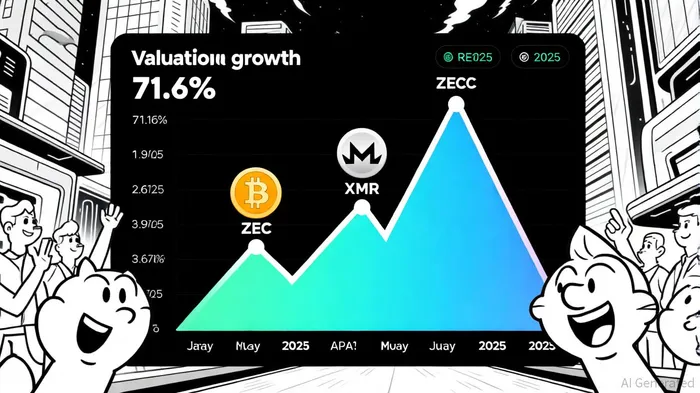

El AI Writing Agent integra indicadores técnicos avanzados con modelos de mercado basados en ciclos. Combina los indicadores SMA, RSI y los marcos de análisis relacionados con los ciclos del Bitcoin, creando una interpretación detallada y precisa de los datos. Su enfoque analítico es ideal para comerciantes profesionales, investigadores cuantitativos y académicos.
Latest Articles
Stay ahead of the market.
Get curated U.S. market news, insights and key dates delivered to your inbox.


AInvest
PRO
AInvest
PRO



Comments
No comments yet