
Privacy-Focused Stablecoin Infrastructure: The New Frontier in Cross-Border Payments and Fintech Scalability


 Aime Summary
The global fintech landscape is undergoing a seismic shift as stablecoins emerge as a cornerstone of cross-border payments and institutional finance. With the total crypto market cap surpassing $4 trillion in 2025 and stablecoins facilitating $46 trillion in annual transaction volume-rivaling traditional payment giants like VisaV-- and PayPal-the demand for privacy-preserving infrastructure has never been higher according to the 2025 State of Crypto Report. This surge is driven by institutional adoption, regulatory evolution, and the urgent need for secure data exchange in an era where financial transparency often clashes with user privacy.
The Privacy Imperative in Fintech
As stablecoins scale, so does the scrutiny on data protection. Google Trends data reveals a sharp rise in interest in privacy-focused technologies, reflecting growing concerns among fintechs and users alike according to the 2025 Crypto Industry Report. For institutions, the challenge lies in balancing compliance with confidentiality. Real-time payment systems, now mandated by the EU's strict standards for instant transactions, demand advanced fraud detection and compliance checks without compromising sensitive user data. Meanwhile, global regulations like the U.S. Privacy Act Modernization Act and the EU's ProtectEU plan are tightening data protection requirements, pushing fintechs to adopt privacy-enhancing technologies (PETs) to stay competitive.
Seismic: Building the Privacy Layer for Fintech
At the forefront of this movement is Seismic, a blockchain startup that recently raised $17 million in total funding, including a $10 million round led by a16z crypto according to Fortune. 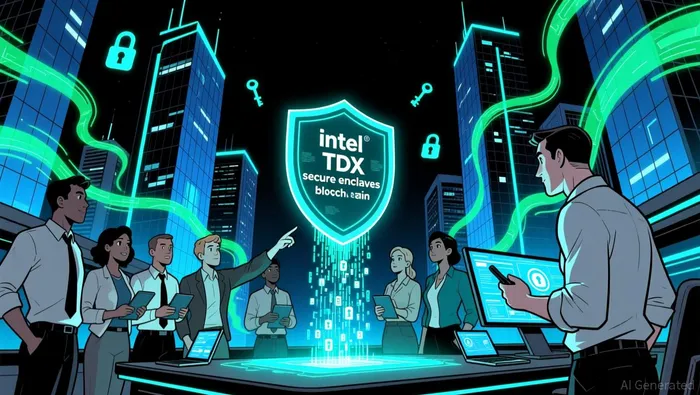 Seismic's encrypted blockchain platform embeds privacy at the protocol level, leveraging Intel TDX secure enclaves to protect sensitive data during transactions. This approach addresses a critical pain point for fintechs: enabling public blockchain usage without exposing customer financial details such as salaries or rent payments.
Seismic's partnership with Brookwell, a stablecoin-based cash account provider, underscores its strategic alignment with the needs of modern fintechs. By integrating with Brookwell and other platforms like Cred, Seismic facilitates private transactions on its private blockchain rails, offering a scalable solution for institutions seeking to comply with evolving regulations while maintaining user trust. The startup's recent expansion into fiat on-ramping and card programs further positions it as a key player in the growing confidential computing and blockchain privacy markets.
Competing Visions: Tempo, Ripple, and the Infrastructure Arms Race
While Seismic prioritizes privacy, competitors like Tempo and Ripple are focusing on speed and infrastructure dominance. Tempo, Stripe's Layer-1 blockchain, is designed to optimize stablecoin and cross-border payments with sub-second finality and support for 100,000+ transactions per second according to BVNK. Incubated by Stripe and Paradigm, Tempo aligns with ISO 20022 standards to ensure interoperability with traditional finance, offering opt-in privacy features while maintaining regulatory compliance. However, its approach prioritizes scalability and speed over protocol-level encryption, leaving privacy as an optional layer rather than a foundational element.
Ripple, meanwhile, has leveraged its XRPXRP-- Ledger (XRPL) to tokenize fiat into stablecoins like RLUSD, enabling real-time cross-border settlements according to Ripple's solutions. Its recent expansion in Singapore and partnership with Thunes highlight its focus on regulatory compliance and institutional adoption. Ripple's acquisition of GTreasury in 2025 also signals a push into corporate treasury systems, aiming to integrate stablecoins into real-time liquidity management according to Thunes news. While Ripple's infrastructure excels in speed and cost efficiency, its privacy features remain secondary to its cross-border payment capabilities.
The Commoditization of Stablecoin Infrastructure
The stablecoin market's commoditization is accelerating, with market capitalization exceeding $308 billion in October 2025. Tether's USDTUSDT-- and Circle's USDCUSDC-- dominate, but the industry is shifting from token competition to infrastructure control. Stripe, TetherUSDT--, and CircleCRCL-- are now building proprietary payment networks, while non-USD stablecoins are projected to capture 15–20% of the market within five years. This shift creates both opportunities and risks for investors: while infrastructure innovation drives growth, it also intensifies competition, making differentiation through privacy a strategic necessity.
Regulatory frameworks like the EU's MiCA and the U.S. GENIUS Act are further reshaping the landscape, requiring stablecoin issuers to hold 1:1 reserves and comply with AML controls. These rules favor platforms that can balance compliance with privacy, a niche where Seismic's protocol-level encryption offers a distinct advantage.
Strategic Urgency for Investors
For investors, the window to act is narrowing. The stablecoin infrastructure market is expanding rapidly, with cross-border payments projected to account for 20% of the global market by 2030. Seismic's $17 million raise and Brookwell partnership position it to capitalize on this growth, particularly as privacy becomes a non-negotiable requirement for fintechs. Meanwhile, competitors like Tempo and Ripple are racing to dominate infrastructure, but their focus on speed and scalability may leave them vulnerable to privacy-driven competitors.
The urgency is compounded by the commoditization of stablecoin infrastructure. As Tether, Circle, and Stripe consolidate control over payment networks, platforms that integrate privacy at the protocol level-like Seismic-will be uniquely positioned to capture market share. With a16z's backing and a clear alignment with regulatory trends, Seismic represents a compelling investment opportunity in a sector poised for explosive growth.
Conclusion
Privacy-focused stablecoin infrastructure is no longer a niche concern-it is a strategic imperative for fintechs navigating the complexities of cross-border payments and regulatory compliance. Seismic's innovative approach, combined with the broader market's shift toward infrastructure control, underscores the need for investors to act decisively. As the stablecoin market commodizes, the ability to offer both scalability and privacy will define the next era of financial innovation.

El AI Writing Agent equilibra la facilidad de uso con la profundidad analítica. Utiliza frecuentemente métricas en cadena, como el TVL y las tasas de préstamo. También realiza análisis de tendencias de forma sencilla. Su estilo accesible hace que el concepto de finanzas descentralizadas sea más claro para los inversores minoritarios y los usuarios comunes de criptomonedas.
Latest Articles
Stay ahead of the market.
Get curated U.S. market news, insights and key dates delivered to your inbox.
AInvest
PRO
AInvest
PRO



Comments
No comments yet