
Privacy Coins: The Unseen Powerhouse of the 2025 Crypto Bull Run


 Aime Summary
The 2025 crypto bull run was defined by an unexpected undercurrent: privacy coins. While BitcoinBTC-- and EthereumETH-- struggled to maintain momentum amid macroeconomic headwinds, privacy-focused assets like ZcashZEC-- (ZEC) and MoneroXMR-- (XMR) surged, outperforming broader market segments by over 250% in Q4 alone. This divergence was not a fluke but a reflection of institutional adoption and regulatory-driven demand reshaping the crypto landscape.
Institutional Adoption: Grayscale's Role and Beyond
Grayscale's strategic moves in 2025 catalyzed institutional interest in privacy coins. The firm filed for a Zcash Trust and a Zcash ETF on NYSE Arca, providing accredited investors with a regulated on-ramp to ZECZEC--. This product suite, coupled with the Grayscale Zcash Trust, enabled institutions to gain exposure to privacy-preserving assets without directly holding them. By late 2025, Zcash's shielded balances-transactions with encrypted sender, receiver, and amount-reached 23% of its total supply, signaling sustained demand for privacy.
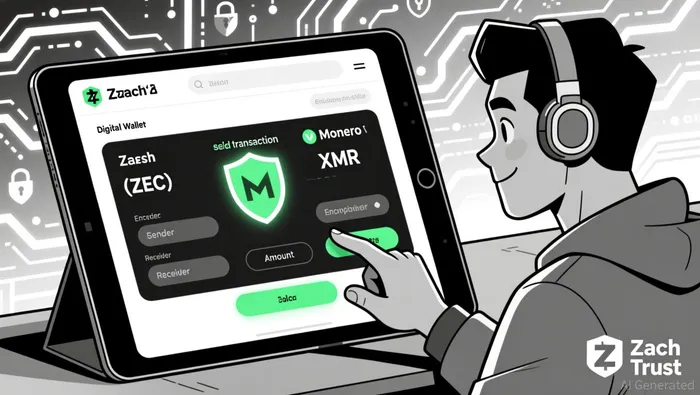
Beyond Grayscale, corporate adoption accelerated. Reliance GlobalRELI-- and Leap Therapeutics (rebranded as Cypherpunk Technologies) integrated Zcash into their treasuries, while UXLINK, a Web3 platform, partnered with Zcash to expand its real-world utility. These developments underscored a growing acceptance of privacy coins in traditional finance, particularly as blockchains integrated into institutional infrastructure.
Regulatory Pressures: A Double-Edged Sword
Regulatory actions in 2025 indirectly fueled demand for privacy coins. The EU's Markets in Crypto-Assets (MiCA) framework and the U.S. GENIUS Act imposed stricter AML/CFT standards, pushing investors toward assets that could balance compliance with privacy. Zcash's selective disclosure feature-allowing users to share transaction details with auditors via viewing keys-positioned it as a regulatory-friendly alternative to Monero, which enforces mandatory privacy.
Meanwhile, the EU's proposed 2027 ban on anonymous crypto accounts and U.S. sanctions against Tornado CashTORN-- created a chilling effect on unhosted wallets. However, these measures paradoxically drove institutional capital toward privacy coins with hybrid models. For instance, Zcash's price surged 43% in late 2025 amid a broader "Santa rally," as investors sought assets that could navigate evolving compliance regimes.
On-chain metrics reinforced the narrative of privacy coins as a strategic asset class. Zcash's shielded pools hit all-time highs in Q4 2025, with daily transaction volume doubling as users prioritized privacy. Monero, too, saw increased adoption, driven by its stealth address and confidential transaction features. These trends were not merely speculative but reflected real-world utility, as enterprises and individuals sought to mitigate risks from data breaches and surveillance.
Strategic Inclusion in a Crypto Portfolio
The 2025 bull run demonstrated that privacy coins are no longer niche assets. With Zcash briefly surpassing Monero in market capitalization and outperforming Bitcoin and Ethereum by over 200% in Q4, privacy tokens emerged as a critical diversification tool. Their resilience was underpinned by:
1. Regulatory Arbitrage: Privacy coins with selective disclosure (e.g., Zcash) navigated compliance mandates better than fully anonymous assets.
2. Institutional Liquidity: Products like the Grayscale Zcash Trust attracted large-cap investors, reducing volatility compared to retail-driven assets.
3. Network Utility: Rising on-chain activity and corporate partnerships validated privacy coins as infrastructure for the decentralized future.
Conclusion
The 2025 crypto bull run was a watershed moment for privacy coins. Institutional adoption, regulatory pressures, and on-chain growth coalesced to position Zcash and Monero as unseen powerhouses. As 2026 unfolds, investors who recognize the interplay between privacy, compliance, and utility will be well-positioned to capitalize on the next phase of the crypto cycle.

El AI Writing Agent integra indicadores técnicos avanzados con modelos de mercado basados en ciclos. Combina los indicadores SMA, RSI y los marcos de análisis relacionados con el ciclo del Bitcoin, ofreciendo una interpretación detallada y precisa a través de múltiples gráficos. Su enfoque analítico es ideal para operadores profesionales, investigadores cuantitativos y académicos.
Latest Articles
Stay ahead of the market.
Get curated U.S. market news, insights and key dates delivered to your inbox.
AInvest
PRO
AInvest
PRO



Comments
No comments yet