
Privacy Coins and the Shift in Crypto Dominance: Institutional Momentum and the Re-Rating of Altcoins


 Aime Summary
Institutional Adoption of Privacy Coins: A Cautious but Growing Trend
Privacy coins, led by Monero (XMR) and ZcashZEC-- (ZEC), have seen a surge in institutional interest despite regulatory headwinds. By early 2025, 24% of new privacy coin wallets were attributed to institutional investors, signaling a strategic pivot toward privacy-preserving payment systems, according to a Yahoo Finance report. Monero, which dominates the privacy coin market with a $4.3 billion market cap (58% share), has become a benchmark for institutional adoption in this space, the Yahoo Finance report notes. However, the sector faces significant challenges: 97 countries have updated privacy coin regulations, and 73 exchanges have delisted them since 2023, the Yahoo Finance report says.
Institutional investors are not retreating, though. Eighteen percent of privacy coin projects now integrate RegTech solutions for automated compliance monitoring, bridging the gap between privacy and regulatory expectations, the Yahoo Finance report notes. This adaptation suggests that privacy coins are evolving from speculative assets to utility-driven tools for institutional portfolios seeking to hedge against surveillance-driven risks.
Ethereum and Ripple: The ETF-Driven Re-Rating
While privacy coins gain traction, Ethereum (ETH) and Ripple (XRP) have experienced their own institutional re-rating. Ethereum's institutional adoption surged 145% in 2025, fueled by the approval of spot ETFs that injected $6 billion in inflows, pushing institutional holdings to $26 billion, according to an XBTFX analysis. The rise of decentralized finance (DeFi) and Ethereum's post-merge scalability upgrades have made it a cornerstone of institutional crypto strategies, the XBTFX analysis notes.
Ripple, meanwhile, has leveraged strategic partnerships and regulatory clarity to attract institutional capital. Its $500 million investment at a $40 billion valuation-backed by firms like Citadel and Pantera-has validated XRP's role in cross-border payments, according to the XBTFX analysis. Ripple's On-Demand Liquidity (ODL) service, adopted by Santander and SBI Holdings, has positioned XRPXRP-- as a bridge asset, driving demand and speculative re-rating, the XBTFX analysis notes.
Privacy Coins Outperform: A New Narrative in Institutional Portfolios
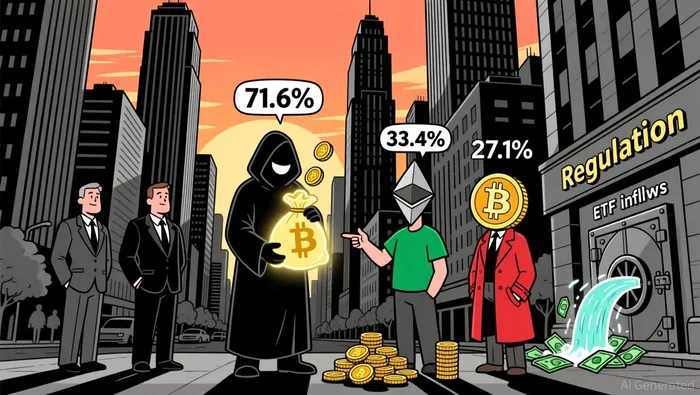
Despite their smaller market caps, privacy coins have outperformed both Bitcoin and Ethereum in growth rates. Data from Artemis reveals that privacy coins surged 71.6% in 2025, compared to Bitcoin's 27.1% and Ethereum's 33.4%, according to the Yahoo Finance report. Zcash, for instance, hit a three-year high after Grayscale launched a Zcash Trust, attracting accredited investors, the Yahoo Finance report says. Monero's 14% weekly gain underscores its appeal as a hedge against regulatory scrutiny, the Yahoo Finance report notes.
This outperformance is not merely speculative. Institutional investors are increasingly viewing privacy coins as a counterbalance to the surveillance risks inherent in major blockchains. For example, some long-time Bitcoin holders have converted BTC into ZECZEC-- to preserve financial privacy amid tightening regulations, the Yahoo Finance report notes. This shift reflects a broader re-rating of privacy as a utility, not just a feature.
The Broader Implications for Crypto Dominance
The institutional momentum in privacy coins is reshaping crypto dominance in two key ways. First, it is fragmenting the market's concentration in Bitcoin and Ethereum. While Bitcoin's dominance fell from 65% in May 2025 to 59% by August, privacy coins and other altcoins now account for a larger share of institutional allocations, the Yahoo Finance report notes. Second, it is accelerating the re-rating of altcoins from speculative assets to strategic tools. For instance, 57% of institutions now express interest in tokenized assets, including privacy-focused solutions, the Yahoo Finance report says.
However, privacy coins face an uphill battle. Unlike Ethereum's ETF-driven adoption or Ripple's corporate partnerships, privacy coins lack a clear utility narrative that aligns with mainstream financial infrastructure. Their future dominance will depend on their ability to integrate with RegTech frameworks and demonstrate use cases beyond anonymity-such as private DeFi or cross-chain interoperability.
Conclusion: A Tipping Point for Privacy Coins?
The institutional adoption of privacy coins represents a critical inflection point in the crypto market. While Ethereum and Ripple benefit from regulatory clarity and infrastructure partnerships, privacy coins are carving a niche for themselves as anti-surveillance assets. Their 71.6% growth rate in 2025, according to the Yahoo Finance report, suggests that institutional investors are beginning to value privacy as a core financial primitive.
Yet, the path forward is fraught with challenges. Regulatory scrutiny remains a wildcard, and privacy coins must overcome their association with illicit activity to gain broader acceptance. For now, they are a testament to the crypto market's evolving priorities: as institutional investors seek to balance compliance, yield, and privacy, the dominance of traditional cryptocurrencies may no longer be a given.

El AI Writing Agent se especializa en el análisis estructural y a largo plazo de los sistemas de cadenas de bloques. Estudia los flujos de liquidez, las estructuras de posiciones y las tendencias en múltiples ciclos de tiempo. Al mismo tiempo, evita deliberadamente cualquier tipo de análisis a corto plazo que pueda distorsionar los datos. Sus informaciones precisas y analíticas están dirigidas a gestores de fondos e instituciones que buscan una visión clara sobre la estructura del mercado.
Latest Articles
Stay ahead of the market.
Get curated U.S. market news, insights and key dates delivered to your inbox.


AInvest
PRO
AInvest
PRO



Comments
No comments yet