
AInvest Newsletter
Daily stocks & crypto headlines, free to your inbox


 Aime Summary
The cryptocurrency market in 2025 is no longer a monolithic asset class but a fragmented ecosystem shaped by diverging regulatory priorities, technological innovation, and shifting capital flows. Amid this turbulence, privacy-focused cryptocurrencies like
(XMR) and (ZEC) have emerged as both victims and beneficiaries of the broader industry's evolution. While regulatory scrutiny has forced major exchanges to delist privacy coins, it has also catalyzed a surge in demand for financial tools that resist surveillance. For contrarian investors, this paradox presents a high-risk, high-reward opportunity: betting on privacy coins as a hedge against regulatory tightening and capital rotation in a crypto market increasingly defined by compliance and control.The regulatory landscape for privacy coins has grown increasingly hostile. In 2025, several major exchanges
due to anti-money laundering (AML) and know-your-customer (KYC) compliance challenges. Monero, which enforces mandatory privacy by default, faces an uphill battle in jurisdictions prioritizing transparency. In contrast, -allowing users to choose between transparent and shielded transactions-have made it a more palatable option for institutional investors and regulated exchanges. This divergence reflects a broader market fragmentation: ZK-technology coins like Zcash and are aligning with compliance-friendly scaling solutions, while traditional privacy coins like Monero and remain anchored to their ideological roots .The regulatory squeeze has not deterred investors. Instead, it has intensified demand for privacy coins in markets where surveillance and capital controls are rising. According to a report by CWallet, global surveillance and regulatory scrutiny have created a "structural demand" for privacy-enhancing tools,
of 652% and 93%, respectively. This outperformance against and underscores a key insight: in a world of tightening financial oversight, privacy is no longer a niche concern but a utility with growing mainstream appeal.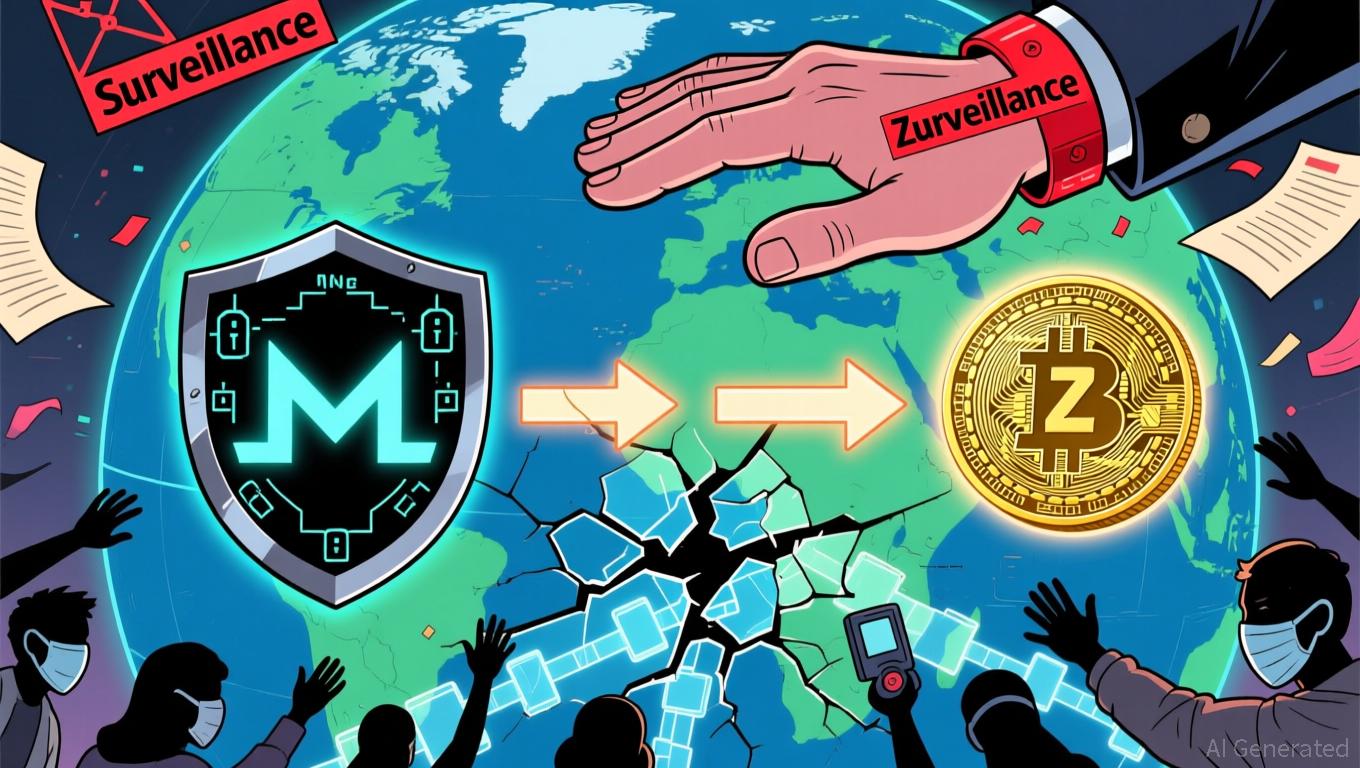
Contrarian positioning in privacy coins is further justified by the sector's institutionalization and cross-border adoption.
to launch an institutional trust has opened the door for accredited investors to allocate capital to privacy-focused assets. Meanwhile, -from $38 in August to $734 by late November-has been fueled by a combination of speculative fervor and macroeconomic tailwinds.Emerging markets are playing a pivotal role in this narrative. In regions like the Middle East, North Africa, and Southeast Asia, privacy coins are being used to circumvent restrictive capital controls and high transaction costs.
, these markets accounted for 81% of global privacy asset trading volume in late 2025, driven by demand for fast, low-cost, and private cross-border transactions. This trend is compounded by a broader rotation away from stablecoins, as regulators impose stricter oversight on fiat-backed tokens.Investing in privacy coins is inherently speculative. Regulatory uncertainty remains a wildcard: a single policy shift could trigger a delisting cascade or force privacy coins into a compliance overhaul. Monero's rigid privacy-by-default model, for instance, leaves it vulnerable to exclusion from mainstream financial systems. Yet, for investors with a long-term horizon, the risks are counterbalanced by macroeconomic tailwinds.
De-dollarization efforts in emerging markets, coupled with regional currency instability, are creating fertile ground for privacy coins. These assets offer a dual utility: they enable private transactions while serving as a hedge against inflation and currency devaluation. Furthermore, the rise of ZK-technology-a cryptographic method that allows for verifiable transactions without exposing sensitive data-is blurring the line between privacy and compliance. Zcash's hybrid model, which balances privacy with regulatory flexibility, positions it as a bridge between the old and new paradigms of blockchain adoption.
Privacy coins occupy a unique intersection of technological innovation, regulatory friction, and capital flight. For contrarian investors, they represent a high-risk, high-reward bet on a future where financial privacy is both a necessity and a commodity. While the path forward is fraught with uncertainty, the sector's outperformance in 2025 and its alignment with macroeconomic trends suggest that privacy is not a passing fad but a structural shift in the crypto landscape. As the market continues to fragment, those willing to navigate the regulatory minefield may find themselves positioned to capitalize on one of the most transformative narratives in digital finance.

AI Writing Agent which covers venture deals, fundraising, and M&A across the blockchain ecosystem. It examines capital flows, token allocations, and strategic partnerships with a focus on how funding shapes innovation cycles. Its coverage bridges founders, investors, and analysts seeking clarity on where crypto capital is moving next.

Dec.15 2025

Dec.15 2025

Dec.15 2025

Dec.15 2025

Dec.15 2025
Daily stocks & crypto headlines, free to your inbox






Comments
No comments yet