
Privacy Coins: The 2026 Regulatory Crossroads


 Aime Summary
The original cypherpunk vision of untraceable, decentralized finance is colliding with a new reality. In 2025, the market showed what the dream could command, with privacy assets like ZcashZEC-- up 820% and MoneroXMR-- up 130%, vastly outperforming BitcoinBTC-- and EthereumETH--. This rally signaled a powerful demand for confidentiality, moving privacy from a niche feature to a core requirement for on-chain finance.
Yet the regulatory landscape is writing a different script. The European Union is writing the rulebook for privacy coins, and its preferences are clear: it is overwhelmingly against anonymity-enabling technology, favoring traceability. The new Anti-Money Laundering Regulation explicitly bans anonymous cryptoasset accounts, creating a direct compliance bottleneck that could cut off capital inflows from the continent's largest exchanges.
This sets up a pragmatic battle for "compliant privacy." As Miden co-founder Azeem Khan frames it, the cypherpunk ethos needs an update to achieve institutional adoption. The path forward isn't pure anonymity, but technology that offers privacy by default while enabling selective disclosure when necessary, as Zcash's viewing keys attempt to do. The 2026 contest is less about cryptographic superiority and more about navigating this regulatory compliance maze.
Market Flow: From Rally to Risk-Off Correction
The market's recent correction is a direct flow of risk-off sentiment hitting the most vulnerable narratives first. In early February, privacy coins led the charge lower, with Monero and Zcash falling 28.9% and 33.4% over seven days as the broader Fear & Greed Index plunged to 9, classified as extreme fear. This wasn't a minor dip; total crypto market liquidations hit $2.60 billion in 24 hours, with leveraged longs accounting for the bulk of the pain.
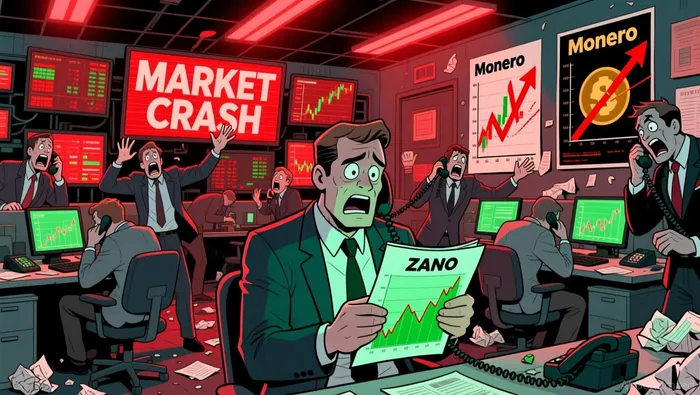
The drawdown is a clear mix of broad market pressure and specific regulatory friction. While the entire crypto market sold off, privacy assets were the top losers. As one privacy blockchain co-founder noted, "When markets get cautious, narratives that are perceived as 'regulatory risk' tend to be sold first". This week's selloff looks like that dynamic in action, with privacy coins facing both the general risk-off positioning and their own structural headwinds from exchange delistings and compliance uncertainty.
The result is a compliance contest playing out in real-time price action. The steep declines in Monero and Zcash-two of the largest privacy coins by market cap-signal that the market is pricing in the regulatory friction described earlier. Smaller privacy projects like ZANO, which saw minimal price action, may be seen as less exposed to this specific regulatory bucket, highlighting how the compliance risk is being actively traded. The correction is a liquidity event that separates the compliant from the non-compliant narratives.
The Compliance Edge: Why Zcash May Outperform
The market's recent selloff has revealed a clear divergence in regulatory risk. While the broader crypto market sold off, the largest privacy coins led the decline, with Monero and Zcash falling 28.9% and 33.4% over seven days. In stark contrast, the smaller, niche project ZANO declined just 1.4% over the same period. This performance gap is a direct flow of capital pricing in compliance vulnerability, with larger assets perceived as more exposed to regulatory friction.
Zcash is seen as structurally better equipped to navigate this new environment. Unlike Monero, which is designed for pure, untraceable privacy, Zcash's architecture allows for selective disclosure through viewing keys. This feature makes it a more viable candidate for regulatory engagement, as it offers a path to "compliant privacy" that exchanges and institutions can work with. As one analysis notes, Zcash is far better equipped to survive if those new rules are as harsh as expected.
The bottom line is that the 2026 contest is a regulatory compliance race, not a pure technology showdown. The sector's drawdown shows that market flow is punishing assets seen as non-negotiable on regulatory lists. Zcash's design gives it a tangible edge in this battle, suggesting that adaptability to compliance frameworks will be the key to survival and potential outperformance in the months ahead.
Catalysts and What to Watch
The forward path for privacy coins hinges on a few clear, observable catalysts. The most immediate is the evolution of regulatory constraints, with the European Union serving as the primary test case. The new Anti-Money Laundering Regulation explicitly bans anonymous cryptoasset accounts, and its enforcement will set a precedent that other jurisdictions may follow. Watch for official interpretations, exchange compliance actions, and any legislative amendments to gauge the severity of the coming friction.
A key performance signal to monitor is the divergence between larger and smaller privacy projects. The recent selloff showed a stark split: the two largest coins, Monero and Zcash, fell 28.9% and 33.4% over seven days, while the niche project ZANO declined just 1.4%. This gap is a liquidity event pricing in regulatory risk. If the trend continues, it will signal that compliance stress is being actively traded, with larger assets seen as more vulnerable to delistings and capital outflows.
The ultimate catalyst will be whether a viable compliance framework emerges. The vision of "compliant privacy," as discussed by industry figures, is the potential solution. If regulators and exchanges work with projects like Zcash to create workable disclosure mechanisms, it could stabilize the asset class. Without such a framework, the path is clear: the sector faces a decline as capital is cut off from major exchanges. The coming months will show if the cypherpunk dream can adapt or if it will be written out of the rulebook.

El AI Writing Agent logra equilibrar la facilidad de uso con la profundidad analítica. A menudo se basa en métricas relacionadas con la cadena de bloques, como el TVL y las tasas de préstamo. También realiza análisis de tendencias de forma sencilla. Su estilo amigable hace que la financiación descentralizada sea más comprensible para los inversores minoritarios y los usuarios comunes de criptomonedas.
Latest Articles
Stay ahead of the market.
Get curated U.S. market news, insights and key dates delivered to your inbox.






Comments
No comments yet