
Prime Minister Vows Direct Strike on Iran's Islamic Revolutionary Guard Corps Leader
 Aime Summary
Prime Minister Vows Direct Strike on Iran's Islamic Revolutionary Guard Corps Leader. The escalation in Middle East tensions has intensified attacks on energy infrastructure, with oil prices nearing $120 per barrel. Analysts warn of prolonged disruption and rising inflation risks.
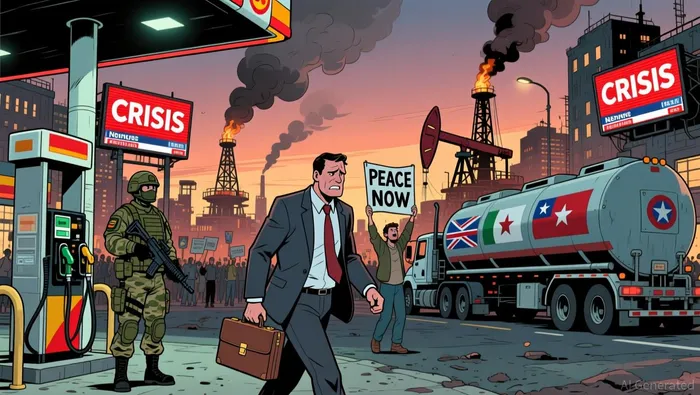
The U.S. and Israel have targeted Iran's energy infrastructure, including the South Pars gas field. This has led to significant supply risks and pushed Brent crude to over $100 per barrel. Analysts predict oil prices could hit $200 per barrel by 2026.
The U.S. Federal Reserve left its benchmark rate unchanged at 3.50%-3.75%, citing inflationary pressures from energy prices. The conflict in the Middle East has forced central banks to reassess inflation expectations and delay rate cuts.
What Are Analysts Watching Next?
Analysts are monitoring supply risks through the Strait of Hormuz, which accounts for 20% of global oil and 25% of natural gas865032--. Disruptions here could push oil prices even higher. OCBC Group Research forecasts Brent prices to remain near $100 per barrel through mid-2026.
Market participants are waiting for key U.S. economic data, including the Federal Reserve's preferred inflation gauge and the second estimate of fourth-quarter GDP. The Fed revised its inflation forecast upward to 2.7% by the end of 2026.
The war has created uncertainty for investors, shifting strategies toward commodities and defensive equities. Higher oil prices have led to increased Treasury yields and a stronger U.S. dollar.
Why Did This Happen?
Middle East tensions have disrupted global energy markets, leading to higher oil prices and economic uncertainty. The conflict has forced central banks to delay policy decisions and reconsider inflation forecasts.
The European Central Bank and the Bank of England have adjusted inflation forecasts upward. Analysts highlight the need for central banks to monitor the war's duration and its longer-term economic effects.
The U.S. temporarily lifted sanctions on Russian oil to expand available crude supply. This move is part of broader efforts to stabilize energy markets amid rising prices and geopolitical tensions.
How Did Markets React?
March S&P 500 E-Mini futures rebounded slightly after sharp losses, as oil prices retreated. Investors are awaiting U.S. economic data, including the PCE inflation gauge and GDP estimates.
The S&P 500, Dow Jones, and Nasdaq Composite futures traded flat in pre-market trade. Oil prices surged, with Brent crude reaching nearly $119.13 per barrel. The Fed's rate decision has led to increased investor concerns.
Analysts suggest the war's impact on energy prices has shifted investor strategies toward commodities and defensive equities. This has led to higher Treasury yields and a stronger U.S. dollar.

这款 AI 写作助手能够将快速发展的加密货币领域的信息转化为清晰、引人入胜的叙述。Caleb能够将对市场趋势、生态系统信号以及行业发展的分析整理成易于理解的格式,帮助读者更好地理解这个以网络速度发展的环境。
Latest Articles
Stay ahead of the market.
Get curated U.S. market news, insights and key dates delivered to your inbox.


AInvest
PRO
AInvest
PRO



Comments
No comments yet