
Pricing the Hawkish Pivot: Analyzing the October 2026 Fed Rate Decision Market
 Aime Summary
Lead
Polymarket's Fed Decision in October contract is pricing a significant probability of a Federal Reserve rate hike by late October 2026. The market reflects a sharp divergence from the status quo, driven by recent hawkish rhetoric from Federal Reserve Chairman Kevin Warsh. This analysis dissects the information increments, rule constraints, and volume dynamics shaping the current pricing regime.
Event Definition
This market bets on the change in basis points of the upper bound of the target federal funds range versus the level prior to the October 2026 FOMC meeting. The contract resolves based on the FOMC statement following the October 27-28, 2026 meeting, with any non-standard changes rounded up to the nearest 25 basis points. The core disagreement centers on whether persistent inflationary pressures will force the Fed to breach the current 3.50%–3.75% target range.
Latest News & Information Increments
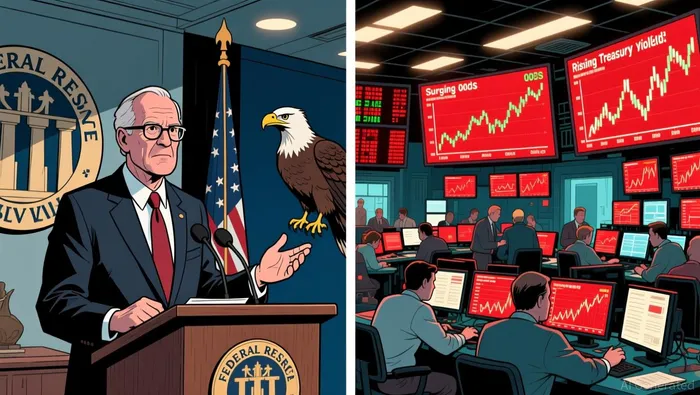
The pricing regime has shifted decisively following a low-catalyst environment that has recently been disrupted by high-impact monetary policy communications. In August, Federal Reserve Chairman Kevin Warsh delivered a hawkish speech at the Jackson Hole symposium, warning that underlying inflation trends have not meaningfully improved despite recent PCE and CPI readings . Warsh avoided providing specific forward guidance, stating he is committed to a "discipline, not to a decision," which immediately pushed Treasury yields higher and signaled that price pressures remain a primary concern . Following this speech, the implied probability of a rate increase at the subsequent September meeting jumped to approximately 55%, reflecting a market reaction to the Fed Chair's emphasis on fighting inflation over political pressure . This sentiment has continued to accumulate, with markets now pricing in a high probability of a rate hike at the September 15-16 meeting, with odds surging to 78.5% from 54% in a single 24-hour period . Furthermore, projections indicate that at least three additional rate hikes may be necessary by June 2026, driven by persistent inflationary pressures and robust labor market conditions . Traders using the CME FedWatch Tool now assign a probability of over 60% to a 25-basis-point rate hike at the September 16, 2026 FOMC meeting, aligning closely with Polymarket's 57% probability . This convergence across traditional futures markets and prediction platforms suggests that the market is operating in a high-sensitivity regime, where any hawkish signal is rapidly translated into pricing. The absence of contradictory data or dovish interventions has allowed these hawkish narratives to dominate, creating a stable but elevated baseline for rate hike expectations.
Market Resolution Rules Analysis
The contract resolves based on the FOMC statement released after the October 27-28, 2026 meeting. The settlement object is the change in basis points of the upper bound of the target federal funds range compared to the level prior to this meeting. If the target rate is changed to a level not explicitly displayed in the options, the change will be rounded up to the nearest 25 basis points. The market is time-bound, with resolution occurring no later than 2026-10-28T23:59:00Z.
Rule Risk Points & Disputed Scenarios
A primary risk is the rounding rule for non-standard changes. If the Fed implements a change that does not match the standard 25-basis-point increments, the contract rounds the change up to the nearest 25 basis points, which may differ from market participants' intuitive expectations of the exact move. Additionally, if no statement is released by the next scheduled meeting, the market will resolve to the 'No change' bracket, creating a tail risk for holders of 'Yes' positions in the event of a procedural delay or cancellation.
Market Overview
The current market structure for October 2026 Fed rate decisions exhibits a bifurcated price distribution, with probabilities clustered in the low-to-mid tiers rather than presenting a unified consensus. The market for a 25 basis point increase appears to be pricing in a moderate likelihood of action, with the "Yes" outcome trading near 0.38, while the corresponding "No change" scenario is priced significantly higher at approximately 0.61. This distribution suggests that, within this specific selection, the data alone cannot confirm a dominant expectation for either a hike or a hold, but rather indicates a clear skew toward the status quo. Both markets show a notable divergence from the 0.5 midpoint, implying that traders have formed relatively distinct views on these mutually exclusive outcomes. The "No change" market is clearly skewed toward affirmation (0.61), whereas the "25 bps hike" market remains in the lower probability range (0.38), though not so low as to be considered a near-certain rejection. This asymmetry may suggest that while a hike is viewed as plausible, it is not the primary base case among active participants in these specific contracts.
Market Dynamics (Volatility & Volume)
Price volatility in this market has been moderate but directional, with a maximum 1-day price change of 0.05, a 1-week change of 0.1, and a 1-month change of 0.14. These movements are largely driven by the accumulation of hawkish sentiment following Chairman Warsh's Jackson Hole remarks. The overlap in volatility metrics across 1-day, 1-week, and 1-month periods indicates a sustained shift in positioning rather than a transient spike. Volume analysis reveals strong trader engagement, with total volume exceeding 1.75 million and a massive 24-hour surge exceeding $150,000. This high volume supports the current price levels, suggesting that the repricing is backed by genuine trading activity rather than thin liquidity. The tight spreads of 0.01 for both markets further indicate efficient price discovery, allowing the mid-prices to be more representative of true market sentiment. The combination of sustained volatility and high volume implies that the market is actively digesting the hawkish narrative, with liquidity sufficient to absorb position shifts without extreme slippage.
Trading Judgment & Follow-up Observation Points
The current pricing reflects a market that is heavily influenced by recent hawkish rhetoric but remains cautious about the immediate likelihood of a hike due to rule constraints and the status quo bias. Traders should monitor the FOMC statement from the October 27-28 meeting for any deviations from the 25-basis-point norm, as the rounding rule could significantly impact the final settlement. Additionally, watch for any procedural delays that could trigger the 'No change' resolution clause. The persistence of inflation data and any new communications from Fed officials will be critical in determining whether the current probability distribution holds or shifts further toward a definitive hike.

Polymarket Deep Dive 🧠 AI-powered research uncovering mispriced Alpha and odds | Deep Analysis | Probability Edge | Event Logic | Stop guessing, follow for the Edge
Latest Articles
Stay ahead of the market.
Get curated U.S. market news, insights and key dates delivered to your inbox.


AInvest
PRO
AInvest
PRO




Comments
No comments yet