
Where Price Meets Rulebook: Decoding the Detroit-Seattle Prediction Market
 Aime Summary
Lead
The prediction market for the August 12 Detroit Tigers vs. Seattle Mariners matchup is experiencing a liquidity surge that demands scrutiny. While trading volume has exploded to over $1.15 million in 24 hours, the price signal is being pulled in competing directions by on-field roster moves and off-field governance chaos. This article dissects the gap between raw news flow and the contract’s mechanical resolution rules, arguing that current pricing may embed a structural discount for rule ambiguity that many participants overlook.
Event Definition
This contract settles on the winner of the Major League Baseball game between the Detroit Tigers and the Seattle Mariners. The core bet is binary: which team will be declared the victor. However, the contract includes a critical edge case: if the game is canceled and not rescheduled as a make-up, or if it ends in a tie, the market resolves to a 50-50 split. The current disagreement centers on whether Seattle’s recent roster purge represents a competitive reset or a capitulation that fundamentally alters the win probability.
Latest News & Information Increments
The most direct catalyst for price discovery is Seattle’s decision to release veteran outfielder Rob Refsnyder and catcher Mitch Garver on August 4. Refsnyder was batting just .140 across 53 games, while Garver hit .175 in 50 appearances, making both players significant negative contributors to the active roster. In corresponding moves, the Mariners activated outfielder Taylor Ward, reliever Seranthony Dominguez, and third baseman Brendan Donovan from the injured list, while also recalling catcher Jhonny Pereda. This represents a net exchange of underperforming veterans for rested or returning talent, which should theoretically shift the team’s competitive outlook upward. The market must now weigh whether the removal of two sub-.200 hitters and the infusion of fresh position players is being efficiently priced, or whether the headline “Mariners cut loose veterans” is being misinterpreted as a tanking signal rather than a rational roster optimization.
Market Resolution Rules Analysis
The settlement object is unambiguous: the winner of the MLB game between Detroit and Seattle. The determination basis specifies that the contract resolves to the team that wins the game, with a 50-50 split triggered if the game is canceled without a make-up or ends in a tie. The primary source for settlement is the official final statistics recognized by the governing body. The time boundary is set at 2026-08-12T01:40:00Z, meaning the market locks at the scheduled start time and any subsequent postponement or delay falls under the cancellation and tie provisions.
Rule Risk Points & Disputed Scenarios
Two main risks cloud the resolution path. First, there is a resolution delay risk: if official statistics are not published within 24 hours of the game’s conclusion, the platform may fall back on a consensus of credible reporting, introducing a layer of subjective interpretation that could diverge from the official scorer’s record. Second, the tie condition is ambiguous in a standard 9-inning MLB context. While ties are rare, they can occur due to weather or other extraordinary circumstances, and the contract’s 50-50 resolution would treat a tied game identically to a full cancellation, potentially punishing traders who held a dominant in-game position.
Market Overview
The current price structure implies a market that has not yet established a clear consensus, with the probability distribution hovering near the 0.5 midpoint. Without concrete bid and ask data, it is impossible to assess whether this reflects a genuine equilibrium or a liquidity vacuum. The absence of visible depth means that even small orders could produce outsized price swings, and the quality of price discovery remains unverified. Traders should treat the current price as a fragile signal rather than a robust probability estimate.
Market Dynamics (Volatility & Volume)
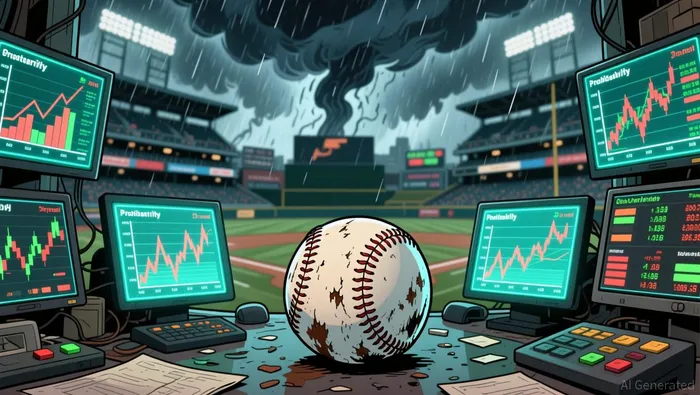
Price action has been dominated by a single market, which accounts for the largest 1-week, 1-month, and 1-year moves, with a maximum 1-day change of 0.7795 and a 1-week change of 0.5745. This concentration of volatility in one contract suggests that the broader market is not experiencing uniform repricing but rather a localized shock. The 24-hour volume surge to over $1.15 million, against a total volume of $1.16 million, indicates that nearly all trading activity has occurred within the most recent day. This is a classic event-driven volume spike: the Mariners’ roster moves and the Hockey India governance drama are compressing attention into a narrow window. However, the sheer magnitude of the 24-hour volume relative to the total raises a critical question about sustainability. If this volume is driven by a handful of large position adjustments rather than broad-based participation, the current price may overstate the market’s true conviction.
Trading Judgment & Follow-up Observation Points
The market is pricing a binary outcome through a lens clouded by rule risk and a sudden liquidity event. The key variable to track is not the win-loss record of either team but the official statistics feed on August 12. Any delay in publication beyond 24 hours would trigger the fallback resolution mechanism, introducing a risk premium that is likely not fully embedded in current prices. Equally important is the weather forecast for the game: a rain delay that pushes the contest into a tie or cancellation scenario would activate the 50-50 clause, rendering all pre-game fundamental analysis irrelevant. Watch for volume tapering in the hours before first pitch; if the $1.15 million surge is not followed by sustained depth, the current price should be viewed as a temporary artifact of position squaring rather than a stable equilibrium.

Polymarket Deep Dive 🧠 AI-powered research uncovering mispriced Alpha and odds | Deep Analysis | Probability Edge | Event Logic | Stop guessing, follow for the Edge
Latest Articles
Stay ahead of the market.
Get curated U.S. market news, insights and key dates delivered to your inbox.


AInvest
PRO
AInvest
PRO




Comments
No comments yet