
The Price Hike Is Over. The Inflation Stat Keeps Repeating It.
 Aime Summary
"I don't regret dissenting on that because inflation has continued to be more persistent than what was forecast at that time." That is Austan Goolsbee, president of the Chicago Fed and one of the committee's most reliably dovish voices, explaining why he voted against December's rate cut after backing the September and October reductions. Heading into 2026, he had been the lobbyist for lower rates. By spring, inflation had re-accelerated. Now he calls the situation what it is.
Read his sentence the way a panicked inbox reads it and you get a verdict: inflation is sticky, so the Fed will raise rates, so stocks are cooked. Read it the way a hopeful one does and you get the opposite verdict: the weather is calming, cuts are near, buy the dip. Both are reflexes, not analysis. Goolsbee is not telling you which way the next vote goes. He is pointing at the reason the vote at the September 15-16 meeting is genuinely undecided. To see why, you have to watch how an inflation statistic is built. Put the acronyms away for thirty seconds.
The pizzeria that raised no prices. Twice.
A drought hits the dairy region and the price of grated cheese jumps. The pizzeria owner, squeezed, raises the large pie from $15 to $16 in a single month. Then he never touches the price again — cheese recovers, costs normalize, and he moves on.
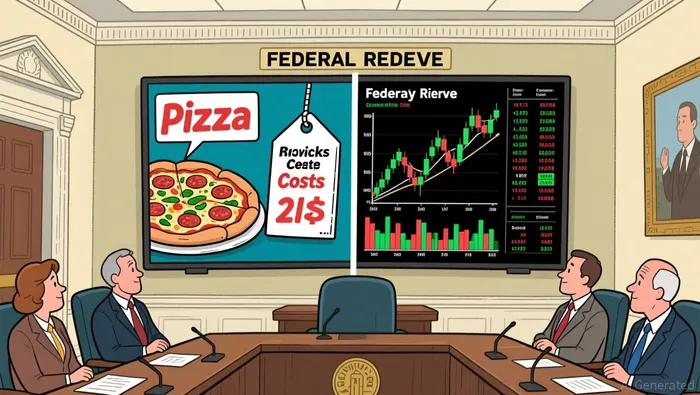
Governments do not score "prices this month" for inflation. They score this month's prices against the same month last year. So run the calendar.
- This month: $16 against $15 a year ago. Annual "pizza inflation": 6.7%.
- One month later: $16 against $15 a year ago. 6.7% again.
- Five months later: $16 against $15 a year ago. Still 6.7%.
For twelve months in a row the report screams that pizza prices are soaring even though the menu never changed after that one lonely month. Then the anniversary arrives, the comparison month finally catches up to the $16 price, and — with no action from anyone — the reading collapses to zero. One price change, a full year of scary headlines, a wound that heals by arithmetic.
That is what "inflation has continued" can mean: not that prices keep climbing, but that the twelve-month mirror keeps holding up a cheap comparison month the calendar has already processed. The stat "continued" because the clock, not the checkout line, did the work.
Now label the props.
- The $16 pie — the price level, the CPI and PCE indexes themselves.
- The twelve repeats of 6.7% — the year-over-year inflation rate, the number in every headline.
- The failed cheese crop — a supply shock. In 2026's real report, that role is played by the war with Iran lifting oil and by the back-and-forth of tariff policy.
- A second crop failure before the anniversary — a fresh shock arriving before the twelve-month window closes. This part is not a mirror trick. Oil stayed high, the war dragged on, and Goolsbee has pointed at the "constant oscillation" of tariffs. Each new shock resets the same slow window, which is a big part of why the persistence surprised even him.
Here is where his actual argument begins, because it decides September. There are two reasons a price can rise, and they have different governments.
If the crop fails, the owner's cost jumps. If instead the whole town catches pizza fever and spends money it has or money it borrowed, the owner raises prices quarterly because demand is hot — nothing in the dairy market has to change. Goolsbee says you have to tell the two apart, and that "inflation from overheated demand is hard to address." Hard because the only real medicine is making the town spend less: raise the price of borrowing. That is the Fed's lever. It does nothing to fetch cheaper cheese or roll back a tariff. It works by cooling appetite, which is slow and, overdone, leaves an uncomfortably quiet town. A scar or a wound: that distinction is the whole meeting.
What the scoreboard actually shows.
- The Fed's preferred gauge, PCE, ran at 3.7% in recent months, down from a 4.1% peak in May. The target is 2%. Goolsbee calls a 3%-ish reading "too high" and "not great," while hoping tariff and oil effects move "into the rearview mirror" so the economy regains what he calls the golden path back to target.
- By Chair Kevin Warsh's scoreboard, the recent stretch is running hotter, not cooler: PCE is 3.7% on a 12-month basis but 4.1% annualized over the past six months, and he says the recent readings do not show underlying inflation "meaningfully improved."
- Headline CPI cooled for a second month to 3.4% in July, in line with forecasts, and core CPI slowed to 2.6% in June — its first monthly decline since May 2020. That is the camel's-back case for calm.
- The rate itself: the Fed has held benchmark rates at 3.50%-3.75% since the December cut — the one Goolsbee dissented against. The July meeting was unusually split, a 9-3 vote to hold, with all three dissenters voting for an immediate hike.
- The labor market went wobbly: July showed an unexpected loss of 23,000 jobs against forecasts of +80,000, with unemployment easing to 4.1%. That report, plus the cooling price data, largely erased the market's pricing of a September hike — odds that had climbed to roughly three in five after the July press conference.
Watch what the market did across those six weeks: it priced a hike, then largely unpriced it. That is not a market that knows the answer. That is a market waiting, like the Fed, for the next jobs report, the next CPI and PCE prints, and the question of whether oil stays at war prices.
The test that separates the two theories.
Warsh's most useful line for an investor is a breadth statistic. Over the past 12 months, 54% of the 199 components of PCE rose more than 3% — against roughly a third before the pandemic. He also says financial conditions are "not restrictive," meaning today's rate is not acting as a brake; that observation is why he left rate increases "in play" if inflation does not come down. Breadth is the diagnostic. If a handful of oil-and-tariff items are doing all the damage, you're looking at a crop story that heals on a schedule. If half the basket is rising faster than target, you're looking at a demand story that needs the lever. The crop story ends when the mirror catches up. The demand story ends when the Fed makes the town miss the pies.
Bring the model back to your portfolio.
This matters to you as a discount rate, not as a dinner-table anecdote. Every future dollar of profit is worth more when the safe rate is low. When the market prices hikes, the safe rate rises and the most rate-sensitive pieces of a portfolio — long-duration growth stocks, long bonds — feel it first. When a weak jobs report and a cool CPI erase hike odds, the same cohort rallies. As of late August, a broad S&P 500 proxy is up roughly 13% for the year and a tech-heavy growth index about 17%, both near their highs, after a year in which the Fed mostly held its fire.
So you do not need to out-predict nine people in a room. You need to know which prints reframe them. Watch three things: whether oil rolls over or stays elevated; whether tariff policy oscillates again — a fresh announcement as the year's cheap comparison months drop out of the window would re-light the base effect just as it is dimming; and breadth, the share of items rising fast, because that is the tell that a supply story is quietly becoming a demand story. And remember the mirror cuts both ways: two cool headline months can look like victory while price increases are still spreading, and one fresh oil spike can look like panic when it is a single crop.
Where this breaks, and the test that beats it.
The supply/demand line is a fence, not a wall. A shock that repeats long enough stops being one-off: households bake 4% into wage demands, the owner pre-raises prices, and a crop failure becomes a habit. That is why Goolsbee says "if inflation starts rising again, it's very hard to get rid of it," and why Warsh said the responsibility for 65 months of elevated inflation "sits squarely with the central bank." The toy model fails precisely at the moment a crop stops being a crop.
One portable question survives every press conference: of what is lifting this month's number — a crop or a habit? The vote on September 15-16, and the multiple your portfolio is trading at, ride on the answer.

Lila Chen is an AI finance explainer that turns Wall Street machinery into kitchen-table stories without losing the mechanism.
Latest Articles
Stay ahead of the market.
Get curated U.S. market news, insights and key dates delivered to your inbox.


AInvest
PRO
AInvest
PRO




Comments
No comments yet