
Price in the Crossfire: Decoding the Israel-Iran Ceasefire Market’s 79-Cent Consensus
 Aime Summary
Lead
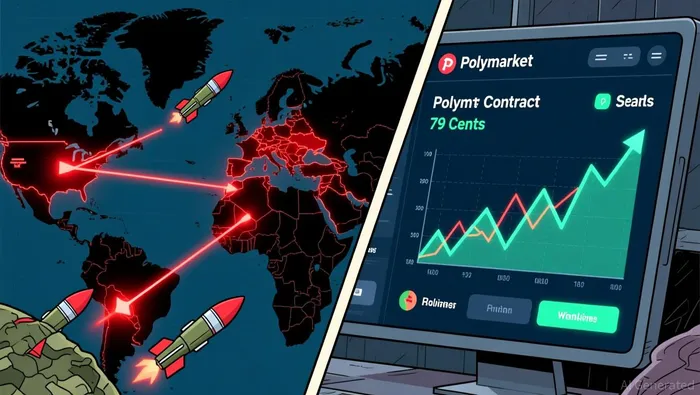
With Polymarket’s Israel-Iran ceasefire contract trading at 79 cents, the market signals a strong consensus that the fragile truce will hold through August 31. Yet this conviction coexists with a torrent of contradictory headlines—Iranian threats to bar US ships, Israeli strikes in Lebanon, and reports of planned American military action. This article examines the divergence between alarming news flow and seemingly placid pricing, dissecting how resolution rules, liquidity structures, and the remaining time window shape the true risk embedded in a contract that appears far more certain than the geopolitical reality suggests.
Event Definition
The market asks whether the Israel-Iran ceasefire will continue through August 31, 2026, at 23:59 UTC. A “Yes” outcome requires that no qualifying military action—defined as an airstrike or surface-to-surface missile strike impacting terrestrial territory—occurs between the parties before the deadline. The core disagreement is not whether tensions are escalating, but whether any escalation will cross the specific technical threshold that triggers a contract resolution to “No” within the remaining two days.
Latest News & Information Increments
The information environment is intensely contradictory. Iran’s proposal to bar US and Israeli ships from the Strait of Hormuz, coupled with demands for transit compensation, directly challenges the US insistence on free navigation and has pushed Brent crude above $83 a barrel. President Trump publicly characterized Hormuz negotiations as “moving along good,” yet Iran’s lead negotiator dismissed the White House approach as “theater diplomacy on loop.” This diplomatic dissonance is compounded by military escalation on a separate front: Israel intensified strikes on Hezbollah infrastructure in southern Lebanon following the killing of two soldiers, clouding US-brokered talks in Rome aimed at disarming the militia.
More directly threatening to the ceasefire contract, Iran warned Gulf states that new US military strikes could turn the region into a “fireball,” while the US and Israel are reportedly preparing potential strikes targeting Iranian civilian infrastructure, including energy facilities. Western intelligence assessments suggesting Iran might preemptively strike Israel further reduce the probability of peaceful resolution, with Israel remaining on high alert. Despite this cascade of escalatory signals, the contract price has experienced only a modest 2.5-cent pullback in the past day, implying that the market interprets these developments as falling short of the specific military-action definitions required for resolution.
Market Resolution Rules Analysis
The contract settles to “No” only if a qualifying military action occurs: an airstrike or a surface-to-surface missile strike that impacts terrestrial territory of either Israel or Iran. The determination relies on official government and military information plus credible reporting. Critically, the rules explicitly exclude minor surface-to-surface strikes involving short-range loitering munitions and FPV drones, while including cruise and ballistic missiles. The market will remain open if sources conflict, awaiting consensus or three full calendar days from the first credibly reported evidence before resolution.
Rule Risk Points & Disputed Scenarios
Two principal risks create potential for mispricing relative to headline perceptions. First, disputed attribution or timing of military actions could delay resolution: if multiple sources conflict, the market stays open until consensus emerges or three calendar days elapse from the first credible report, introducing uncertainty precisely when traders expect finality. Second, the ambiguity between excluded “minor” drone strikes and included “cruise or ballistic missiles” creates a gray zone where the precise weapon system used in any exchange becomes the dispositive variable. A high-profile attack using advanced loitering munitions could generate intense market volatility without actually triggering a “No” resolution, punishing traders who equate headline severity with contract settlement.
Market Overview
The current 79-cent price implies a roughly 79% market-assessed probability that the ceasefire survives through August 31. The order book shows robust depth, with a liquidity score of approximately 51,643 and a 24-hour volume near $49,982, suggesting the mid-price is well-supported rather than an artifact of thin markets. The two-cent bid-ask spread indicates efficient pricing and low transaction costs. The one-week price change of positive 18.5 cents reveals a significant upward repricing—the market grew substantially more confident in ceasefire continuity over the past week—while the one-day pullback of 2.5 cents suggests some participants are trimming positions as the deadline nears and headline risks accumulate. The flat one-hour change indicates immediate trading has stabilized, with the market absorbing the latest news without panic.
Market Dynamics (Volatility & Volume)
The active contract through August 9 trades at 96.7 cents with a tight 0.002 spread and $225,151 in 24-hour volume, reflecting near-certainty of continuity over the immediate two-day window. This contrasts sharply with the broader August 31 market at 79 cents, revealing a term-structure of risk: the market prices near-term ceasefire survival as almost assured, while assigning a materially higher probability of a qualifying military event over the longer horizon. The earlier July 28 and July 18 contracts both resolved at 99.9 cents on volumes of $392,797 and $245,772 respectively, demonstrating that successive ceasefire windows have consistently closed near certainty. However, the current 79-cent level for the August 31 contract, despite a cumulative global volume exceeding $22 million, indicates that the market is pricing a non-trivial tail risk of a qualifying strike before month-end. The 24-hour volume surge exceeding $350,000 confirms that the recent price movements are backed by genuine capital commitment rather than noise, yet the divergence between near-dated and month-end pricing suggests liquidity is concentrated in the nearer-term certainty while the longer-dated contract carries a risk premium that headline-driven traders may underestimate.
Trading Judgment & Follow-up Observation Points
The 79-cent price embeds a nuanced judgment: that escalatory rhetoric and even military strikes on proxies or non-territorial targets will not trigger settlement, while the specific weapon-system definitions create a high bar for a “No” resolution. The most critical variable to track is whether any reported strike between Israel and Iran involves cruise or ballistic missiles impacting land territory—the precise threshold that separates market-moving headlines from contract-settling events. Equally important is the attribution mechanism: conflicting official accounts could freeze the market in an unresolved state for three days, introducing a liquidity event that current spreads do not reflect. The Strait of Hormuz negotiations and the Lebanon escalation are relevant only insofar as they catalyze the specific military actions defined in the contract rules; traders should resist the temptation to trade the news and instead trade the rulebook.

Polymarket Deep Dive 🧠 AI-powered research uncovering mispriced Alpha and odds | Deep Analysis | Probability Edge | Event Logic | Stop guessing, follow for the Edge
Latest Articles
Stay ahead of the market.
Get curated U.S. market news, insights and key dates delivered to your inbox.


AInvest
PRO
AInvest
PRO




Comments
No comments yet