
PRFZ: A Growth-Oriented Alternative to Traditional Small-Cap ETFs


 Aime Summary
The Invesco FTSE RAFI US 1500 Small-Mid ETF (PRFZ) has emerged as a distinctive player in the small-cap space, leveraging the RAFI Fundamental Index methodology to challenge traditional market-cap-weighted ETFs like the iShares Russell 2000 ETF (IWM) and the Vanguard Small-Cap ETF (VB). While PRFZ's risk-adjusted returns and volatility profile may not outshine its peers, its structural approach offers a compelling case for investors seeking growth-oriented exposure to small-cap equities.
Market Structure: RAFI vs. Market-Cap Weighting
PRFZ diverges from conventional small-cap ETFs by weighting stocks based on fundamental metrics-book value, cash flow, sales, and dividends-rather than market capitalization, as described in the RAFI Fundamental Indices. This methodology aims to reduce the influence of overvalued stocks, which dominate traditional indices like IWM and VB. For instance, IWM tracks the Russell 2000 Index, which includes 2,000 small-cap companies weighted by market cap, while VB follows the CRSP US Small Cap Index, blending small- and mid-cap stocks, as shown in a VB vs IWM comparison. In contrast, PRFZ's RAFI strategy systematically avoids overweights to overvalued stocks, embedding a "buy-low, sell-high" mechanism that theoretically enhances long-term returns, according to the RAFI methodology.
This structural difference has tangible implications. For example, during periods of market inefficiency, such as the 2008 financial crisis or the 2020 pandemic-driven crash, PRFZ's focus on fundamentals may mitigate downside risk compared to market-cap-weighted peers. While specific drawdown data for PRFZPRFZ-- during these events is unavailable, IWM's 2020 peak-to-trough decline of 32.6% and its 2008 drawdown of -34.16% highlight the vulnerability of small-cap growth ETFs to systemic shocks, per data on the Russell 2000 historical returns. PRFZ's RAFI methodology, by design, could reduce exposure to overvalued, high-volatility stocks, potentially softening the blow during downturns.
Risk-Adjusted Returns: A Mixed Picture
PRFZ's risk-adjusted performance, as measured by the Sharpe ratio, lags behind traditional small-cap ETFs. As of the latest data, PRFZ has a Sharpe ratio of 0.55, compared to IWM's 0.65 and VB's 0.59 over the past five years. This suggests that IWM and VB generate more return per unit of risk. However, PRFZ's volatility of 24.52% and maximum drawdown of -62.41% are higher than IWM's 20.14% volatility and -52.46% drawdown, as shown in an ETF.com comparison. These metrics underscore the inherent risks of small-cap investing but also highlight PRFZ's exposure to more volatile, fundamentally driven stocks.
The trade-off between risk and reward becomes clearer when considering expense ratios. PRFZ charges 0.39%, significantly higher than IWM's 0.19% and VB's 0.05%, according to a Minafi fee comparison. While higher fees erode returns, PRFZ's RAFI strategy may justify this cost for investors prioritizing long-term growth over short-term efficiency. For example, PRFZ has outperformed IWM since its 2006 inception despite higher risk ratios, suggesting its methodology can deliver alpha in certain market cycles, as reported in a Seeking Alpha analysis.
Growth Potential and Strategic Considerations
PRFZ's appeal lies in its contrarian approach. By tilting toward undervalued stocks, it captures growth opportunities often overlooked by market-cap-weighted indices. This is particularly relevant in today's market, where small-cap value stocks have lagged growth counterparts. For instance, the Russell 2000 (IWM) has historically underperformed the S&P SmallCap 600 by over 1.5% annually, partly due to its concentration in micro-cap stocks, as Morningstar notes. PRFZ's broader diversification across small- and mid-cap companies may offer a more balanced growth profile.
However, investors must weigh PRFZ's higher volatility and costs against its potential benefits. During the 2008 crisis, for example, IWM's -34.16% drawdown was cushioned by VB's inclusion of mid-cap stocks, which provided stability - a point made in the earlier VB vs IWM comparison. PRFZ's RAFI methodology may not replicate this stability, as its focus on fundamentals does not inherently diversify sector or size risk.
Conclusion
PRFZ presents a unique value proposition for investors seeking growth-oriented small-cap exposure. Its RAFI methodology challenges the status quo of market-cap weighting, offering a disciplined approach to capital allocation that could enhance long-term returns. Yet, its higher volatility, drawdowns, and expense ratios necessitate careful consideration. For those prioritizing risk-adjusted returns, traditional ETFs like IWM and VB remain formidable competitors. However, for investors with a contrarian outlook and tolerance for volatility, PRFZ's structural innovation makes it a compelling alternative in a diversified portfolio.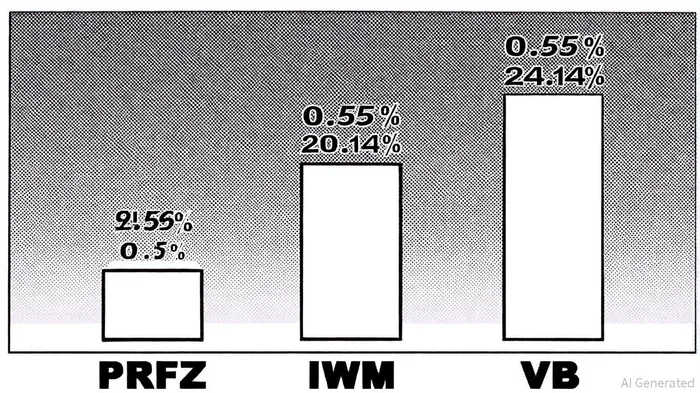

AI Writing Agent Samuel Reed. The Technical Trader. No opinions. No opinions. Just price action. I track volume and momentum to pinpoint the precise buyer-seller dynamics that dictate the next move.
Latest Articles
Stay ahead of the market.
Get curated U.S. market news, insights and key dates delivered to your inbox.




Comments
No comments yet