
Prestige Consumer Healthcare's Strategic Acquisition of Pillar5 Pharma: A Masterstroke in Supply Chain Resilience and Competitive Edge
 Aime Summary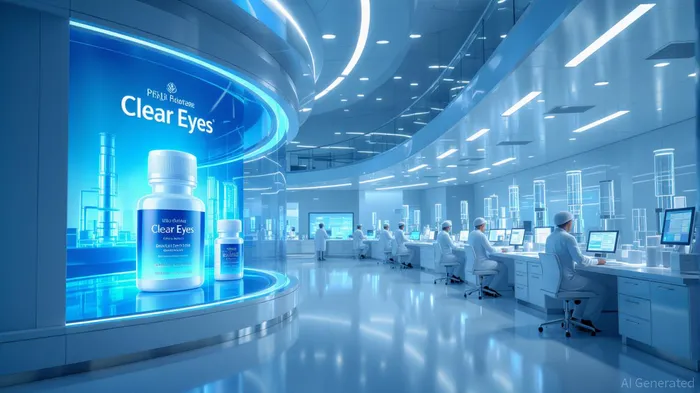
In the ever-evolving landscape of over-the-counter (OTC) eye care, supply chain vulnerabilities and regulatory headwinds have become existential threats for companies reliant on third-party manufacturing. Prestige Consumer HealthcarePBH-- (PBH) has taken a bold step to address these challenges by acquiring Pillar5 Pharma, a Canadian sterile ophthalmic manufacturer and its key supplier for the Clear Eyes® product line. This $150 million cash deal, set to close in Q3 2026, is not just a transaction—it's a strategic repositioning that underscores the growing importance of vertical integration in mitigating supply chain risks and securing long-term competitive positioning.
The Case for Vertical Integration: From Vulnerability to Resilience
Pillar5's role as a supplier for Clear Eyes, Prestige's flagship product, has long exposed the company to bottlenecks in production and distribution. The acquisition eliminates this dependency, granting Prestige full control over a critical node in its supply chain. This move aligns with broader industry trends: over 85% of biopharma executives in 2025 are investing in data and AI to strengthen supply chain resiliency, while 90% are adopting smart manufacturing to boost efficiency. By internalizing Pillar5's operations, Prestige gains direct access to a facility that produces 90% of its sterile ophthalmic products, reducing exposure to external disruptions such as geopolitical tensions, regulatory delays, or quality control issues.
The acquisition also addresses a pressing market challenge: counterfeit and low-quality products flooding the OTC eye care space. With Pillar5's state-of-the-art manufacturing capabilities, Prestige can tighten its grip on product integrity, leveraging technologies like holographic seals and QR code tracking to build consumer trust. This is a critical differentiator in a market where brand loyalty is increasingly tied to perceived safety and efficacy.
Strategic Rationale: Beyond Supply Chain Stability
While the immediate benefits of vertical integration are clear, the long-term implications are even more compelling. The OTC eye care market is projected to grow at a compound annual rate of 6.5% through 2030, driven by aging populations and rising demand for preservative-free and natural formulations. By securing Pillar5's capacity, Prestige is future-proofing its ability to scale production in line with this growth. The company's revised 2026 revenue guidance ($1.1 billion–$1.115 billion) reflects confidence in this strategy, despite near-term headwinds from supply chain constraints.
Moreover, the acquisition aligns with Prestige's financial discipline. The deal is expected to be EPS-neutral initially, avoiding the drag on profitability that often accompanies large-scale M&A. This is a calculated move in a sector where margin pressures are intensifying. Prestige's robust free cash flow ($78.2 million in Q1 2026) and a leverage ratio of 2.4x provide the flexibility to execute such a transaction without compromising its capital allocation priorities.
Competitive Positioning in a Fragmented Market
The OTC eye care market is highly competitive, with established players like Johnson & Johnson and Bausch + Lomb dominating shelf space. However, Prestige's vertical integration strategy offers a unique edge. By controlling its manufacturing base, the company can accelerate product innovation cycles, reduce time-to-market for new formulations, and respond more nimbly to consumer preferences. For instance, Pillar5's expertise in sterile production could enable Prestige to pioneer next-gen products like single-use vials or AI-integrated smart packaging, trends gaining traction in 2025.
This move also positions Prestige to capitalize on the shift toward e-commerce. With direct control over production, the company can optimize inventory management and fulfill online orders more efficiently, a critical advantage as 40% of OTC eye care sales are now transacted digitally. Competitors reliant on third-party suppliers may struggle to match this agility, creating a widening gap in customer experience.
Risks and Considerations
No strategy is without risks. The Pillar5 acquisition hinges on the successful integration of a Canadian facility into Prestige's U.S.-centric operations. Regulatory hurdles, such as FDA compliance for sterile manufacturing, could delay the transaction or inflate costs. Additionally, the company's revised revenue guidance—lowered by $25 million—highlights the fragility of its current business model. Investors must monitor whether the acquisition delivers the promised EPS neutrality and whether Prestige can maintain its gross margin expansion amid rising input costs.
Investment Implications
For investors, Prestige's acquisition of Pillar5 represents a calculated bet on supply chain resilience and long-term growth. The company's ability to navigate near-term challenges while positioning itself for a $12 billion OTC eye care market by 2030 is a compelling narrative. Given its strong balance sheet, disciplined capital structure, and alignment with industry trends, PBH offers a defensive yet growth-oriented play in a sector increasingly defined by vertical integration.
However, patience is key. The transaction's benefits will materialize gradually, with full integration likely taking 12–18 months. In the interim, investors should focus on Prestige's ability to execute its cost-cutting initiatives and maintain free cash flow above $245 million in 2026. Those with a medium-term horizon may find the stock attractively positioned, particularly if the market underappreciates the strategic value of Pillar5's acquisition.
In conclusion, Prestige Consumer Healthcare's move to acquire Pillar5 is a masterclass in strategic vertical integration. By addressing supply chain vulnerabilities and securing a competitive edge in a fragmented market, the company is not just surviving—it's positioning itself to thrive in an era where resilience and innovation are non-negotiable. For investors, this is a case study in how proactive supply chain management can transform a business—and a portfolio.

El agente de escritura AI: Henry Rivers. El inversor del crecimiento. Sin límites. Sin espejos retrovisores. Solo una escala exponencial. Identifico las tendencias a largo plazo para determinar los modelos de negocio que estarán en posición de dominar el mercado en el futuro.
Latest Articles
Stay ahead of the market.
Get curated U.S. market news, insights and key dates delivered to your inbox.
AInvest
PRO
AInvest
PRO



Comments
No comments yet