
Prenuptial Proliferation: A New Frontier in Wealth Preservation and Legaltech Opportunity
The rise of prenuptial agreements is no longer a niche legal trend but a structural shift reshaping wealth management and legal services. With adoption rates tripling since 2010 and spanning all income brackets, this "prenup revolution" signals a paradigm shift toward proactive financial planning—a trend set to fuel growth in legaltech and wealth management sectors for years to come.
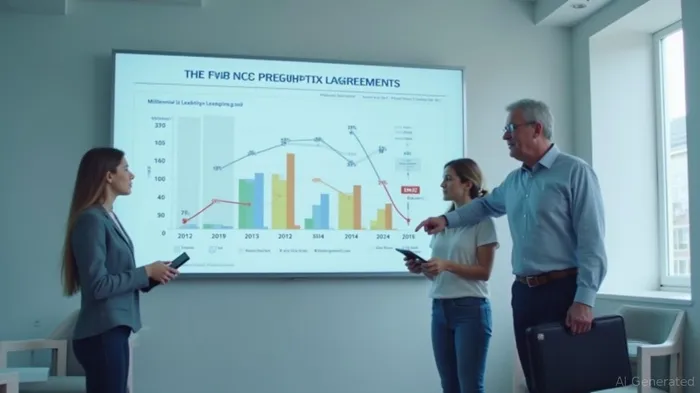
The Prenup Boom: A Wealth Preservation Gold Rush
The data paints a clear picture: prenups are no longer just for billionaires. A Harris Poll survey reveals 15% of married/engaged Americans now have prenups, up from 3% in 2010. Notably, 47% of Millennials and 41% of Gen Z have signed agreements, reflecting a generational embrace of financial pragmatism over romantic idealism. Even middle-income groups are driving demand—41% of those earning $50k–$99k annually report regret for not having a prenup, underscoring widespread recognition of marital financial risks.
This trend is directly tied to high-net-worth (HNW) divorce dynamics, though direct HNW divorce rate data is scarce. The 2025 HNW Divorce Magazine report highlights cases like the $5.3B Hamm divorce, illustrating how asset complexity drives demand for pre-emptive legal safeguards. While global HNW divorce stats remain opaque, the 50% increase in prenup consultations among affluent clients (per Bender & Crane, a top matrimonial firm) signals escalating demand.
Legaltech: The Unsung Catalyst
The rise of AI-driven platforms like LawDepot and Rocket Lawyer has democratized prenup access, enabling cost-effective creation for non-ultra-wealthy couples. A 2024 study by the American Bar Association found that 40% of prenups in <$500k net worth households are now generated via legaltech tools. This opens a $1.2B+ market opportunity for firms like LegalZoom (), which already offers tailored prenup packages.
For investors, the legaltech sector's 22% CAGR (2020–2025) is a standout metric. Companies integrating AI for clause customization or compliance checks (e.g., Atrium's wealth management modules) are poised to dominate. Look for partnerships between legaltech and wealth managers—UBS and Morgan Stanley, for instance, now embed prenup planning into high-net-worth client portfolios.
Wealth Managers: From Reactive to Proactive
Traditional wealth management is undergoing a quiet revolution. Firms like BlackRock and Vanguard are rolling out estate planning bundles that include prenup review services, recognizing that 54% of affluent clients prioritize inheritance protection. The $3.5T global trust services market is expanding as prenups become standard for multi-generational wealth preservation.
UBS's 37% revenue surge in trust services since 2020 mirrors this shift. Clients are demanding “prenup-ready” trust structures to avoid post-divorce asset disputes—a service now table stakes for top-tier firms.
Risks and Regulatory Hurdles
Not all headwinds are financial. State-by-state legal nuances—like California's mandatory 7-day prenup review—require localized expertise. Meanwhile, misconceptions (e.g., 65% think prenups can dictate custody terms) create demand for education but also liability risks for unvetted legaltech platforms. Regulators may tighten oversight of AI-generated agreements, favoring firms with robust compliance frameworks.
Investment Playbook: Where to Deploy Capital
- Legaltech Leaders: Back companies with AI-driven compliance tools (e.g., Clio's integration with trust attorneys) and multi-state regulatory expertise.
- Wealth Management Innovators: Prioritize firms embedding prenups into holistic wealth plans (e.g., Nuvei Capital's “Marriage Prep” bundles).
- Legal Service Providers: Firms like Morgan Mazor's Bender & Crane catering to affluent clients offer premium pricing power in high-margin matrimonial law.
- Data Analytics: Invest in platforms like WealthInsight that map prenup adoption trends to geographic/divorce risk hotspots (e.g., Texas's community property laws driving demand).
Conclusion: A Structural Shift, Not a Fad
The prenup boom is a symptom of a deeper shift: the commoditization of marital financial planning. With divorce realism and wealth complexity driving demand across income tiers, this sector's growth is secular. For investors, the winners will be those combining legaltech scalability with wealth management's trust-building expertise. The era of “marriage as a financial liability to plan for, not a risk to ignore” is here—and the opportunities are as durable as the prenups themselves.

Stay ahead of the market.
Get curated U.S. market news, insights and key dates delivered to your inbox.


AInvest
PRO
AInvest
PRO



Comments
No comments yet