
The Premiumization of Air Travel: How Emirates' 777 Business Class Redesign is Reshaping the Industry


 Aime Summary
In the post-pandemic era, the global travel sector is undergoing a profound transformation. As demand for air travel rebounds, airlines are no longer competing solely on route networks or ticket prices. Instead, the new battleground lies in the ability to deliver premium experiences that justify higher pricing and foster customer loyalty. At the forefront of this shift is Emirates, whose 2025 redesign of its BoeingBA-- 777 Business Class cabins exemplifies how design innovation can redefine the value proposition of air travel.
The Design Revolution: From Criticism to Competitive Edge
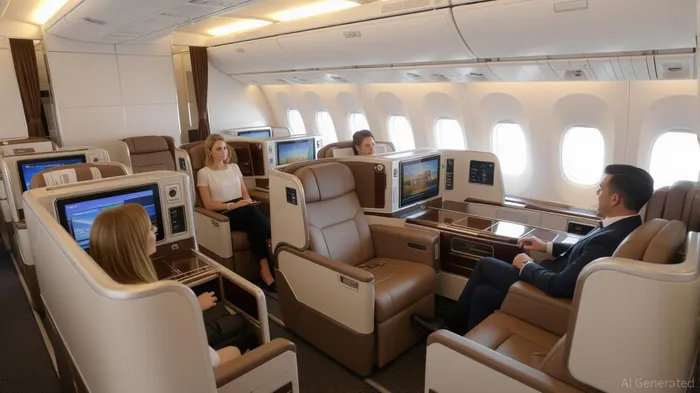
Emirates' redesign addresses one of the most persistent criticisms of its previous 2-3-2 configuration: the absence of direct aisle access for all passengers. By adopting a 1-2-1 layout, the airline ensures every Business Class traveler has personal space and privacy. This change aligns with industry trends set by competitors like Qatar Airways and Finnair, who have long prioritized 1-2-1 or fully enclosed suites. The new layout divides the cabin into two sections—38 seats in total—offering lie-flat 78-inch beds, adjustable lighting, and electric privacy dividers.
The redesign also integrates modern amenities: 23-inch HD screens, USB-C and USB-A ports, and a curated dining experience featuring Middle Eastern specialties and premium wines. These upgrades are not merely cosmetic; they reflect a strategic understanding of post-pandemic traveler priorities. Passengers now demand not just comfort but also personalization, wellness, and seamless digital integration—elements Emirates has embedded into its new cabins.
Customer Loyalty: The Currency of Premium Travel
The redesign's impact on customer loyalty is evident. By eliminating the middle seat and enhancing privacy, Emirates has created a product that resonates with high-net-worth individuals and frequent flyers. The airline's focus on amenities like Bulgari toiletries, noise-canceling headphones, and a 23-inch ICE entertainment system with over 4,000 hours of content elevates the in-flight experience to a level that justifies premium pricing.
Moreover, the retrofit program is part of a broader $5 billion investment in modernizing its fleet. By 2025, 81 Boeing 777-300ERs will be upgraded, with plans to phase out older models in favor of the more efficient 777-9 and 777-8. This commitment to innovation signals to customers that Emirates is not merely reacting to market demands but proactively shaping them.
Premium Pricing Power: A Financial Imperative
The redesign's financial implications are equally compelling. Emirates reported a 20% increase in profit in 2024-2025, driven by its premiumization strategy. While the article focuses on Business Class, the airline's expansion of Premium Economy—offering 1.5–3x the revenue of economy seats—demonstrates a broader trend. By creating a tiered product structure, Emirates captures a wider segment of travelers, from aspirational premium customers to high-net-worth individuals.
The retrofit program also enhances ancillary revenue. Features like minibars, in-flight retail, and loyalty program integration (e.g., free Wi-Fi for Skywards members) diversify income streams. This is critical in an industry where ancillary revenue now accounts for up to 30% of total earnings. For investors, this signals a sustainable model: one that balances innovation with fiscal discipline.
Broader Industry Trends: The Rise of Premiumization
Emirates' strategy mirrors a global shift toward premiumization. Airlines like Singapore Airlines and Korean Air are similarly expanding their premium offerings, recognizing that travelers are willing to pay a premium for differentiated experiences. This trend is reshaping sector valuations, with airlines that invest in innovation outperforming peers.
The retrofit program also aligns with evolving consumer behavior. Post-pandemic, travelers prioritize experiences that blend work and leisure (“bleisure”), demand sustainability (e.g., Emirates' “Farm to Fork” initiatives), and seek digital convenience (e.g., AI-driven entertainment). By addressing these needs, Emirates is not just competing on price but on the totality of the travel experience.
Investment Implications: A Strategic Bet on Premium Travel
For investors, the key takeaway is clear: airlines that prioritize design innovation and customer-centricity are best positioned to thrive in the post-pandemic recovery. Emirates' $5 billion retrofit program is a testament to this, with its focus on premium pricing, ancillary revenue, and customer retention. While the airline is not publicly traded, its parent company, the Emirates Group, is a state-owned entity with strong financial backing. This stability, combined with its leadership in premiumization, makes it a compelling case study for investors in the broader travel sector.
Conclusion: The Future of Premium Travel
Emirates' 777 Business Class redesign is more than a product update—it is a strategic repositioning in a market where design innovation drives loyalty and pricing power. By addressing long-standing criticisms and aligning with post-pandemic traveler expectations, the airline has set a new benchmark for premium air travel. For investors, the lesson is straightforward: in an industry where experiences are the new currency, those who invest in innovation will reap the rewards.
As the global economy continues to recover, the premium airline sector offers a unique opportunity. Airlines that, like Emirates, blend technological advancement with cultural resonance will not only survive but thrive—providing a compelling long-term investment thesis for those who recognize the value of design-driven differentiation.

Delivering real-time insights and analysis on emerging financial trends and market movements.
Latest Articles
Stay ahead of the market.
Get curated U.S. market news, insights and key dates delivered to your inbox.
AInvest
PRO
AInvest
PRO



Comments
No comments yet