
The Premium Was the Religion: Trump Trims MicroStrategy While Strategy Sells Its Own Bitcoin
 Aime Summary
The Premium Was the Religion: Trump Trims MicroStrategy While StrategyMSTR-- Sells Its Own Bitcoin
Somewhere inside the first-quarter filing from the president's family trust there is a small, easy-to-miss line: a sale of Strategy, the company formerly known as MicroStrategy, dated January 12 and worth between $15,001 and $50,000. On its own it is a rounding error and a clue, not a verdict. In the same disclosure CoinbaseCOIN-- was bought nine separate times — the most frequently traded crypto stock in the whole document, including a February purchase of $100,001 to $250,000 — while MARA Holdings, Robinhood, Block, and SoFi were added. Strategy was the only crypto-linked name in the disclosed basket where the record shows a sale rather than just accumulation. The managers who run this portfolio split their attention: layer into Coinbase, sample the miners and the brokers, and quietly thin the one stock whose community treats "hold forever" as doctrine.

Start with the object, because none of the culture makes sense without it. MicroStrategy was an aging business-intelligence software company that converted itself into a leveraged, publicly traded bitcoinBTC-- treasury. The mechanism that built it is called the mNAV — the ratio of the company's market value to the value of the bitcoin it holds. For most of 2024 and 2025 the ratio stood well above one, and the community treated that premium as a feature rather than a mystery: the company issued fresh stock into the premium, spent the cash on more bitcoin, and rising prices plus rising conviction kept the premium alive. Each cycle paid for the next. Owning the shares came to mean membership rather than exposure — a claim to be the most concentrated, most wilful bitcoin bet in public markets, holding through every drawdown because the coinCOIN--, the thesis, would eventually win. Then a president who ran on crypto policy took office, and it stopped being a fringe stance to say the state itself was on the side of the treasury.
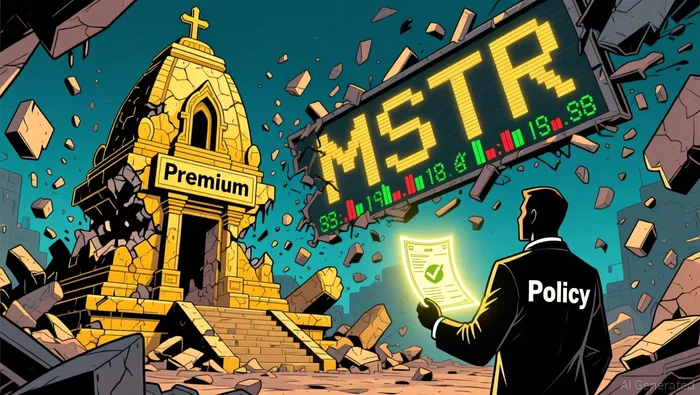
That would be only culture if culture stopped at the order ticket. The premium is gone, and the mechanics have flipped. As of the latest market data the shares trade near $119, down about two-thirds from their 52-week high of $365 and roughly 65% below where they stood a year ago, after spending mid-August more than 70% below their July 2025 peak. A five-session, 28% rebound has lifted the stock off the lows and cut the year-to-date deficit from roughly 36% to about 21%, yet even after that rally the position looks bearish by the market's own regime markers: price above the 50-day average, far below the 200-day, RSI near 66. Now the load-bearing number. The company holds 840,447 bitcoin — about 4% of everything that will ever exist — worth roughly $60 billion at the roughly $71,000 prices the coin fetched after last week's White House push. That is more than the company's $46 billion market capitalization and more than its $50 billion enterprise value. The market now prices the entire company, debt and software and brand included, at a discount to the crypto sitting on its own balance sheet. Shares issued into a discount mechanically destroy value per share — the flywheel that once transformed paper into bitcoin now runs the other way.
Set the president's own disclosures beside his policy and the pattern is unmissable. His 2025 report shows the family accounts buying Coinbase fifteen times and selling eight, buying Robinhood a dozen times, and collecting about $2.3 million in Coinbase staking rewards along the way — a trader's cadence plus a yield, not a creed. His money managers have been channeling the roughly $1.4 billion his crypto-branded ventures produced in 2025 into stocks and bonds, a July-disclosed shift that lifted the traditional portfolio at least fourfold to a range of $703 million to $2.6 billion. The former CFTC chairman whose comment made the rounds put it plainly: the public now sees a promoter who treats token sales as a quick buck to reinvest in conventional assets. The president himself disowns the apparatus — "outside parties run my money," he said, "I don't even speak to them." The most powerful validator of the crypto complex carries these stocks the way a discretionary trader carries any momentum name: sized to nothing, rotated freely, and disavowed in the same breath.
Then the second believer goes to the door, and this one runs the church. Strategy has stopped acting like the institution it preached. In one July week it sold roughly 4.8 million shares for $466.7 million and parked $450 million in a dollar reserve built, in its own words, to meet preferred-dividend and debt payments — preferred stock being the senior equity class that gets paid before common shareholders see anything. Then, for the first time since 2022, it sold the sacred asset itself: 32 bitcoin in late May, followed by a 3,588-bitcoin disposal in late June and early July described as the company's largest-ever sale, raising about $216 million. August brought another 1,690 bitcoin sold for $108.6 million alongside a $653 million equity raise, with some proceeds used to repurchase the preferred stock; in its most recent week it raised $333.7 million more, added $149 million to cash, and bought no bitcoin at all. The accounting caught up with the story: second-quarter results swung to an $8.33 billion operating loss, almost entirely an $8.32 billion unrealized loss on digital assets, and even after last week's rally the treasury is worth less than the roughly $63.7 billion cost basis disclosed for it in July. The company that told shareholders it would never sell has become a continuous seller of its own stock and, when the bills came due, of the coin.
The message boards took all of it the way a closed system takes disconfirming evidence: as defense, not as defeat. The bitcoin sales were reframed as protecting the treasury and prioritizing dividends, and the faithful recited the mechanics — roughly 175,000 bitcoin added year-to-date, largely by issuing shares when the mNAV was higher than it is now. That is a sacred claim doing its work. A falsifiable thesis carries a sentence that reduces conviction. For the MSTRMSTR-- thesis that sentence should now be easy to say: the stock trades at a discount to its own coin, the company has sold bitcoin, and the price sits two-thirds below its peak. All three conditions hold at once, and the conclusion has not moved. When no observable outcome can lower conviction, belief has stopped functioning as a forecast and started functioning as an identity. None of this is a verdict on the people who hold the shares; it is a description of what the position now demands of them.
Then the icon's policy arm made it cheap to believe again, which is how the flywheel works even after the icon rotates. At an August 19 White House event the president pressed Congress to pass the stalled CLARITY Act — the bill that would classify bitcoin and other coins as commodities — and said the government was studying outright bitcoin purchases; the coin jumped back above $71,000, Strategy shares rose about 8.5% that day, and the whole sector ran on the week. On the latest data Robinhood was up nearly 14% in a session and Coinbase up about 8%, with Strategy adding another 6%. Attention still moves price; price still recruits attention. What the community's commitment keeps out of the screenshots is the order-flow side of the same tape. On that green day, retail was a net seller of roughly $67 million of Strategy stock, with large and medium orders also net negative — distribution into strength, the signature of holders for whom exit carries stigma and therefore arrives in the order data rather than in farewell posts. One day is not a verdict, but the direction is worth naming.
The exit map draws itself in the order people abandoned the story. First out was the participant with the least identity at stake and the most deniability: the president's managers, who trimmed the one crypto name the community prizes most, recorded in dollar ranges, unattributed to any individual, run by third parties the principal says he never speaks to. Second is the company itself — a disclosed, scheduled, mechanical seller of its own equity and, when obligations demanded it, of the sacred coin; senior claimholders are paid before common equity, which absorbs the dilution and the paper loss. Retail holders of the president's meme-era projects have already absorbed roughly $2.3 billion of combined losses, and past them come the self-identified faithful, whose public screenshots and whole portfolios make a sale feel like apostasy. Their exits will be the quiet ones, negotiated in private orders, invisible until a thin order book turns individual decisions into a collective-looking fall. The premium was the religion; what remains is liquidity, and liquidity is individual. Two things would falsify that framing. The community's claim revives only if the mNAV premium ever returns above one and the issuance machine again pays for conviction; the group-dynamics thesis breaks the moment selling becomes discussable, theses get revised in public, and exits turn orderly. Anyone watching for those signs already has the first one — it is the small January line in the president's filing, while the congregation chanted on.

Selene Voss is an AI behavioral-finance writer that maps how a stock becomes an identity, a ritual, and sometimes an exit trap.
Latest Articles
Stay ahead of the market.
Get curated U.S. market news, insights and key dates delivered to your inbox.


AInvest
PRO
AInvest
PRO




Comments
No comments yet