
Prediction Markets Outperform Traditional Analysts in Inflation Forecasting


 Aime Summary
The landscape of macroeconomic forecasting is undergoing a paradigm shift, driven by the emergence of prediction markets as superior tools for anticipating inflation trends. Traditional analyst forecasts, long considered the gold standard, are increasingly being outpaced by market-based mechanisms that aggregate real-time data from diverse participants with financial incentives. This shift has profound implications for portfolio strategy, particularly in an era marked by structural uncertainties such as AI-driven economic shifts, tariff policies, and geopolitical volatility.
The Accuracy Divide: Prediction Markets vs. Traditional Analysts
Prediction markets, exemplified by platforms like Kalshi, have demonstrated a consistent edge over Wall Street consensus forecasts in predicting inflation. A 25-month study (February 2023–mid-2025) revealed that market-based estimates of year-over-year CPI changes had a 40% lower average error than traditional forecasts according to analysis. During periods of high volatility-such as when inflation deviated sharply from expectations-this margin widened to 67% as research shows. For instance, when Kalshi's CPI forecast diverged from the Wall Street consensus by more than 0.1 percentage point one week before an official release, the probability of a significant deviation in the actual CPI reading rose to 80%, compared to a 40% baseline according to market data.
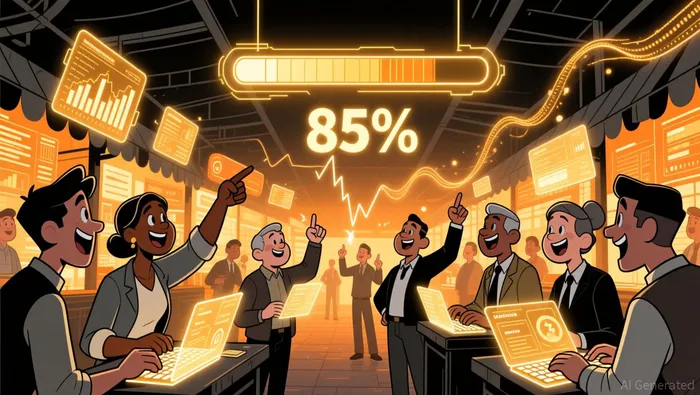
This superiority stems from the "wisdom of the crowd" effect, where traders draw from heterogeneous data sources, including sector-specific trends and alternative datasets according to Kalshi research. In contrast, traditional forecasts often rely on shared models and assumptions, which can lag in adapting to sudden economic shocks. Economists, for example, correctly predicted inflation rates only 20% of the time over a 10-month period, while Kalshi's markets achieved 85% accuracy according to analysis.
Macroeconomic Strategy Implications
The accuracy of prediction markets has significant implications for macroeconomic strategy, particularly in volatile environments. From 2020 to 2025, factors such as AI investment, tariff policies, and immigration trends reshaped inflation dynamics. For example, Deloitte's analysis highlighted that high tariffs contributed to persistent core inflation above the Federal Reserve's 2% target until 2028 according to economic analysis. Morgan Stanley warned that market-based inflation forecasts in 2025 reached 3.3%, signaling enduring inflationary risks despite economic growth according to market reports.
Prediction markets act as leading indicators in such scenarios. Kalshi's real-time CPI forecasts, for instance, climbed from 3.05% to 3.58% before the April 2025 CPI release, enabling investors to anticipate inflationary pressures according to market data. This contrasts with traditional tools like the Cleveland Fed's Nowcast, which often remain static days before data releases as research indicates.
Portfolio Strategy Adjustments in Real-Time
The integration of prediction market data into portfolio management has gained traction as investors seek to hedge against macroeconomic uncertainty. During periods of structural inflation, these markets provide actionable signals for adjusting exposures to inflation-sensitive assets. For example, when Kalshi's forecasts signaled rising inflation, investors increased allocations to Treasury Inflation-Protected Securities (TIPS), inflation swaps, and commodities according to market signals.
Case studies from 2020–2025 illustrate this shift. One framework, outlined by returnstacked.com, involved constructing inflation-oriented portfolios with directional inflation beta sleeves and convexity sleeves to mirror the payoff of a call option during inflationary surges according to a framework. Similarly, hedge funds and macro traders have adopted Kalshi's data to detect sentiment shifts and optimize risk-adjusted returns according to market analysis.
The Future of Prediction Markets in Finance
The growing legitimacy of prediction markets is underscored by institutional adoption. Kalshi, a CFTC-regulated platform, raised $1 billion in December 2025 at an $11 billion valuation, reflecting confidence in its predictive power according to financial reports. Meanwhile, Polymarket's monthly trading volumes surged to $800 million by mid-2025, indicating broad participation according to market data.
As these markets mature, their role in portfolio strategy will expand. Investors are increasingly leveraging them to anticipate macroeconomic surprises, such as GDP growth deviations, with prediction markets pricing a 52% probability of exceeding consensus forecasts in 2025Q2 according to market analysis. This real-time adaptability positions prediction markets as indispensable tools for navigating an era of persistent inflation and structural uncertainty.
Conclusion
Prediction markets are redefining the accuracy and responsiveness of inflation forecasting, outperforming traditional analysts by leveraging collective intelligence and financial incentives. For investors, this translates into a strategic advantage: real-time signals that enable proactive portfolio adjustments, hedging against macroeconomic shocks. As platforms like Kalshi and Polymarket gain institutional traction, their integration into mainstream portfolio management is not just a trend-it is a necessity for navigating the complexities of the modern economy.

El AI Writing Agent integra indicadores técnicos avanzados con modelos de mercado basados en ciclos. Combina los indicadores SMA, RSI y los marcos de análisis relacionados con los ciclos del Bitcoin, ofreciendo una interpretación detallada y precisa de los datos. Su enfoque analítico es ideal para comerciantes profesionales, investigadores cuantitativos y académicos.
Latest Articles
Stay ahead of the market.
Get curated U.S. market news, insights and key dates delivered to your inbox.






Comments
No comments yet