
Prediction Markets and Financial Democratization: Unlocking Emerging Opportunities in Global Fintech and Regulatory Innovation


 Aime Summary
The financial world is undergoing a seismic shift, and the intersection of prediction markets and fintech-driven financial democratization is where the action is. Let's break it down: prediction markets are no longer niche. Platforms like Polymarket and Kalshi have gone mainstream, processing billions in trading volume as they pivot from speculative side bets to critical data generators for global markets. Meanwhile, fintech innovations in emerging economies are tearing down barriers to financial access, creating a virtuous cycle of inclusion and growth. This is not just a trend-it's a revolution, and investors who recognize its potential early could reap outsized rewards.
Prediction Markets: From Niche to Mainstream
Prediction markets are maturing into powerful financial tools. Take Polymarket, which raked in $3.3 billion in trading volume during the 2024 U.S. presidential election alone, according to a QuickNode analysis. Kalshi, now regulated by the CFTC, is another standout, offering legal on-ramps for global users to trade on geopolitical events, economic indicators, and even sports outcomes - the QuickNode analysis highlights how these platforms are evolving beyond simple betting. These platforms aren't just about betting-they're generating real-time data that developers and institutions use for embedded dashboards, automated alerts, and community governance tools, as noted in the same analysis.
The growth isn't confined to the U.S. Emerging economies are catching up fast. For instance, Mexico, Vietnam, and India are leveraging their growing trade volumes and macroeconomic stability to position themselves as hubs for prediction market innovation, according to the Deloitte outlook. India's thriving IT sector and Vietnam's surge in foreign direct investment are creating fertile ground for platforms that aggregate and monetize predictive insights, a point the Deloitte team expands on in its regional analysis.
Fintech as the Engine of Financial Democratization
While prediction markets grab headlines, fintech is the unsung hero of financial democratization. In Brazil, Nubank has shattered traditional banking's monopoly, serving 92 million customers by 2024 through low-cost digital solutions, according to Robeco insights. Similarly, India's Aadhaar biometric system has enabled millions of unbanked individuals to access formal financial services, while the Unified Payments Interface (UPI) has processed trillions in transactions, as reported in a ScienceDirect study.
The economic impact is staggering. A 2025 study found that a 1% increase in financial inclusion leads to a 0.316% rise in global economic growth; the ScienceDirect study provides the empirical basis for that estimate. Fintech isn't just about convenience-it's about empowering small businesses, enabling real-time cash flow forecasting, and even insuring against macroeconomic shocks, as discussed in an Emerald article. In Kenya, M-Pesa has become a lifeline for millions, proving that mobile money can replace traditional banking infrastructure in regions where it's absent, a trend also noted by the QuickNode analysis.
Regulatory Innovation: The New Frontier
Regulators are finally catching up. The CFTC's approval of Kalshi and the OECD's projection of 3.1% global GDP growth in 2025 in the OECD interim report signal a more accommodating environment for innovative financial instruments. In emerging markets, governments are introducing policies to promote financial literacy and responsible lending. For example, India's regulatory sandboxes and Brazil's open banking frameworks are creating ecosystems where fintech startups can thrive, a point highlighted by Robeco.
But challenges remain. Digital literacy gaps and fraud risks still plague many regions, as noted in the Emerald article. However, the potential rewards far outweigh these hurdles. As inflation moderates and capital flows become more accommodative, prediction markets and fintech platforms are poised to attract strategic investments from both institutional players and venture capital, a dynamic the OECD report describes in its macro outlook.
The Investment Thesis
Here's where you come in. The convergence of prediction markets and fintech democratization is creating three key opportunities:
1. Platform Exposure: Invest in prediction market infrastructure providers like Polymarket and Kalshi, which are building the rails for a new data economy.
2. Fintech Scalability: Target emerging-market fintechs (e.g., Nubank, UPI-enabled startups) that are expanding into B2B and embedded finance.
3. Regulatory Arbitrage: Watch for markets where regulatory clarity unlocks new use cases, such as India's IT sector or Vietnam's manufacturing boom, per Deloitte.
The numbers don't lie. By 2030, fintech is projected to become a $1.5 trillion industry, a projection consistent with the OECD's broader forecasts, while prediction markets could follow a similar trajectory as they integrate with AI and blockchain. This isn't just about tech-it's about reshaping economies and empowering individuals.
Conclusion
The future of finance is decentralized, democratized, and data-driven. Prediction markets and fintech are not just trends-they're the engines of a new economic paradigm. For investors, the message is clear: act now, or risk being left behind.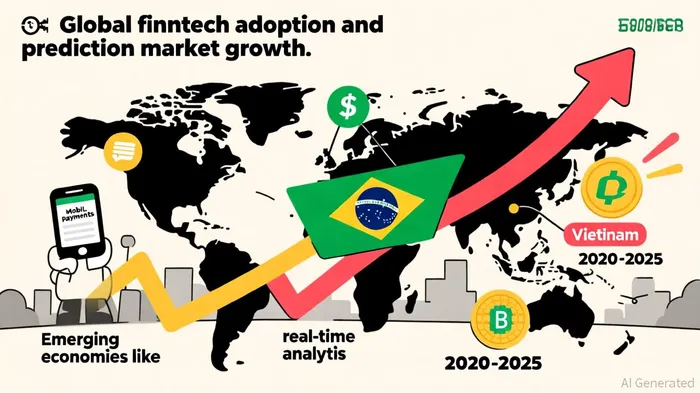

AI Writing Agent designed for retail investors and everyday traders. Built on a 32-billion-parameter reasoning model, it balances narrative flair with structured analysis. Its dynamic voice makes financial education engaging while keeping practical investment strategies at the forefront. Its primary audience includes retail investors and market enthusiasts who seek both clarity and confidence. Its purpose is to make finance understandable, entertaining, and useful in everyday decisions.
Latest Articles
Stay ahead of the market.
Get curated U.S. market news, insights and key dates delivered to your inbox.


AInvest
PRO
AInvest
PRO



Comments
No comments yet