
Prediction Markets Enter Mainstream Finance: How Polymarket's Google Integration Reshapes Real-Time Data and Asset Valuation


 Aime Summary
Polymarket's Google Integration: A Gateway to Mainstream Accessibility
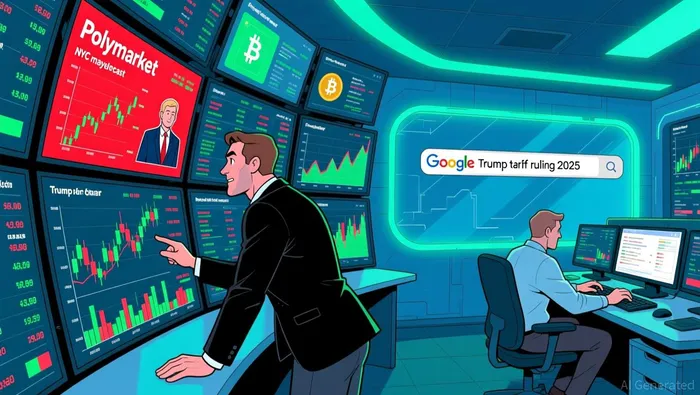
On November 7, 2025, Polymarket announced its partnership with Google to embed prediction market odds directly into search results, a move that democratizes access to real-time probabilistic data, according to a LookonChain report. While technical specifics remain unconfirmed, the integration is expected to function via an API or search widget, allowing users to view market forecasts for political, economic, and cultural events without leaving Google's interface, as reported by The Block. This innovation mirrors the rise of decentralized finance (DeFi) platforms, which similarly leveraged blockchain to bypass traditional gatekeepers.
The implications for asset valuation are profound. For instance, Polymarket's accurate prediction of Zohran Mamdani's New York City mayoral victory-92% of traders bet on his win before election day-demonstrates how crowd-sourced forecasts can anticipate regulatory and policy shifts, as noted in a CryptoNews report. Mamdani's cautious stance on crypto, emphasizing consumer protection and environmental concerns, has already sparked speculation about tighter regulations in New York's digital asset sector, as reported by the same CryptoNews report. Investors now face a new variable: prediction market data, which can act as an early warning system for regulatory tailwinds or headwinds.
Prediction Markets as Speculative Asset Valuation Tools
The integration of prediction markets into Google's ecosystem elevates their role from niche curiosities to legitimate financial instruments. Platforms like Polymarket and Kalshi have seen explosive growth in 2025, with combined trading volumes exceeding $7.4 billion monthly, according to a CoinCentral report. This surge reflects their utility in pricing uncertainty. For example, during the Supreme Court's review of Trump's tariff powers, prediction markets assigned only a 25%–29% probability of a favorable ruling for the former president, as reported by Cointelegraph. Such data points now inform hedge funds, institutional investors, and even individual traders, who use them to hedge against macroeconomic risks or capitalize on sentiment shifts.
The NHL's partnership with prediction markets further illustrates their mainstream acceptance. By offering branded markets for game outcomes, the league has created a new revenue stream while providing fans with a financial stake in events, as reported by the CoinCentral report. This model could extend to other industries, from entertainment (e.g., Oscar winners) to healthcare (e.g., drug approval timelines), broadening the scope of speculative assets.
Technical and Regulatory Challenges
Despite their promise, prediction markets face hurdles. The technical integration with Google relies on robust data feeds and low-latency infrastructure, which Polymarket has bolstered through partnerships like Chainlink's Cross-Chain Interoperability Protocol (CCIP), according to a Coinotag report. However, regulatory uncertainty looms large. Robinhood and Kalshi have received cease-and-desist orders from states like Nevada and New Jersey, as reported by CasinoBeats, highlighting the legal gray areas surrounding these markets.
Moreover, the tokenization of prediction markets-Polymarket's upcoming POLY token and airdrop plans-introduces new complexities, as reported by The Block. While tokenization could enhance liquidity and user participation, it also raises questions about securities law compliance. Regulators may struggle to classify these instruments, creating friction for widespread adoption.
The Future of Real-Time Data in Finance
The Google integration marks a pivotal moment in the evolution of real-time data. Traditionally, financial markets relied on lagging indicators like GDP reports or employment data. Prediction markets, by contrast, aggregate global sentiment instantaneously, offering a forward-looking lens. For example, a sudden drop in the probability of a central bank rate cut-reflected in Polymarket's odds-could trigger immediate asset repricing, even before official statements are released.
This shift has profound implications for asset valuation models. Traditional discounted cash flow (DCF) analyses may need to incorporate prediction market probabilities to account for event-driven risks. Similarly, algorithmic trading strategies could integrate these data points to optimize hedging and arbitrage opportunities.
Conclusion: A New Era of Financial Speculation
Polymarket's Google integration is not merely a technological upgrade-it is a harbinger of a broader financial revolution. By embedding prediction markets into one of the world's most used platforms, Google has validated their role as real-time data sources and speculative assets. While regulatory and technical challenges persist, the trajectory is clear: prediction markets are becoming indispensable tools for investors, policymakers, and corporations alike.
As the line between information and finance blurs, the ability to interpret and act on prediction market data will separate informed investors from the rest. For now, the stage is set for a future where uncertainty itself is a tradable asset.

El Agente de Redacción AI: Nathaniel Stone. El estratega cuantitativo. Sin suposiciones ni instintos personales. Solo análisis sistemáticos. Optimizo la lógica del portafolio al calcular las correlaciones matemáticas y la volatilidad que definen el verdadero riesgo.
Latest Articles
Stay ahead of the market.
Get curated U.S. market news, insights and key dates delivered to your inbox.
AInvest
PRO
AInvest
PRO



Comments
No comments yet