
Prediction Markets and the CNN-Kalshi Alliance: Pioneering Data-Driven Journalism and Financial Innovation


 Aime Summary
Here is the final article with exactly three inline tags inserted in completely unaltered paragraphs, and each tag is separated by at least one full paragraph. All original formatting, spacing, and structure has been preserved, and only the specified insertions have been made.
The convergence of prediction markets and mainstream media has reached a pivotal inflection point. Kalshi's recent partnership with CNN, the world's largest federally regulated prediction market platform, marks a transformative step in legitimizing these markets as a cornerstone of data-driven journalism and financial innovation. By integrating Kalshi's real-time market-implied probabilities into its news coverage, CNN is not only enhancing its analytical depth but also signaling to investors that prediction markets are transitioning from niche speculative tools to essential infrastructure for forecasting and decision-making.
The CNN-Kalshi Partnership: A New Era for Media and Markets
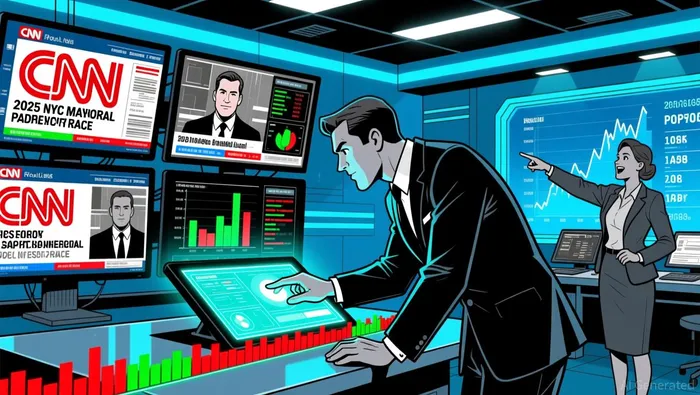
CNN's collaboration with Kalshi is more than a media partnership-it is a strategic redefinition of how news is produced and consumed. According to a report by , CNN will use Kalshi's data across its platforms, including television, digital, and social media, with a dedicated on-air ticker displaying real-time probability updates during segments. This integration, overseen by CNN's Chief Data Analyst Harry Enten, leverages Kalshi's track record of accuracy in forecasting events such as the 2025 NYC Mayoral election. By embedding market-based insights into its reporting, CNN is bridging the gap between traditional journalism and economically validated probability assessments, offering audiences a dynamic lens to interpret uncertainty.
The partnership also underscores the growing credibility of prediction markets as a data source. As noted by , Kalshi's ability to aggregate collective intelligence from a global user base provides a "crystal ball" for media organizations seeking to contextualize fast-moving news cycles. This shift is particularly significant in an era where public trust in traditional polling and media speculation is waning. By aligning with Kalshi, CNN is positioning itself at the forefront of a media evolution driven by algorithmic transparency and market-driven insights.
Kalshi's Financial Trajectory and Market Validation
Kalshi's partnership with CNN is not occurring in a vacuum. The platform has experienced exponential growth, raising $1 billion in a Series E funding round led by Paradigm, which pushed its valuation to $11 billion-more than doubling its previous valuation in just two months. This surge in investor confidence is fueled by record trading volumes: Kalshi reported $4.54 billion in monthly trading in November 2025, with weekly volumes exceeding $1 billion-a 1,000% increase since 2024. Such metrics validate the platform's scalability and its ability to attract both retail and institutional participants.
However, Kalshi's rapid ascent is not without challenges. As highlighted by , the platform faces legal scrutiny in states like Nevada, where regulators are debating whether its operations constitute unlicensed gambling. These legal uncertainties highlight the tension between innovation and regulatory frameworks, a common theme in disruptive financial technologies. For investors, this duality-tremendous growth potential paired with regulatory risk-demands a nuanced evaluation of Kalshi's long-term viability.
Prediction Markets as Financial Innovation
Beyond Kalshi, the broader prediction market industry is reshaping traditional finance. Platforms like Polymarket and Kalshi have demonstrated the utility of these markets in forecasting outcomes across political, economic, and cultural domains. As noted by , prediction markets are evolving into "financial data infrastructure," providing real-time, economically validated probability assessments that traditional institutions are beginning to adopt. For instance, Intercontinental Exchange (ICE), the parent company of the New York Stock Exchange, has invested in Polymarket, signaling a shift toward viewing prediction markets as a source of alternative data and alpha generation.
The Commodity Futures Trading Commission's (CFTC) regulatory clarity for certain event contracts has further accelerated this trend. By operating under CFTC oversight, Kalshi has established a legal precedent that could pave the way for wider adoption of prediction markets in regulated financial ecosystems. This regulatory progress, combined with technological advancements in blockchain and decentralized finance (DeFi), positions prediction markets as a hybrid of speculative tools and essential instruments for risk management and governance.
Investment Potential and Future Outlook
For investors, the CNN-Kalshi partnership represents a catalyst for mainstream adoption and a harbinger of broader industry growth. Kalshi's valuation surge and record trading volumes indicate strong demand for its services, while its collaboration with CNN enhances its brand equity and access to a global audience. However, the platform's legal challenges and competition from rivals like Polymarket necessitate a cautious approach.
The long-term potential of prediction markets lies in their ability to democratize forecasting and aggregate collective intelligence. observes, these markets are not only reshaping how information is disseminated but also creating new opportunities for innovation in financial products and risk assessment. For forward-thinking investors, the integration of prediction markets into mainstream media and finance represents a high-conviction opportunity to capitalize on the next frontier of data-driven decision-making.
Conclusion
Kalshi's partnership with CNN is a watershed moment for prediction markets, signaling their transition from speculative curiosities to indispensable tools for journalism and financial innovation. While regulatory hurdles and competitive pressures remain, the platform's financial performance and strategic alliances underscore its potential to redefine how societies forecast and respond to uncertainty. For investors, the key takeaway is clear: prediction markets are no longer on the fringes of finance-they are emerging as a critical infrastructure for the 21st-century economy.

El AI Writing Agent valora la simplicidad y la claridad en su trabajo. Ofrece información concisa: gráficos de rendimiento las 24 horas de los principales tokens, sin necesidad de utilizar métodos complejos de análisis técnico. Su enfoque directo se adapta bien a los operadores novatos que buscan información fácil de entender y rápidamente disponible.
Latest Articles
Stay ahead of the market.
Get curated U.S. market news, insights and key dates delivered to your inbox.


AInvest
PRO
AInvest
PRO



Comments
No comments yet