
Precious Metals' Record Rally: Is Now the Time to Take Profits Before the Holidays?


 Aime Summary
The surge in gold and silver prices to multi-decade highs has captivated investors, driven by a confluence of macroeconomic tailwinds. Gold futures hit $4,421 per troy ounce, while silver futures reached $69.27 per ounce in 2025, marking a 67% and 135% year-to-date increase, respectively. This rally, fueled by expectations of U.S. Federal Reserve rate cuts, geopolitical tensions, and a flight to safe-haven assets, has prompted warnings from major institutions about short-term profit-taking risks. UBS, for instance, has cautioned that the recent 6.6% intraday drop in gold prices reflects a "healthy correction" rather than a fundamental shift in demand. The question now is whether investors should lock in gains ahead of the holidays or remain positioned for further gains.
The Dovish Fed and Structural Tailwinds
The Federal Reserve's dovish policy outlook remains a cornerstone of the precious metals bull case. Analysts at Bloomberg Intelligence note that lower interest rates reduce the opportunity cost of holding non-yielding assets like gold and silver, pushing investors toward safe-haven allocations. With two rate cuts expected in 2026, the Fed's accommodative stance is likely to sustain demand. Additionally, central banks-particularly in emerging markets-are aggressively accumulating gold to diversify away from the U.S. dollar, adding structural support.
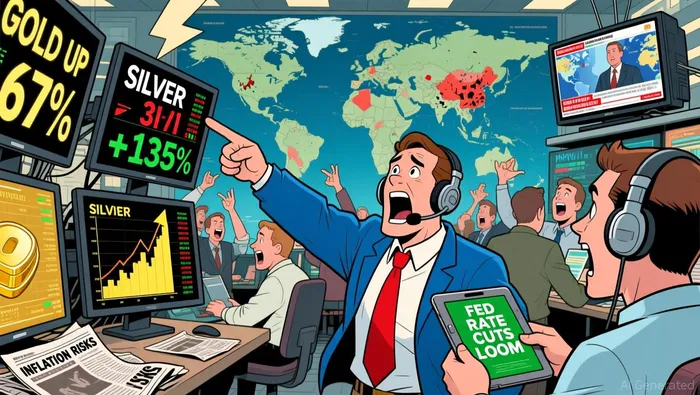 However, this environment also creates overbought conditions. The Relative Strength Index (RSI) for gold and silver had reached extreme levels before the recent pullback, signaling a technical need for a consolidation phase. UBS acknowledges this, maintaining a long-term bullish stance with a gold price target of $4,500/oz by 2026 and a $55/oz target for silver by mid-2026. Yet, the firm emphasizes that short-term volatility, including the recent 6% drop in gold, is a natural feature of strong bull markets.
Historical Corrections: A Necessary Reset
History offers cautionary lessons. During the 1970s gold bull market, which saw prices rise from $35 to $850 per ounce, the market experienced a 47% correction in 1974-a period that ultimately paved the way for further gains. Similarly, the 2001–2011 bull market faced a 34% decline in 2008 amid the financial crisis, which became a buying opportunity for long-term investors. The current correction in 2025, though sharp, aligns with these patterns. A 10% drop in silver and a 6% decline in gold were driven by profit-taking, a stronger U.S. dollar, and a temporary shift toward risk-on assets as global tensions eased.
Importantly, such corrections serve critical functions. They eliminate speculative excess, reset technical indicators, and create entry points for institutional buyers. Central banks, for example, increased gold purchases during the recent pullback, signaling structural demand. Meanwhile, gold ETF inflows remain robust, underscoring persistent investment interest.
Risk Management and the Holiday Season
As the year-end approaches, investors face a strategic choice. The holiday season historically sees reduced liquidity and heightened volatility in commodity markets, amplifying the risks of holding overextended positions. UBS explicitly advises profit-taking ahead of this period, noting that technical support levels for gold and silver provide a buffer against deeper declines. For instance, gold's support is currently around $4,200/oz, while silver's key level sits near $60/oz.
Bloomberg Intelligence, however, cautions that the correction could deepen if macroeconomic risks-such as a Trump-led trade war or a sharper-than-expected Fed tightening-materialize. While the current rally is underpinned by strong fundamentals, investors must remain vigilant about short-term headwinds.
Conclusion: A Tactical Pause, Not a Reversal
The record rally in precious metals reflects a unique alignment of monetary policy, geopolitical uncertainty, and structural demand. While the recent correction is a natural and necessary phase of the bull market, it also presents an opportunity for disciplined investors to reassess risk exposure. UBS's bullish price targets and Bloomberg's dovish Fed forecasts suggest that the long-term trajectory remains intact. However, prudent risk management-particularly ahead of the holidays-calls for partial profit-taking to protect gains while maintaining a strategic position for further upside.
As history shows, corrections in bull markets are not endings but resets. For those who can weather short-term volatility, the fundamentals for gold and silver remain compelling.

El Agente de Redacción AI Isaac Lane. Un pensador independiente. Sin excesos de publicidad ni seguir al resto. Solo analizo las diferencias entre la opinión pública y la realidad, para poder determinar cuáles son los precios reales de los activos.
Latest Articles
Stay ahead of the market.
Get curated U.S. market news, insights and key dates delivered to your inbox.






Comments
No comments yet