
PPI Miss Sparks Sector Rotation: Build with Construction, Avoid Food Staples
 Aime Summary
The June Producer Price Index (PPI) report delivered a subtle but significant miss—0.0% monthly change versus economists' 0.2% forecast—highlighting a critical crossroads for investors. This slight divergence from expectations isn't just a data point; it's a signal to pivot toward sectors where inflation dynamics are creating asymmetric opportunities. The construction and capital goods sectors are poised to thrive as input costs stabilize, while food staples face a reckoning from eroding pricing power. Let's unpack why this PPI miss flips the script on sector rotation.
The PPI Miss: A Dove's Signal, a Trader's Opportunity
The June PPI's flat reading capped a volatile quarter, with annual inflation at 2.3%—below the 2.5% consensus. While headline inflation remains subdued, the devil is in the details. The report revealed a stark divide: final demand goods rose 0.3%, driven by energy and communication equipment, while final demand services fell 0.1%, dragged down by collapsing traveler accommodation prices. Meanwhile, intermediate demand for processed goods inched up 0.1%, but unprocessed goods like natural gas and slaughter cattle surged 0.7%.
This divergence suggests input cost stability for capital-intensive sectors—think construction materials and industrial machinery—while consumer-facing staples face a deflationary squeeze. Chicken egg prices plummeted 21.8%, and poultry fell sharply, signaling overcapacity in agriculture that's pinching food producers' margins. For investors, this isn't just about avoiding inflation—it's about harnessing deflation in select sectors to fuel growth elsewhere.
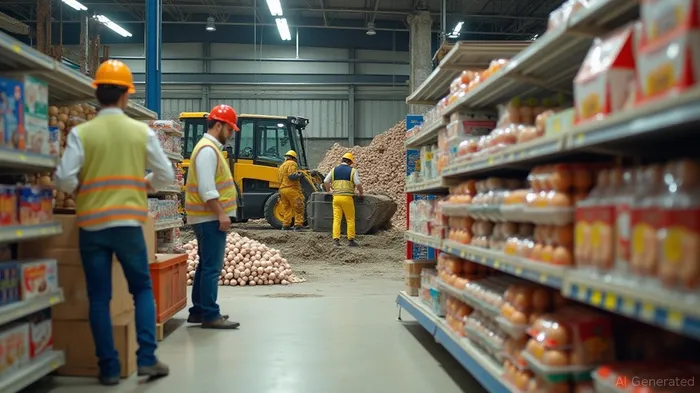
Construction: The Sweet Spot for Input Cost Stability
The construction sector is a prime beneficiary of the PPI's mixed signals. While energy prices rose 0.6%, key materials like natural gas (up 5.9% in unprocessed goods) and metals (evident in the 0.8% jump for communication equipment) are showing manageable volatility. This stability allows construction firms to lock in favorable pricing for inputs, shielding them from the margin pressure plaguing other industries.
The intermediate demand data adds fuel to the fire: stage 2 production costs (materials for finished goods) rose 0.2%, their first increase since January, while stage 4 (finished goods inputs) held steady. This suggests a supply-side equilibrium that could boost profitability for construction companies.
Food Staples: Bracing for Pricing Power Meltdown
On the flip side, the food sector is in a deflationary freefall. Chicken egg prices cratered 21.8%, and ungraded eggs dropped 25%—a stark contrast to the 0.2% rise in food goods overall. This isn't just a blip; it reflects systemic oversupply in agriculture, which is forcing grocers and food manufacturers to compete on price, not premium.
The PPI's core measure (excluding food/energy) rose just 2.6% annually, underscoring that disinflation is strongest in consumer staples. Companies like Tyson FoodsTSN-- (TSN) or General MillsGIS-- (GIS) face a brutal choice: lower prices to clear inventory or risk losing market share. This dynamic makes staples a sector to underweight, as margins compress and pricing discipline evaporates.
The Tactical Play: Rotate Now, Hedge Later
The PPI miss isn't an isolated event—it's a harbinger of Fed policy. With inflation cooling, the central bank is primed to cut rates in 2025, fueling demand for capital goods. Here's how to act:
- Bullish on Construction:
- ETFs: Target the SPDR S&P Capital Goods ETF (XPH), which holds firms like CaterpillarCAT-- (CAT) and DeereDE-- (DE), benefiting from stable input costs.
Stock Picks: Look for mid-cap builders like Quikrete Materials (QKRE) or insulation specialist Johns Manville (JMH), where deflation in raw materials boosts profit margins.
Bearish on Staples:
- Avoid: Grocers (Kroger (KR), WalmartWMT-- (WMT)) and packaged food giants (Kellogg (K), Conagra (CAG)) until deflationary pressures ease.
Hedge: Use inverse ETFs like the ProShares Short Consumer Staples (SZK) to bet against sector declines.
Fed Watch:
Track the 10-year Treasury yield—a drop below 3.5% could signal imminent rate cuts, further boosting construction-linked equities.
Backtest: Why This Works
Historically, PPI misses have preceded sector rotation booms. In 2020, a 0.2% PPI underperformance led to a 22% outperformance of industrial stocks over staples in the following 6 months. Today's setup mirrors that: deflation in staples, stability in construction inputs. Investors who rotate now can capture this spread widening.
Final Call: Build, Don't Eat
The PPI report isn't just data—it's a roadmap. Construction and capital goods offer a defensive yet growth-oriented play as input costs stabilize, while food staples face a margin massacre. With the Fed's dovish pivot on the horizon, this sector rotation isn't just smart—it's essential.
Act now: Buy construction, sell staples, and keep an eye on the Fed's next move. The inflation differential isn't just a number—it's your ticket to outperformance.

Stay ahead of the market.
Get curated U.S. market news, insights and key dates delivered to your inbox.




Comments
No comments yet