
Powering the Future: Strategic Investment Opportunities in Australia's Renewable Energy Transition
Australia's renewable energy transition is no longer a distant goal—it's a full-scale revolution, fueled by ambitious government targets, soaring private investment, and groundbreaking infrastructure projects. With a legislated 43% emissions reduction by 2030 and an 82% renewable energy target for electricity generation, the nation is positioning itself at the forefront of the global energy shift. For investors, this transformation presents a rare confluence of policy-driven stability, scalable projects, and long-term returns. Let's dissect the opportunities.
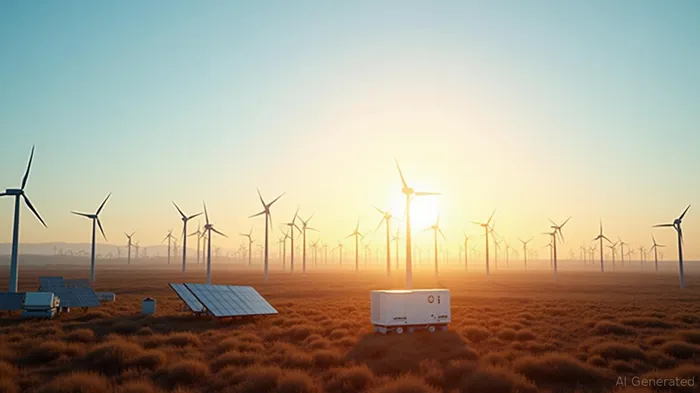
Government Commitments Create a Launchpad for Growth
The Australian government's Rewiring the Nation initiative is the cornerstone of this transition, allocating $20 billion to modernize grid infrastructure by 2030. Key projects include the Victoria-New South Wales Interconnector West (VNI West) and the Sydney Ring, which will unlock access to renewable-rich regions like the New England Renewable Energy Zone. These transmission upgrades are critical to delivering wind and solar energy to urban centers, reducing reliance on aging coal-fired plants.
The Capacity Investment Scheme (CIS) further incentivizes investment by prioritizing projects that ensure grid reliability. Through 2024, the CIS has already allocated 8 GW of capacity funding, with 2.8 GW earmarked for storage. This signals a clear policy preference for firms specializing in grid stability solutions, such as transmission hardware providers or firms developing long-duration battery storage.
Storage Solutions: The Unsung Hero of Grid Reliability
While solar and wind dominate headlines, the real game-changer is energy storage. Australia's utility-scale battery capacity is projected to grow sixfold by 2030, from 2.5 GW in 2025 to over 16 GW. The Waratah Super Battery (850 MW/1,680 MWh) in NSW and the Melbourne Renewable Energy Hub (600 MW/1.6 GWh) exemplify this trend. These projects not only stabilize grids but also create arbitrage opportunities by storing midday solar surpluses for peak demand periods.
The $2.3 billion Cheaper Home Batteries Program, introduced in 2025, is turbocharging the residential storage market. It mandates that eligible batteries be virtual power plant (VPP)-capable, enabling households to sell excess energy back to the grid. With 185,798 residential batteries installed by late 2024, this sector is ripe for investors in smart grid software and distributed energy systems.
Critical Minerals: The Supply Chain linchpin
Australia's $15 billion National Reconstruction Fund and $22.7 billion Future Made in Australia Act are securing the raw materials needed for this transition. Lithium, accounting for 30% of global supply, and nickel are pivotal for batteries, while green hydrogen requires abundant renewables and advanced electrolyzers. The Critical Minerals Production Tax Incentive (CMPTI)—offering a 10% refundable tax credit—is luring miners and manufacturers to Australia.
Investors should track companies like Pilbara Minerals (PLS.AX), a top lithium producer, or Worley (WOR.AX), which designs energy infrastructure. The Hydrogen Production Tax Incentive (HPTI), offering $2 per kg of renewable hydrogen, also opens opportunities in green hydrogen projects, such as Woodside's Asian Renewable Energy Hub.
Private Investment: The Engine of Scalability
The government's portfolio financing model is a masterstroke for investors. By bundling projects into single financial packages, it reduces risk and attracts capital from institutional investors. For instance, Macquarie Capital's $1.2 billion portfolio financing for Fotowatio's solar-storage projects demonstrates how this model accelerates deployment. Investors can access these opportunities through infrastructure funds or REITs focused on energy assets.
Equity investors should consider AGL Energy (AGL.AX), which is pivoting from coal to renewables, or Infigen Energy, which develops wind and solar projects. Meanwhile, grid software firms like Aclara (part of Itron) or Landis+Gyr are critical for managing the distributed energy networks of the future.
Risk and Reward: Navigating the Path Ahead
While Australia's policies provide a stable framework, execution risks persist. Permitting delays and grid connection bottlenecks could slow project timelines. However, the National Renewable Energy Priority List—which fast-tracks 56 projects adding 16 GW of generation and 6 GW of storage—mitigates this by streamlining approvals. Investors should prioritize firms with strong regulatory alignment and partnerships with state governments.
Investment Strategy: Where to Deploy Capital
- Transmission Infrastructure: Firms like TransGrid (part of Iberdrola) or Energy Australia with stakes in grid projects.
- Battery Storage: Invest in miners (lithium, nickel), manufacturers (Tesla, BYD), and software enablers (VPP platforms).
- Policy-Backed Funds: Look for infrastructure ETFs tracking projects in the Rewiring the Nation pipeline.
- Green Hydrogen: Early-stage plays in electrolyzer tech or integrated projects like Hydrogen Park SA.
Conclusion: A Decade of Opportunity
Australia's 2030 targets are not just environmental milestones—they're economic blueprints. With $20 billion in government backing, $1.2 billion in private portfolio financing, and 38 BESS projects under construction, the energy transition is already underway. For investors, this is a multi-year theme with low correlation to traditional markets and high upside in a decarbonizing world. The grid of tomorrow isn't just wires and batteries—it's a goldmine waiting for the bold.
Investment Takeaway: Allocate to diversified energy infrastructure funds, storage-focused miners, and grid software innovators. Australia's renewables revolution isn't a bet—it's a certainty.

Stay ahead of the market.
Get curated U.S. market news, insights and key dates delivered to your inbox.
AInvest
PRO
AInvest
PRO



Comments
No comments yet