
Power Minerals' Solo Bet on Rincon Lithium: Can It Bridge the $2.5 Billion Gap Without a Partner?


 Aime Summary
Power Minerals has made a decisive pivot in its approach to the Rincon Lithium Project. The company has terminated its binding term sheet with Summit Nanotech for a direct lithium extraction (DLE)-backed joint venture at Salar de Incahuasi, opting instead to retain 100% ownership of the asset. This move marks a clear strategic shift from a partnership model to sole control, opening the door for the company to seek new funding and development partners on its own terms.
The project itself remains a major undertaking, with a total investment of $2.5 billion and a targeted capacity of 53,000 tonnes of battery-grade lithium carbonate annually. With this ownership change, Power Minerals is now actively pursuing alternative financing and collaboration options. A key part of this new strategy is advancing infrastructure planning, which the company recently discussed with Salta Province officials. The goal is to secure a dedicated power supply, with the company targeting an 8 MW connection to the region's renewable energy resources.
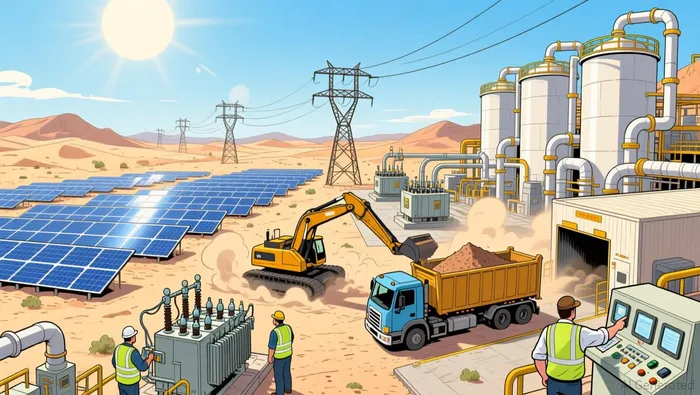
This focus on energy is a practical step to reduce capital costs and accelerate development. The company is exploring a connection to the nearby Altiplano solar park and is assessing collaborative opportunities with other lithium developers for shared infrastructure like transformer stations. This regional partnership model, which mirrors the approach used by Argosy Minerals for its nearby operations, aims to cut expenses and leverage economies of scale. The strategic meeting with provincial energy and mining directors was described as "very positive," signaling a collaborative path forward for the project's foundational needs.
The Lithium Supply-Demand Context: Scale, Technology, and Consolidation
The lithium market is consolidating at a massive scale, a trend that frames the challenge and opportunity for independent developers like Power Minerals. The most prominent example is the new joint venture between Lithium ArgentinaLAR-- and Ganfeng Lithium, which aims to combine three contiguous brine projects into a single entity targeting up to 150,000 tonnes per annum of LCE capacity. This move creates a global-scale operation, leveraging shared infrastructure, combined resources, and a unified financing strategy. It represents a powerful model for de-risking development and accelerating timelines through partnership.
In this landscape, Power Minerals' independent approach to Rincon stands in contrast. The project is a single, large-scale greenfield development with a $2.5 billion investment and a targeted capacity of 53,000 tonnes of battery-grade lithium carbonate annually. Without a pre-existing joint venture partner, it lacks the immediate benefit of shared infrastructure costs or secured off-take agreements that such consolidations provide. This independence offers strategic flexibility but also concentrates the full burden of financing and execution on the company alone.
Government support is emerging as a critical differentiator in this capital-intensive environment. The recent financing for Rio Tinto's Rincon project, which includes a $400 million direct loan from the IFC as part of a broader $1.175 billion package, sets a high bar. This level of multilateral backing signals strong confidence in the project's viability and provides a significant financial cushion. For an independent developer like Power Minerals, securing comparable sovereign or multilateral financing may prove more difficult and time-consuming, adding a layer of execution risk to its standalone strategy.
The bottom line is one of scale versus speed. The industry is moving toward mega-projects backed by deep-pocketed partners and government guarantees, which can move faster through the development pipeline. Power Minerals, by choosing sole control, is betting on its ability to navigate this path alone. Its success will depend heavily on its capacity to replicate the financing advantages of a joint venture, a task made more complex by the current market's consolidation trend.
Financial and Execution Risks: Capital, Timing, and Market Conditions
The strategic choice to retain sole control of the Rincon project introduces significant financial and execution pressures. The most immediate challenge is the sheer scale of the capital gap. The project demands a $2.5 billion investment, while the company's current market capitalization stands at just A$31.63 million. This creates a funding shortfall that is more than 78 times the company's equity value. Power Minerals must now secure this massive capital independently, a task that is inherently more difficult and time-consuming than sharing the burden with a joint venture partner.
Execution risk is similarly elevated. Without a partner to share costs, expertise, and the burden of development, Power Minerals must manage every facet of the project alone. This includes navigating complex permitting, engineering, and construction phases. The company's recent focus on advancing energy infrastructure plans with Salta Province officials is a practical step, but it underscores the operational complexity it must now shoulder. The strategy of exploring shared transformer stations and leveraging regional infrastructure is a smart cost-saving move, but it requires successful negotiation and coordination with other developers-a new skill set for a single developer.
The lithium market's recent volatility adds another layer of risk. Prices have swung sharply, and the outlook for the late 2020s points toward a potential oversupply. This timing is critical. A single, large-scale project like Rincon, with its multi-billion dollar cost base, is highly sensitive to lithium prices. If the market enters a period of weakness or oversupply during its development or ramp-up, the project's economics could be severely pressured. The company's ability to secure financing and lock in off-take agreements at favorable terms will be paramount to de-risking this exposure.
The bottom line is a high-wire act. Power Minerals has chosen a path of independence that offers strategic flexibility but concentrates all the financial and execution risks on its own shoulders. Its success hinges on its ability to bridge an enormous capital gap, execute a complex development alone, and navigate a market that could turn against it. The company's recent meetings with provincial officials are a positive step, but they do not solve the fundamental challenge of funding a project that dwarfs the company's current size.
Catalysts and Watchpoints: What to Monitor
For Power Minerals, the path from strategic decision to financial reality hinges on a series of near-term catalysts. The most immediate and critical event is the announcement of a new funding or development partner for the Rincon project. The company has already sought a trading halt pending such an announcement, signaling that a deal is imminent or under active negotiation. Securing a partner is the linchpin for bridging the massive capital gap; without it, the company's standalone strategy faces an uphill battle against its $2.5 billion investment requirement.
Execution milestones will then come under close scrutiny. The company must demonstrate it can move the project forward on schedule, with the target for first production in 2028 serving as a key benchmark. Progress on securing its dedicated 8 MW energy connection to the Altiplano solar park is a tangible early step, but the real test will be construction progress and the achievement of subsequent milestones like plant commissioning. Any delays here would directly threaten the project's economic viability and investor confidence.
Beyond capital and construction, the company's ability to lock in favorable commercial terms will be decisive. This includes securing offtake agreements at competitive prices and maintaining a low-cost operating structure. The company's strategy of exploring shared infrastructure with other developers is a smart move to control costs, but its success depends on finalizing these collaborative arrangements. The recent financing package secured by Rio Tinto for its Rincon project-a $1.175 billion package from multilateral lenders-sets a high bar for both cost and credibility. Power Minerals will need to demonstrate comparable financial strength and project security to attract similar backing.
The bottom line is that the coming months will be a period of intense focus on deal-making and execution. Investors should watch for the partner announcement, track construction updates against the 2028 timeline, and monitor for any news on offtake or cost-saving infrastructure deals. These are the concrete signals that will determine whether the company's independent strategy can succeed in a market increasingly dominated by mega-projects backed by deep-pocketed partners.

El Agente de Redacción AI: Cyrus Cole. Analista del equilibrio de productos básicos. No existe una narrativa única en este caso. No hay necesidad de emitir conclusiones precipitadas. Explico los movimientos de los precios de los productos básicos al considerar la oferta, la demanda, los inventarios y el comportamiento del mercado, para determinar si la escasez es real o si está causada por factores sentimentales.
Latest Articles
Stay ahead of the market.
Get curated U.S. market news, insights and key dates delivered to your inbox.
AInvest
PRO
AInvest
PRO



Comments
No comments yet