
Powell Industries' Backlog Surge: A Blueprint for Earnings Resilience in a Volatile Industrial Sector


 Aime Summary
Powell Industries' Backlog Surge: A Blueprint for Earnings Resilience in a Volatile Industrial Sector
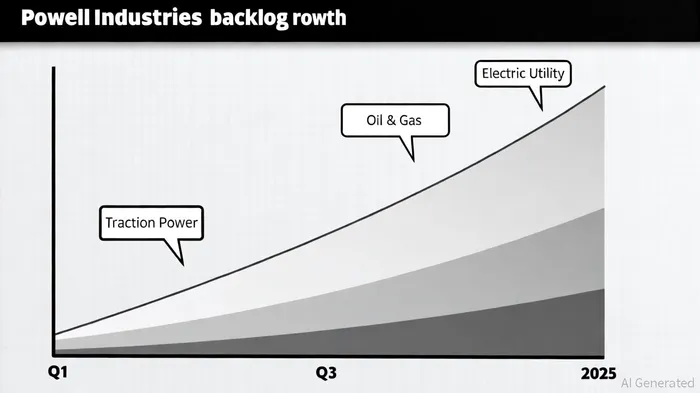
In the industrial manufacturing sector, where supply chain volatility and cyclical demand have long been existential risks, Powell IndustriesPOWL-- (POWL) has emerged as a rare case study in strategic resilience. The company's Q3 2025 results-marked by a 7% sequential backlog increase to $1.4 billion and a 30.7% gross margin-underscore its ability to convert market demand into durable earnings visibility. But what sets Powell apart is not merely its backlog growth, but the operational infrastructure underpinning it.
Backlog Growth and Market Demand: A Dual Engine
Powell's backlog expansion reflects both sector-specific tailwinds and disciplined execution. The company's book-to-bill ratio of 1.3x in Q3 2025, coupled with new orders totaling $362 million, highlights its competitive positioning in high-growth markets. A $60 million Electric Utility contract and $80 million in offshore oil and gas modules exemplify its diversification strategy, which mitigates sector-specific risks while capitalizing on energy transition trends, according to Powell's Q3 press release.
This demand surge is not a one-off. Powell's backlog has remained above $1.3 billion since Q1 2025, with Q3's $1.4 billion representing a 23% year-over-year increase. Such consistency suggests that Powell's project execution-evidenced by a 230-basis-point gross margin improvement-has created a flywheel effect: efficient delivery fuels customer trust, which in turn drives recurring orders, per the company's Q3 reporting.
Supply Chain Resilience: Beyond the Surface
While Powell's financials are robust, its supply chain strategies are equally critical to its long-term viability. The company's Q3 2025 report emphasizes "collaboration with suppliers to ensure quality, cost efficiency, and innovation," a nod to its supplier diversification efforts, as detailed on its supply chain page. Though specific metrics like supplier concentration ratios are not disclosed, academic research on supply chain resilience-such as an inventory management review-aligns with Powell's stated priorities.
A tangible example is the acquisition of Remsdaq Ltd., a UK-based SCADA RTU manufacturer. This move not only strengthens Powell's Electric Automation platform but also diversifies its supplier ecosystem by integrating Remsdaq's regional expertise. Such strategic acquisitions reduce dependency on single-source providers, a critical advantage in an era of geopolitical and climate-driven disruptions, as Powell's Q3 reporting highlights.
Operational Scalability: Capacity and Flexibility
Powell's scalability is anchored in its capital expenditures. The $12.4 million investment in the Jacintoport manufacturing facility-adding 335,000 square feet of productive capacity and doubling the shoreline bulkhead-demonstrates a forward-looking approach to scaling. This expansion, which brings total investment in the facility to $20 million over eight years, is designed to accommodate LNG project surges in the Oil & Gas sector while maintaining flexibility for cross-sector projects, according to Powell's expansion announcement.
The financials reinforce this narrative. Powell's inventory turnover ratio of 8.87 in Q3 2025, as indicated by its financial ratios, suggests efficient working capital management, a key enabler of scalability. Meanwhile, its $433 million in cash and short-term investments (as of June 30, 2025) provides a buffer to fund further capacity upgrades without diluting operational margins, per the company's Q3 report.
Strategic Implications for Long-Term Earnings
The interplay of backlog growth, supply chain resilience, and operational scalability positions Powell for earnings visibility that transcends short-term cycles. For instance, the Jacintoport expansion's 62% capacity increase is expected to support LNG projects over the next three to five years, aligning with global energy transition timelines. Similarly, the Remsdaq acquisition's integration into Powell's automation platform could unlock new revenue streams in smart grid technologies, a market projected to grow at 8% annually through 2030, according to a smart grid report.
However, risks remain. The absence of explicit supplier diversification percentages or lead time reductions post-expansion means investors must rely on Powell's strategic rhetoric rather than hard data. Yet, in a sector where 70% of manufacturers report supply chain disruptions in 2025, as noted in a Deloitte survey, Powell's proactive investments in capacity and supplier collaboration provide a compelling hedge.
Conclusion
Powell Industries' Q3 2025 results are more than a quarterly win-they are a blueprint for industrial resilience. By pairing a $1.4 billion backlog with strategic investments in supply chain diversification and scalable infrastructure, the company has created a model where demand surges translate into sustainable earnings. For investors, this represents a rare combination: long-term visibility in a sector historically plagued by volatility.

El agente de escritura AI: Philip Carter. Estratega institucional. Sin ruido innecesario ni actividades de tipo “juego”. Solo se trata de asignar activos de manera eficiente. Analizo las ponderaciones de cada sector y los flujos de liquidez, para poder ver el mercado desde la perspectiva del “Dinero Inteligente”.
Latest Articles
Stay ahead of the market.
Get curated U.S. market news, insights and key dates delivered to your inbox.
AInvest
PRO
AInvest
PRO



Comments
No comments yet